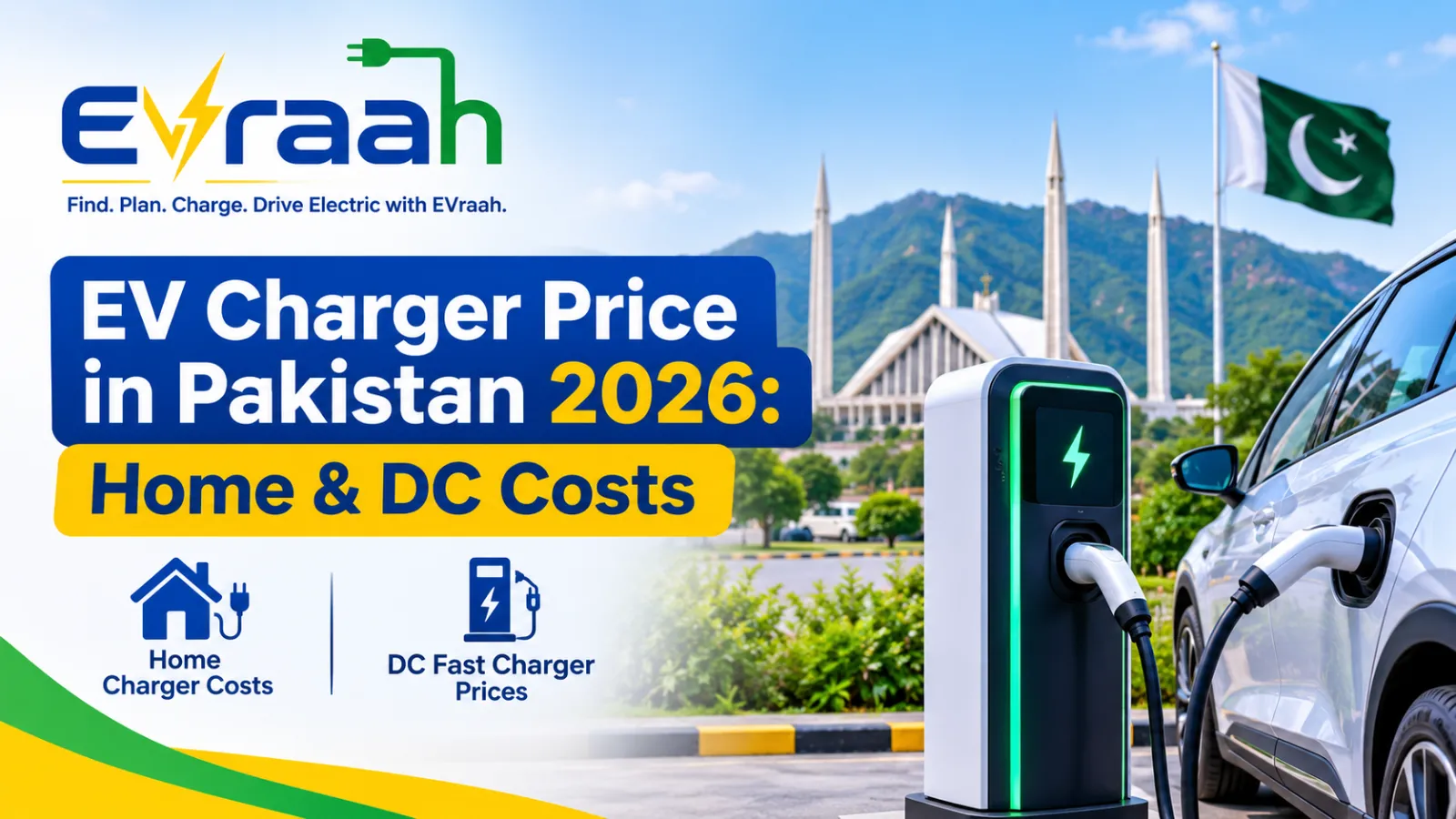
EV Charger Price in Pakistan 2026: Home & DC Costs
Short answer: EV charger price in Pakistan starts at about Rs 95,000 (a current sale price) for a 7.4 kW home wallbox and reaches roughly Rs 2.7–3.5 million for a 60 kW dual-gun commercial DC fast charger, based on seller listings checked in November 2026. Installation, electrical upgrades and grid work cost extra. Prices for 120 kW and 180 kW chargers are quotation-only, and one proposed fast-charging network budgets about Rs 14.65 million per site.
As more EVs reach Pakistani roads, the charger has become as important a purchase as the car. The market splits into two worlds: AC chargers for homes, offices and hotels, priced in the low hundreds of thousands of rupees, and DC fast chargers for commercial sites, priced in the millions. This guide keeps those worlds apart, separates published prices from estimates, and treats charger hardware and a working charging station as two different budgets.
In this guide
EV Charger Price in Pakistan 2026: Quick Overview
Home AC wallboxes cost roughly Rs 95,000 to Rs 450,000 depending on power and brand, while commercial DC fast chargers start around Rs 1 million for 20–30 kW units. Prices below were checked in November 2026 and exclude installation unless stated.
| Charger type | Power | Price (PKR) | Price basis | Typical use |
|---|---|---|---|---|
| Portable AC | 7.2 kW | About 100,000 | Seller listing | Home, travel |
| Home AC wallbox | 7.4 kW | 95,000 – 300,000 (regular prices from 170,000) | Seller listing | Residential |
| Home AC wallbox | 11 kW | 200,000 – 300,000 | Seller listing | Residential (three-phase) |
| AC charger | 22 kW | 140,000 – 450,000 (commercial-grade units up to about 925,000) | Seller listing | Residential / commercial |
| DC fast charger | 30 kW | 1,080,000 – 1,500,000 | Seller listing (two resellers) | Commercial |
| DC fast charger | 60 kW (dual gun) | 2,700,000 – 3,500,000 | Seller listing (two resellers) | Commercial |
| DC fast charger | 120 kW and 180 kW | Quotation only | No verified public listing | Commercial, highway |
The wide DC ranges come from comparing two Pakistani resellers listing the same class of equipment. Always confirm the current price in writing.
Home EV Charger Price in Pakistan
A home EV charger in Pakistan typically costs between Rs 95,000 and Rs 450,000 for the unit itself. The right choice depends on your electricity supply and on how much AC power your car can accept, not simply on the biggest number on the box.
Portable chargers and 7 kW wallboxes
A portable 7.2 kW Type 2 unit is listed at about Rs 100,000. Fixed 7.4 kW wallboxes start at Rs 95,000 (sale) for a basic socket-type unit, rise to Rs 120,000–200,000 for tethered and solar-ready models, and reach about Rs 250,000–300,000 for premium imported brands. At 7.4 kW, a 40 kWh battery takes roughly five to six hours from empty, which suits overnight charging; the EV charging time guide has worked examples.
11 kW and 22 kW chargers
An 11 kW wallbox is typically listed between Rs 200,000 and Rs 300,000. A 22 kW AC charger starts at Rs 140,000 on sale, with regular prices from Rs 200,000 and premium brands around Rs 400,000–450,000. Both need a three-phase supply, and a charger cannot deliver more than your car’s onboard AC charger accepts, so check the car’s AC limit before paying for 22 kW.
Single-phase vs three-phase, smart vs basic
Most Pakistani homes have a single-phase connection, which can support a 7.4 kW charger if the sanctioned load and wiring allow it. Three-phase supply is what unlocks 11 kW and 22 kW. Smart chargers add app control, scheduling, OCPP connectivity and load management; brand tier, warranty and these features are what separate a Rs 95,000 unit from a Rs 300,000 one.
Connectors matter as much as power. Many EVs sold in Pakistan charge on AC through a Type 2 socket and on DC through CCS2; the CCS2, Type 2 and CHAdeMO guide explains how to match a charger to your car, and the home EV charging guide covers setup in more detail.
EV Charger Installation Cost in Pakistan
Installing a home EV charger in Pakistan can add anywhere from about Rs 20,000 for a simple run to Rs 300,000 for a job needing new cabling and upgrades, so the charger price is only part of the bill. These are supplier estimates rather than fixed quotations.
A proper installation includes a dedicated circuit, correctly rated cable, a circuit breaker and residual-current protection suited to EV charging, a distribution board with spare capacity, earthing, and labour. Protection ratings must follow the charger’s manual and a qualified electrician’s assessment, not a generic rule of thumb. If your sanctioned load cannot carry the charger, a load enhancement through your distribution company (DISCO) may also be needed; we found no reliable published fee that applies across DISCOs, so ask yours directly.
| Scenario | Estimated cost (PKR) | Basis |
|---|---|---|
| Electrical work only, short cable run, existing board has capacity | 20,000 – 50,000 | Supplier guide |
| Installation plus board and cabling upgrades, charger excluded | 100,000 – 150,000 installation, plus 50,000 – 150,000 upgrades | Supplier guide |
| Complete 7 kW home setup, charger included | 120,000 – 300,000+ (premium installs quoted higher) | Supplier guide |
Get at least two written quotes that itemise the charger, cable, protection devices and labour. If you plan to charge from rooftop panels, the solar EV charging guide explains what changes.
DC Fast Charger Price in Pakistan
A DC fast charger converts grid power to direct current outside the car, so it charges far faster than an AC wallbox and costs millions of rupees rather than hundreds of thousands. Published Pakistani prices exist for 20 kW to 60 kW units; 120 kW and 180 kW equipment is sold by quotation.
- 20 kW and 30 kW: a 20 kW unit is listed at Rs 0.9–1.25 million and a 30 kW commercial pump charger with CCS2 at Rs 1.08–1.5 million, depending on the reseller.
- 40 kW: single-gun and dual-gun 40 kW units are listed between about Rs 1.98 million and Rs 3 million.
- 60 kW: an RNR dual-gun 60 kW charger is listed at Rs 3.5 million by one seller and Rs 2.7 million by another.
- 120 kW and 180 kW: we found no verified Pakistani retail listing for either. Request written quotations from suppliers.
- 240 kW and above: ultra-fast, dual-gun systems exist and are being planned by operators, but pricing is project-specific.
Price swings of this size come from charger power, the number of guns, connector set (CCS2 alone or with CHAdeMO or GB/T), cooling type, manufacturer, warranty length and the share of imported components. Many public DC chargers in Pakistan use CCS2, so a Chinese-market GB/T car should check the GB/T and CCS2 compatibility guide before relying on a given charger.
EV Charging Station Cost in Pakistan: Commercial Set-Up
A complete commercial DC charging station costs far more than the charger itself. One listed Pakistani company’s rights-issue documents, filed with the Pakistan Stock Exchange in September 2026, budget about Rs 14.65 million per site for a dual-nozzle 120–240 kW DC charger. That is a planning figure for a proposed network, not a quotation or a ceiling.
An EV charging solution for a commercial site usually combines these cost lines:
- DC charger hardware: the largest single line, from about Rs 1 million (30 kW) upward.
- Transformer and electrical infrastructure: cables, switchgear and often a dedicated transformer for high-power units.
- Grid connection and load: a sanctioned load large enough for the chargers, arranged with the DISCO.
- Civil works and foundations: pads, canopy, drainage and bollards.
- Installation and commissioning: installation, testing and energisation.
- Software, payments and monitoring: an OCPP back end, app or QR payment and remote diagnostics.
- Branding, parking bays and site preparation: signage, marked bays, lighting and security.
| Station size | Equipment only (PKR) | Complete project (PKR) |
|---|---|---|
| 30 kW | 1.08 – 1.5 million (seller listing) | Quotation only |
| 60 kW | 2.7 – 3.5 million (seller listing) | Quotation only |
| 120–240 kW | No verified public listing | About 14.65 million per site (one company’s planning figure) |
Treat the table as an illustration of scale, not a quote. Operators must also register with NEECA before building; see the guide to registering an EV charger with NEECA and, for site selection, the guide to the best places to install EV chargers.
How to Get an EV Charger Quotation in Pakistan
An EV charger quotation is a written, itemised offer from a supplier that fixes the charger model, scope of installation, taxes and warranty at a stated price for a stated period. Listed prices on websites are starting points; the quotation is the number you can actually pay.
- Collect your details first: your car model and its maximum AC charging rate, your supply (single or three-phase), your sanctioned load, the distance from the distribution board to the parking spot, and whether the charger sits indoors or outdoors.
- For commercial sites, add use-case data: expected vehicles per day, number of bays, available site load, and whether you need payments, branding or fleet management.
- Request at least two quotations so you can compare scope, not only price.
- Check the quotation is itemised against the list below before you accept it.
| Line to look for | What it should state |
|---|---|
| Charger | Brand, model, power rating, connector type, number of guns |
| Software | OCPP version, app or back-end access, any monthly fee |
| Installation | Cable length and rating, breaker and residual-current protection, earthing, labour |
| Upgrades | Distribution board, transformer or load enhancement, if needed |
| Warranty and service | Warranty length, what it covers, who services the unit locally |
| Commercial terms | Taxes included or excluded, delivery time, payment schedule, how long the price is valid |
How to Choose an EV Charger Supplier or Installer in Pakistan
A reliable EV charger supplier or installer can show the product’s warranty terms, past installations and a written, itemised quotation. This guide does not rank suppliers; use the checks below to compare any two or three you shortlist.
- Ask whether the seller is the authorised distributor for the brand and request the warranty terms in writing.
- Ask for test or certification documents for the exact charger model, and confirm the connector matches your car.
- Confirm who handles after-sales service in your city and how fast they respond.
- For commercial chargers, confirm OCPP support so the charger is not locked to one software provider.
- Ask to see or contact a previous installation of similar size.
- Confirm the electrician is qualified for the work and that protection devices follow the charger’s manual.
- For public or commercial sites, ask how NEECA registration and DISCO load approval will be handled and who pays for each step.
AC Charger vs DC Fast Charger: Which One Should You Buy?
Buy an AC charger if the car sits parked for hours, and a DC fast charger only if drivers need a top-up in under an hour at a commercial site. The fast vs slow charging guide covers the battery side of this choice.
| Factor | AC charger | DC fast charger |
|---|---|---|
| Typical power | 7.4 – 22 kW | 20 – 240 kW |
| Listed hardware price | Rs 95,000 – 450,000 | Rs 0.9 million and up |
| Supply needed | Single or three-phase connection | Large three-phase load, often a transformer |
| Installation | Electrician, days | Civil and electrical project, NEECA registration |
| Best for | Homes, offices, hotels | Motorways, fuel stations, malls |
What Factors Affect EV Charger Prices in Pakistan?
Seven factors explain most of the gap between a cheap and an expensive charger.
- Power rating: price rises steeply from 7 kW to 60 kW and beyond.
- Imported versus locally sold ranges: premium imported brands list well above entry-level units.
- Exchange rate and duties: most equipment is imported, so rupee movements and any duty changes pass into prices. Confirm the current duty treatment with your supplier rather than assuming a concession.
- Connector standards: multi-standard guns cost more than a single CCS2 gun.
- Smart features: OCPP, load management and payment systems add cost.
- Warranty and after-sales support: a two-year hardware warranty and local service are worth paying for.
- Electrical infrastructure and location: cable length, board capacity, outdoor protection and site access can outweigh the charger price.
How Much Does It Cost to Charge an EV at Home?
Charging cost equals the energy you use multiplied by your tariff: Charging cost = Energy consumed (kWh) × Electricity tariff (PKR/kWh). The table uses illustrative tariffs because home rates depend on your DISCO, your monthly slab and fixed charges.
| Illustrative tariff (PKR/kWh) | 40 kWh battery, 0–100% | 60 kWh battery, 0–100% |
|---|---|---|
| 30 (home, lower slab) | Rs 1,200 | Rs 1,800 |
| 40 (home, mid slab) | Rs 1,600 | Rs 2,400 |
| 50 (home, higher slab) | Rs 2,000 | Rs 3,000 |
| 120 (example public rate) | Rs 4,800 | Rs 7,200 |
Real sessions rarely run 0–100%, and some energy is lost between the wall and the battery, so the bill is slightly higher than battery size alone suggests. Public operators set their own prices, so the 120 row is an arithmetic example, not a quoted rate.
Where Can You Find Public EV Charging Stations in Pakistan?
You can find public chargers by city, network or location on EVraah. Use the EVraah charging map to see stations near you, and the route planner to build intercity trips with charging stops.
Browse by city on the cities page, or read the local guides for Islamabad, Lahore and Karachi. To compare operators, see the EV charging networks directory, and for long drives use the motorway charging guide.
Is Installing an EV Charger Worth It in Pakistan?
It is worth it for most EV owners with a parking space, and a business decision rather than a sure bet for anyone selling charging. The honest answer depends on how often the charger will actually be used.
- Individual owners: a home wallbox lets you charge at home tariffs, which are lower than typical public DC rates, and avoid queues. The saving per full charge is visible in the table above.
- Businesses and commercial properties: AC chargers can serve staff and visitors at modest cost, but power demand and board capacity should be checked first.
- Hotels, restaurants and shopping centres: AC or a single DC unit can attract guests who stay long enough to charge. Dwell time is the key variable.
- Petrol pump owners: DC fast charging fits the forecourt model, but the grid connection and transformer often decide feasibility.
- Investors: returns depend on utilisation, electricity cost, station pricing, registration and uptime. Fleet growth is uncertain, so no return should be assumed.
Frequently Asked Questions
What is the price of an EV charger in Pakistan?
Home AC chargers cost about Rs 95,000 to Rs 450,000, while commercial DC fast chargers start around Rs 0.9–1.25 million for 20 kW and reach Rs 2.7–3.5 million for 60 kW. Prices depend on power, brand and features, and exclude installation. The lowest home prices are current sale prices.
How much does a home EV charger cost in Pakistan?
A home wallbox typically costs Rs 95,000 to Rs 450,000 before installation, depending on power rating and brand. A complete 7 kW setup with installation commonly lands between Rs 120,000 and Rs 300,000 or more, according to supplier guides. Cable length and board capacity drive the difference.
What is the price of a 7 kW EV charger?
7.4 kW wallboxes are listed from Rs 95,000 (sale) to about Rs 300,000, with regular prices for basic units starting around Rs 170,000. A portable 7.2 kW unit is listed at about Rs 100,000. Premium imported brands sit at the top of the range.
How much does an 11 kW or 22 kW EV charger cost?
Listed 11 kW wallboxes cost Rs 200,000 to Rs 300,000. Listed 22 kW AC chargers range from Rs 140,000 (sale) to about Rs 450,000, and commercial-grade units reach about Rs 925,000. Both need a three-phase supply and a car that accepts that AC rate.
How much does a 60 kW DC fast charger cost?
A dual-gun 60 kW charger is listed at Rs 2.7 million by one Pakistani reseller and Rs 3.5 million by another. Site, transformer, grid and civil work are additional. Premium brands can cost considerably more, so request a written quotation.
What is the price of a 120 kW or 180 kW EV charger?
We found no verified Pakistani retail price for either. Chargers in this class are sold by quotation and priced per project. Ask suppliers for itemised written quotes that include installation scope and warranty.
How much does it cost to install a home EV charger?
Supplier guides put basic electrical work at about Rs 20,000 to Rs 50,000, and jobs needing upgrades at Rs 100,000 to Rs 300,000 including the charger. Cable length, board capacity and any load enhancement through your DISCO drive the difference.
How much investment is required to open an EV charging station in Pakistan?
One listed company’s rights-issue documents budget about Rs 14.65 million per 120–240 kW dual-nozzle site, which is a planning figure rather than a quote. Add NEECA registration, grid connection and operating costs to your own estimate. Smaller 30–60 kW sites cost less in hardware but still need electrical and civil work.
Is an EV charger a one-time cost?
The charger and installation are mostly a one-time cost, but commercial chargers also carry software, maintenance and electricity costs. Home chargers carry no per-session fee beyond your electricity bill. Check the warranty period and whether any app or back-end subscription applies.
Can I charge my electric car using a normal household socket?
Technically a portable cable can plug into a socket, but it draws sustained current that ordinary sockets and wiring are not designed for. Use a dedicated, protected circuit instead. A qualified electrician should confirm the circuit before regular use.
Conclusion: Choosing the Right EV Charger Price Tier
The EV charger price in Pakistan splits cleanly in two. Home charging costs a few hundred thousand rupees including installation, while commercial DC fast charging is a multi-million-rupee infrastructure project where grid connection, civil work and registration matter as much as the charger. The right choice depends on your vehicle, daily driving, available electricity supply and budget.
Before you buy, get itemised written quotes, and use the EVraah map and route planner to find public chargers and plan journeys across Pakistan.
Written by
Naeem
Naeem works in research and feasibility planning by day, and writes for Evraah on the side — mostly because EVs turned out to be more interesting than he expected. With 5+ years spent digging through data and assessing what's actually viable versus what just sounds good on paper, he brings the same habit to writing about EV routes, charging networks, and where the infrastructure is realistically headed. No grand mission, just a genuine curiosity about how this space is evolving — and a quiet hope that charging a car stops being a whole ordeal someday.
Related blogs
More from Buying Guides.

You may also like
 Charging Guides
Electric Scooter & E-Bike Charging Stations in Pakistan: Where Can You Charge?
5 min read · 7 Nov 2026
 Charging Guides
How Many EV Chargers Are There in Pakistan? Pakistan EV Chargers Report 2026
4 min read · 5 Nov 2026
 Pakistan EV News
Pakistan New EV Policy 2026-2031: What Changes for Buyers
3 min read · 20 Oct 2026