Pakistan New EV Policy 2026-2031: What Changes for Buyers
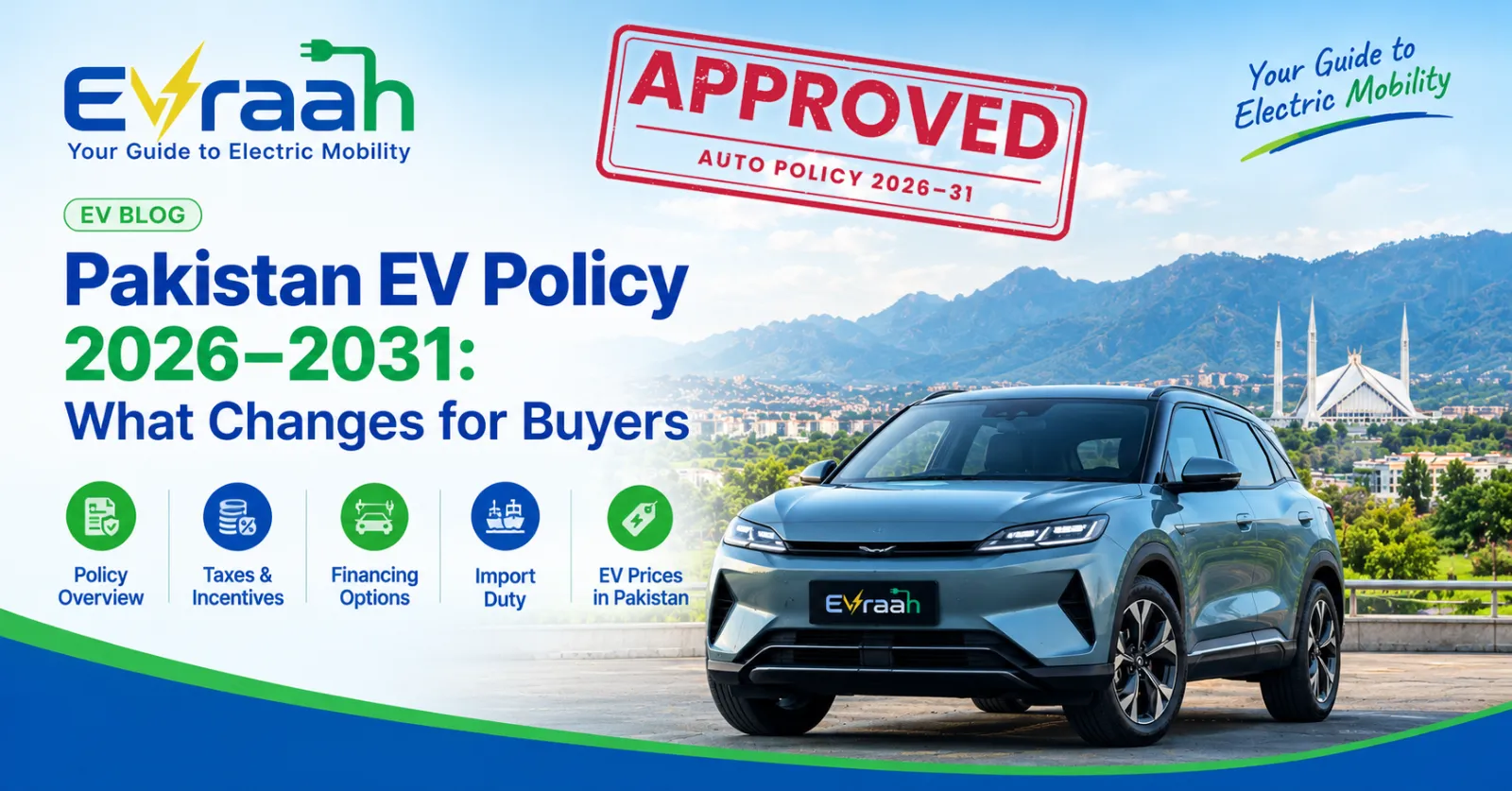
Short answer: Pakistan’s new EV policy is the Auto Policy 2026-31, approved by Prime Minister Shehbaz Sharif. It sets out a 1% sales tax on battery electric vehicles (BEVs), 6% on range-extended EVs and 9% on plug-in hybrids, raises the EV financing limit from Rs3 million to Rs10 million and extends loan tenure from three to five years. These rates still need legislation, which is targeted for December 2026, so treat them as approved policy direction rather than notified law. A 1% sales tax on locally made EVs is already in force until 30 June 2027.
In this article
What is Pakistan’s Auto Policy 2026-31?
The Auto Policy 2026-31 is Pakistan’s five-year framework for the car industry, covering exports, import tariffs, local manufacturing and electric vehicles. It replaces the previous five-year policy, which expired on 30 June 2026. Its stated goals for 2030-31 are $6 billion in vehicle exports and $1.2 billion in auto-parts exports, alongside wider EV adoption and stronger local manufacturing.
For EV buyers, three parts matter most: the sales tax structure, the financing rules and the import tariff path. EVraah’s earlier explainer on Pakistan’s auto policy 2026-31 and EV tax relief covers the draft approved in September 2026. This article covers the latest approved version.
What sales tax will EVs pay under the new policy?
The approved policy proposes differentiated sales tax rates by powertrain: 1% for battery electric vehicles, 6% for range-extended electric vehicles and 9% for plug-in hybrids. It does not adopt the 18% rate that was reportedly recommended by the International Monetary Fund. The tiers tax a vehicle less the less petrol it uses.
| Vehicle type | Proposed sales tax | How it works |
|---|---|---|
| Battery electric vehicle (BEV) | 1% | Runs only on a battery and plugs in to charge. |
| Range-extended EV (REEV) | 6% | An electric motor drives the wheels; a small petrol engine generates electricity when the battery runs low. |
| Plug-in hybrid (PHEV) | 9% | Combines a petrol engine and a rechargeable battery; both can drive the wheels. |
| Any EV valued above $75,000 | 10% federal excise duty | Proposed for high-value EVs, in addition to the sales tax. Imported EVs valued above Rs20 million already pay tiered excise duty today. |
Some of this relief already exists. A 1% sales tax on locally manufactured EVs applies until 30 June 2027 under the Budget 2026-27 Finance Bill (check the enacted text and your vehicle’s eligibility), and the sales tax on locally made hybrids up to 2,000cc fell from 25% to 18% under S.R.O. 1525(I)/2026 from 13 September 2026. The new policy therefore largely carries forward existing relief for locally made battery EVs, while the 6% and 9% tiers for range-extended and plug-in hybrids are new.
The policy also proposes a lower import tariff category for smaller EVs priced below $15,000. If you are unsure which category a model falls into, EVraah’s guide to the types of EVs in Pakistan explains the differences between BEVs, hybrids and plug-ins.
How does the new policy change EV financing?
The policy proposes raising the EV financing limit from Rs3 million to Rs10 million and extending the maximum loan tenure from three years to five years. The aim is to make EVs reachable for more buyers, with particular emphasis on smaller, more affordable vehicles for lower-income consumers.
A longer tenure lowers each monthly instalment but increases the total interest paid over the loan, so compare the full cost of any offer rather than the instalment alone. Buyers working on a tighter budget can start with EVraah’s list of the cheapest electric cars in Pakistan. Actual lending terms depend on how banks apply the new limits once the rules are in force.
What happens to EV import duty and tariffs?
The policy reduces import duties gradually, with the government aiming to bring the tariff rate down to 15% by 2030-31 to increase competition in the domestic market. It also envisages lower import tariffs for EVs, including the reduced category for models below $15,000. The cut is gradual, so the 15% rate applies only by 2030-31.
Today, eligible imported four-wheel EVs pay a concessionary 25% customs duty, and EV-specific components for local assembly carry as little as 1%. EVraah’s breakdown of EV import duty in Pakistan explains the CBU and CKD routes and the current excise duty tiers.
What is confirmed and what is still proposed?
The policy itself has been approved, but the tax rates are described as a proposed framework that needs legislation, and the relevant legislation is targeted for completion by December 2026. Final prices and sales will depend on the notified rules, how they are implemented and which suitable vehicles are available.
This is also why EVraah’s stance on timing has not changed: a tax cut that is not yet law is not a reliable reason to delay a purchase you need now, and for locally made EVs the 1% rate already applies. The reasoning is covered in should you buy an EV in Pakistan now.
What else does the Auto Policy 2026-31 include?
Beyond EV taxes, the policy is an export and industrial reform package. The measures most relevant to buyers and the wider market are listed below.
- Export targets: mandatory targets for vehicle makers, with compensation equal to 5% of export value for companies that expand exports, an extra 10% incentive for exports above the previous year’s level, and penalties, including possible cancellation of manufacturing certificates after two consecutive misses.
- Automotive Development Levy: a proposed levy on vehicles with engines above 1,000cc, estimated to raise more than Rs232 billion over five years to fund export incentives, industrial programmes and technology upgrades for parts makers.
- Localisation: new local-production targets for auto parts, with incentives withdrawn from companies that miss them.
- Pakistan Automotive Testing Institute: a new body for vehicle quality, research and certification, with international safety standards applied to both locally built and imported vehicles.
- Consumer protection: protections in vehicle sales agreements and audits twice a year to improve transparency.
What does the new EV policy mean for EV buyers and charging?
For buyers, the policy points toward cheaper EVs, longer and larger loans and gradually lower tariffs, but none of this is guaranteed until the legislation passes. The practical impact also depends on charging access, because tax relief only helps if the car can be charged conveniently. Separately, the NEV Policy 2025–30 targets new energy vehicles at 30% of new vehicle sales by 2030, as explained in EVraah’s guide to the 2030 EV sales target, and the network side is covered in the future of EV charging in Pakistan.
Before you commit, compare the full ownership cost rather than the sticker price alone. EVraah’s EV vs petrol running cost and EV charging cost guides show how fuel savings and charging prices change the total. To check whether chargers exist where you drive, use the EVraah charging map and plan longer trips with the route planner.
Frequently asked questions
What is Pakistan’s new EV policy for 2026-2031?
It is part of the Auto Policy 2026-31, a five-year plan approved by Prime Minister Shehbaz Sharif. It proposes lower sales tax on EVs, higher EV financing limits, gradual tariff cuts and export targets for local manufacturers. The EV measures sit inside a broader industry and export package.
How much sales tax will electric cars pay in Pakistan?
The policy proposes 1% on battery electric vehicles, 6% on range-extended EVs and 9% on plug-in hybrids. A 10% federal excise duty is also proposed for EVs valued above $75,000. These are proposed rates until the legislation is passed, although a 1% rate on locally made EVs already applies until June 2027.
Is the new EV policy final?
The policy has been approved, but the tax rates need legislation, which is targeted for December 2026. Final rules, effective dates and exemptions may differ from the current summary. Check the latest notified rates before buying.
How much can I borrow to buy an EV under the new policy?
The policy proposes raising the EV financing limit from Rs3 million to Rs10 million and extending the maximum tenure from three to five years. Your bank’s final terms, eligibility checks and rates will still apply.
Will EV prices fall in Pakistan after the policy?
Lower sales tax and tariffs can reduce prices, but the size of any drop depends on the final rules, implementation and which models are available. The policy’s tariff reductions are phased, with the main cut targeted by 2030-31.
Does the policy include rules for charging stations?
The published summaries of the approved Auto Policy 2026-31 do not list specific charging-station rules, but they note that EV uptake depends on charging infrastructure. The September draft proposed a 1% customs duty on imported charging equipment and support for battery-swap stations, though the latest summary does not confirm either. Separately, the NEV Policy 2025–30 targets 3,000 public charging stations by 2030, and you can see the stations operating today on the EVraah charging map.
Last reviewed: 20 October 2026. Policy details may change when legislation is finalised; EVraah will update this page as rules are notified.
Written by
Naeem
Naeem works in research and feasibility planning by day, and writes for Evraah on the side — mostly because EVs turned out to be more interesting than he expected. With 5+ years spent digging through data and assessing what's actually viable versus what just sounds good on paper, he brings the same habit to writing about EV routes, charging networks, and where the infrastructure is realistically headed. No grand mission, just a genuine curiosity about how this space is evolving — and a quiet hope that charging a car stops being a whole ordeal someday.
Related blogs
More from Pakistan EV News.
Should You Buy an EV in Pakistan Now or Wait for the 2026–31 Auto Policy?
Pakistan's New Auto Policy Could Give EVs a Major Tax Boost
How to Register Your EV Charger with NEECA in Pakistan: Step-by-Step Guide
You may also like
 Buying Guides
BYD Atto 3 Price in Pakistan 2026: Specs, Range and Charging Cost
4 min read · 19 Oct 2026
 Buying Guides
BYD Atto 2 Price in Pakistan 2026: Specs, Range, Features and Charging Cost
6 min read · 14 Oct 2026
 Charging Guides
Can You Charge an EV With Solar Panels in Pakistan?
5 min read · 13 Oct 2026