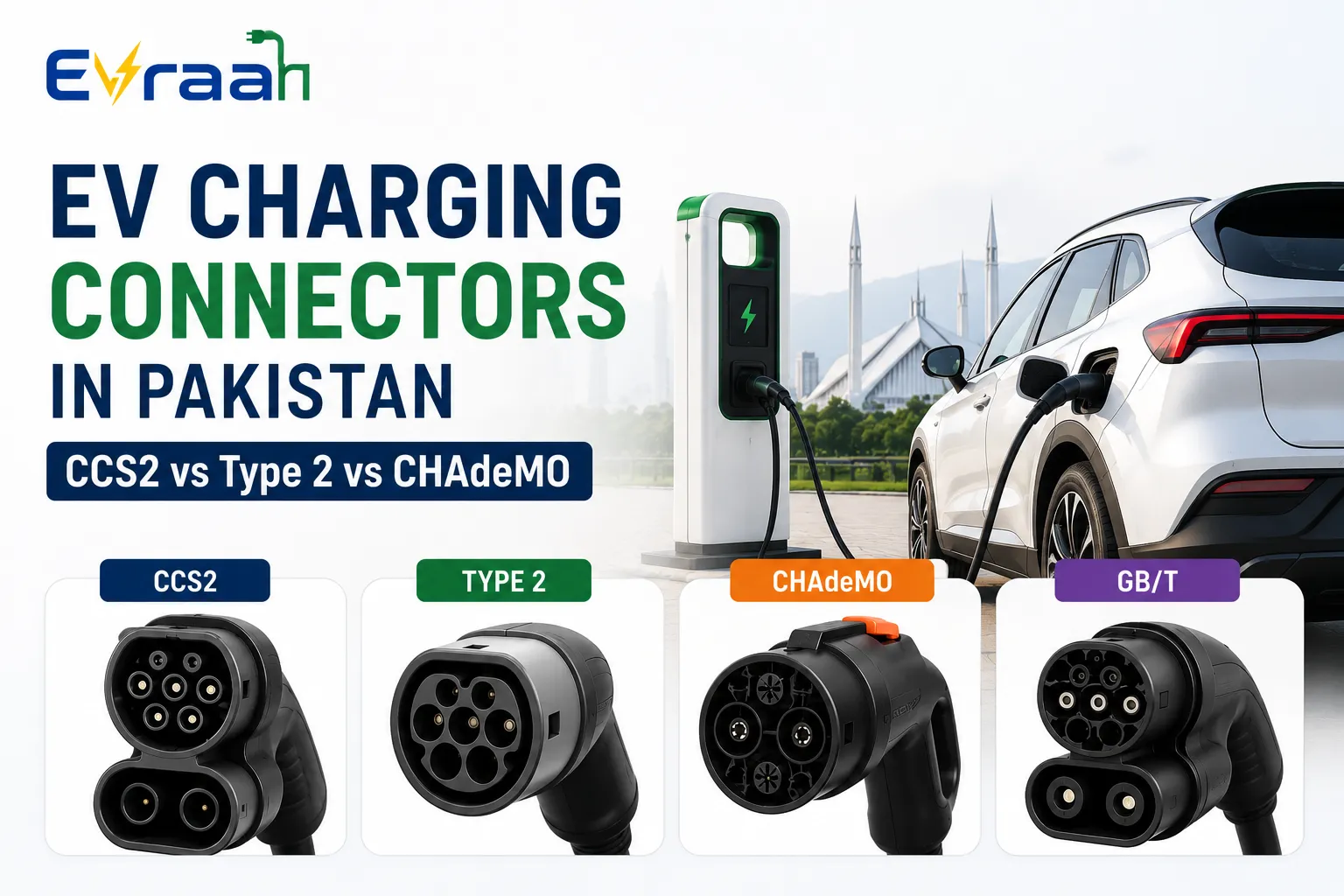
EV Charging Connectors in Pakistan: CCS2 vs Type 2 vs CHAdeMO
EV Charging Connectors in Pakistan: CCS2 vs Type 2 vs CHAdeMO
You arrive at a public charging station with 15% battery remaining, park beside the charger, and then notice something important: the plug does not match your car.
That is why understanding EV charging connectors in Pakistan matters just as much as knowing where charging stations are located. An EV charger may offer plenty of power, but your car cannot use it unless the connector, charging standard, and vehicle hardware are compatible.
For Pakistani EV owners, the main names to understand are CCS2, Type 2, CHAdeMO, and GB/T. This guide explains what each connector does, how to identify it, and what to check before buying an EV or planning an intercity journey.
Why EV Charging Connectors Matter in Pakistan
EVs do not all use one universal charging plug. The connector fitted to your vehicle can depend on the manufacturer, model year, and the market for which the car was originally produced.
This is particularly important in Pakistan because drivers may encounter locally sold EVs alongside Chinese-market vehicles, Japanese imports, and European-specification cars.
Pakistan's NEECA framework for EV charging infrastructure recognises several connector families, including CCS2, CHAdeMO, GB/T and Mennekes/Type 2. This makes checking the exact vehicle specification more useful than assuming one connector dominates every charging station.
If you mostly charge at home, connector compatibility affects which wallbox and cable you need. If you drive between Lahore, Islamabad, Karachi or other cities, it can determine whether a public charger along your route is actually usable.
AC vs DC Charging: What Is the Difference?
Understanding AC and DC charging makes the different EV connector types much easier to understand.
AC Charging
AC charging is commonly used at homes, offices, hotels, shopping centres and other places where an EV remains parked for several hours.
The charging point supplies alternating current, while the car's onboard charger converts that electricity into DC for storage in the battery.
Type 2 is widely associated with AC charging. Actual charging speed depends on the charging point, electrical supply and the maximum capacity of the vehicle's onboard charger.
If you plan to charge regularly at your house, read EVraah's Home EV Charging in Pakistan guide before choosing a wallbox or electrical setup.
DC Fast Charging
DC fast chargers perform the AC-to-DC conversion outside the vehicle and supply DC electricity directly to the battery. This enables significantly higher charging power and makes DC charging more practical during motorway and intercity trips.
CCS2 and CHAdeMO are examples of DC fast-charging systems.
However, connector type and charging speed are not the same thing. A charger rated at a high power level cannot force an EV to accept more power than its battery and charging system allow.
For a deeper explanation, see EVraah's Fast Charging vs Slow Charging guide.
CCS2: What Pakistani EV Owners Need to Know
CCS2 stands for Combined Charging System Combo 2.
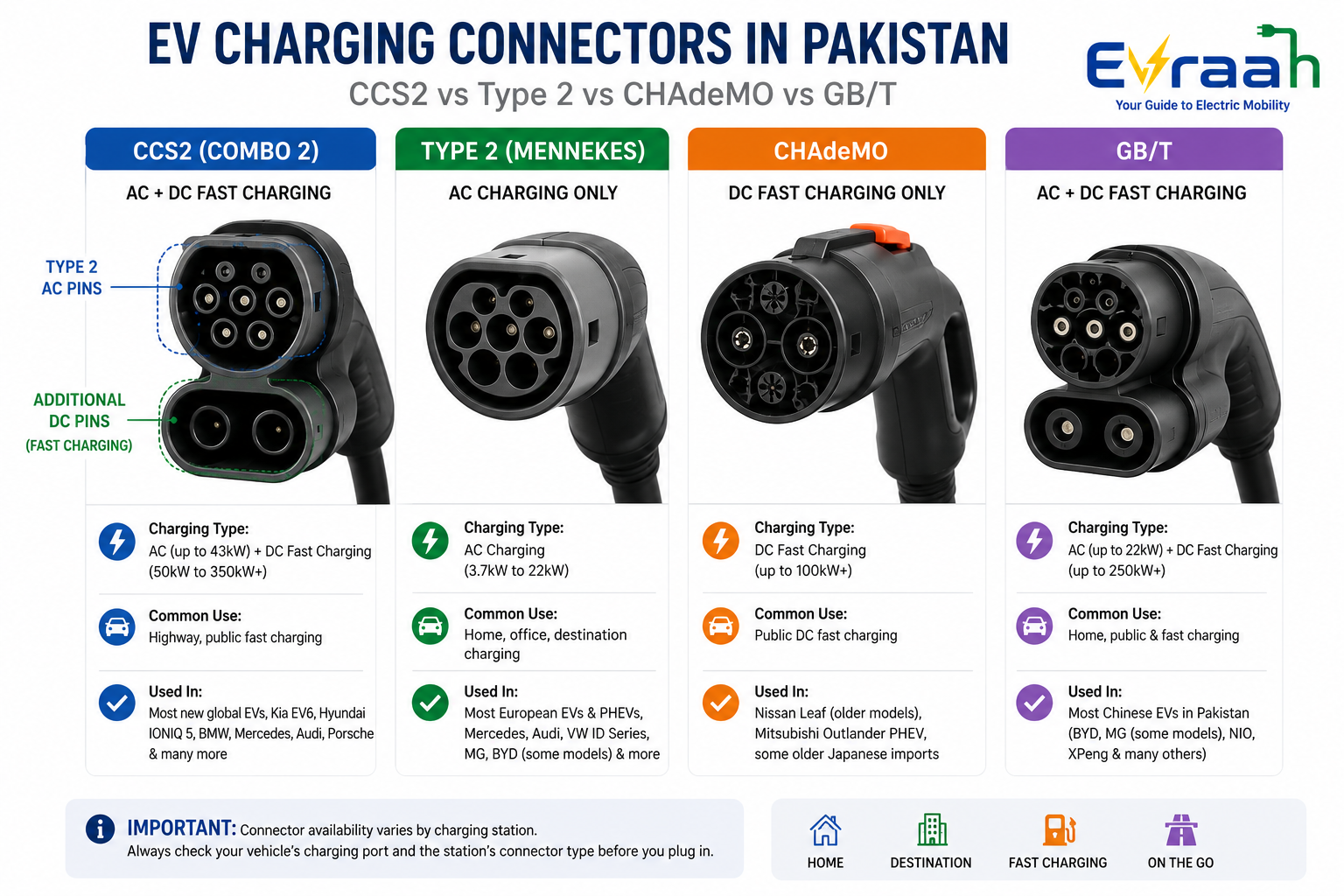
The easiest way to recognise a CCS2 vehicle inlet is to look for the familiar Type 2-shaped section at the top and two larger DC contacts underneath.
CharIN's CCS documentation explains that the Combo 2 interface builds on Type 2 and extends it for DC charging. This combined design allows compatible vehicles to use Type 2 AC charging as well as CCS2 DC fast charging through the same vehicle inlet.
CCS2 is already fitted to some officially marketed EVs in Pakistan. For example, MG Motors Pakistan lists CCS2 DC charging for the Binguo EV. Connector specifications should still be checked model by model rather than assuming every vehicle from the same manufacturer uses identical hardware.
For public and motorway charging, CCS2 can be particularly useful when your route includes compatible DC stations.
Charging time will still depend on the vehicle and charger. EVraah's guide on how long it takes to charge an EV in Pakistan explains why battery size, charging limits, temperature and state of charge all affect the length of a charging stop.
Type 2: The Common AC Charging Connector
Type 2, sometimes called Mennekes, is primarily an AC charging interface.
It is commonly associated with home wallboxes and destination chargers where the vehicle can remain connected for longer periods. Depending on the electrical installation and vehicle, Type 2 systems may support single-phase or three-phase AC charging.
The important point is that Type 2 should not automatically be called a fast charger. The connector tells you how the vehicle connects. It does not guarantee a particular charging speed.
Your EV's onboard charger remains a limiting factor.
CCS2 vs Type 2: What Is the Difference?
This distinction causes a lot of confusion:
- Type 2: primarily an AC charging interface.
- CCS2: uses the Type 2-based section and adds two larger contacts for DC fast charging.
Therefore, a car with a CCS2 Combo 2 inlet can normally use compatible Type 2 AC charging through the upper section. A vehicle equipped only for Type 2 AC charging does not automatically gain CCS2 DC charging capability simply because the upper plug shape looks similar.
CHAdeMO: Where Does It Fit in Pakistan?
CHAdeMO is a separate DC fast-charging standard developed in Japan.
Pakistani buyers are most likely to encounter CHAdeMO when considering certain Japanese EV imports.
A familiar example is the second-generation Nissan LEAF. Nissan's documentation for earlier LEAF models identifies CHAdeMO-compatible quick charging, while newer generations in some markets have moved to other connector standards.
That variation is exactly why model year and market specification matter.
If you own or plan to buy a used imported EV with CHAdeMO, check suitable CHAdeMO charger availability in Pakistan along the routes you actually use before depending on public DC charging.
Do not assume that a station advertising "DC fast charging" automatically has a CHAdeMO plug.
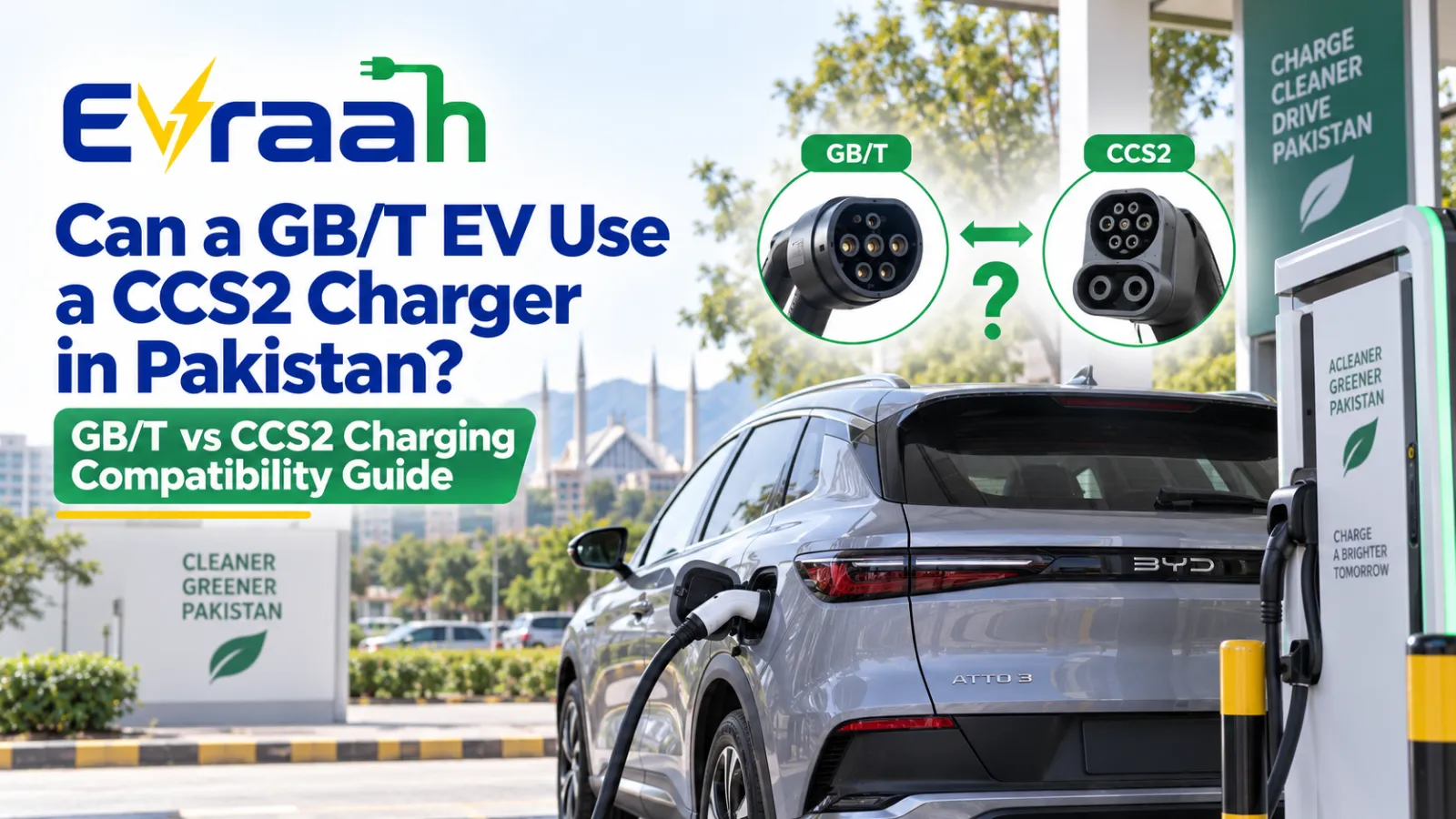
What About GB/T?
GB/T is highly relevant to Pakistani EV buyers because some vehicles originally manufactured for the Chinese domestic market may use Chinese charging interfaces.
The GB/T family includes separate arrangements for AC and DC charging, unlike CCS2's combined vehicle-inlet concept. China has also continued developing its national high-power charging standards.
However, one rule is especially important:
Do not assume every Chinese EV uses GB/T.
A Chinese manufacturer may produce a domestic-market version with one charging standard and an export version with another. If you are considering a privately imported BYD, MG, Deepal or another Chinese EV, verify the exact car rather than relying only on the brand.
Pakistan's NEECA framework also references GB/T among the connector families relevant to EV charging infrastructure.
CCS2 vs Type 2 vs CHAdeMO vs GB/T
| Connector | Main Use | Charging Type | Typical Use | What Pakistani Drivers Should Know |
|---|---|---|---|---|
| CCS2 | Regular + fast charging | AC interface + DC | Public fast charging and compatible AC charging | Look for two large DC contacts below the Type 2 section |
| Type 2 | Regular charging | AC | Home and destination charging | Charging speed depends on the onboard charger and supply |
| CHAdeMO | Fast charging | DC | Certain Japanese EVs and imports | Confirm station availability before travelling |
| GB/T | Regular or fast charging | AC or DC | Some Chinese-market vehicles | Check whether your exact vehicle is GB/T or export specification |
Which Connector Does Your EV Use?
You do not need to be an electrical engineer to identify the correct charger.
Use this checklist:
- Inspect the charging port. Look at the shape and number of contacts.
- Check the owner's manual. Find the AC and DC charging specifications.
- Check the manufacturer's specifications. Use information for your exact variant.
- Confirm the market version. Imported and locally supplied versions can differ.
- Check the charging station details. Make sure your connector is actually available.
- Verify again before a long trip. Do not depend on assumptions from another owner's car.
Charging-port identifiers can also help determine connector compatibility. If a plug does not match the vehicle's specified charging inlet, do not try to force the connection.
Can You Use an EV Charging Adapter?
Sometimes, but adapters are not universal solutions.
A charging connection involves more than making two plug shapes physically fit. The vehicle and charger also communicate and must operate within compatible electrical and safety requirements.
AC adapters are available for some applications, but you should not assume that an adapter will safely convert every CCS2, CHAdeMO or GB/T charging situation.
Use equipment approved by the vehicle or charging-equipment manufacturer and appropriately rated for the intended use.
Avoid homemade wiring, modified plugs or attempts to bypass charging safety systems.
Which EV Connector Is Best for Road Trips in Pakistan?
There is no connector that is automatically best for every Pakistani driver.
The practical choice depends on:
- Your vehicle's connector
- Its maximum DC charging capability
- Charger locations on your route
- Station operating status
- Compatible plugs at each site
- Backup charging options
For example, if you regularly travel between Punjab's two major cities, EVraah's Lahore to Islamabad EV M-2 charging guide shows why confirming connector compatibility and keeping backup charging locations matters on a real motorway journey.
For longer cross-country journeys, you can also use EVraah's Karachi to Lahore EV charging playbook when planning charging stops and battery margins.
The biggest mistake is choosing a car based only on a headline charging-speed figure. A fast-charging capability has little value on a road trip if the stations available on your route do not support your vehicle's connector.
How to Check Charging Compatibility Before a Road Trip
Do these checks before leaving:
- Confirm your vehicle's AC and DC connector types.
- Check the plug offered at your planned station.
- Verify the station's current status where possible.
- Check access conditions or operating hours.
- Keep at least one alternative charging location.
- Start with enough charge to handle a detour.
- Do not deliberately plan to reach a charger almost empty.
Pakistan's public charging infrastructure is developing, but charger availability and operating status can change. EVraah's Lahore to Islamabad EV charging guide shows why checking current information is better than treating an old charger list as a guarantee.
Frequently Asked Questions
What is CCS2 charging?
CCS2 is a combined charging interface based on Type 2 with two additional contacts for DC charging. Compatible vehicles can use the inlet for Type 2 AC charging and CCS2 DC fast charging.
What is a Type 2 EV charger?
Type 2 is primarily an AC charging interface commonly used for home, workplace and destination charging. Actual power depends on both the charging equipment and your EV's onboard charger.
Is CCS2 the same as Type 2?
No. CCS2 builds on the Type 2 interface but adds two larger contacts for DC fast charging.
What is a CHAdeMO charger?
CHAdeMO is a DC fast-charging system associated particularly with Japanese EVs, including certain generations of the Nissan LEAF.
Which EV connector is common in Pakistan?
Pakistan has a mixed charging environment. NEECA's framework references CCS2, CHAdeMO, GB/T and Type 2, so owners should confirm the connector fitted to their specific vehicle rather than assume one standard works everywhere.
Can a Type 2 EV use a CCS2 charger?
Only if the vehicle has the appropriate CCS2 Combo 2 inlet and supports DC charging. A Type 2-only AC vehicle does not automatically support CCS2 DC charging.
What connector do Chinese EVs use?
It varies. Chinese domestic-market cars may use GB/T, while export versions can be configured for other regional standards. Check the exact model, market and model year.
How do I know which EV charger I need?
Check your charging-port design, owner's manual and official vehicle specifications, then match those details with the connector offered by the charging station.
Final Thoughts
The most important rule for EV charging connectors in Pakistan is straightforward: match the charger to your actual vehicle, not simply its brand or country of manufacture.
Type 2 is mainly used for AC charging. CCS2 extends the Type 2-based interface with DC fast-charging contacts. CHAdeMO remains important for some Japanese EV imports, while GB/T requires attention when dealing with certain Chinese-market vehicles.
Once you know your connector, learn how charging power affects your waiting time with EVraah's complete EV charging-time guide for Pakistan.
Most importantly, check your vehicle, charger and route before you need to plug in. Discovering that the connector does not fit when your battery is already nearly empty is a problem that good planning can easily prevent.
Related blogs
More from EV Basics.
WLTP vs NEDC vs CLTC vs EPA: EV Range Explained for Pakistan
EV Maintenance Cost in Pakistan 2026: Complete Service & Repair Guide
EV Battery Guide for Pakistan: Lifespan, Degradation, Charging & Replacement Cost
You may also like
 Pakistan EV News
Should You Buy an EV in Pakistan Now or Wait for the 2026–31 Auto Policy?
6 min read · 4 Oct 2026
 Charging Guides
10 EV Charging Tips for New Drivers in Pakistan
5 min read · 30 Sept 2026
 Charging Guides
Can a GB/T EV Use a CCS2 Charger in Pakistan? Complete Compatibility Guide
5 min read · 22 Sept 2026