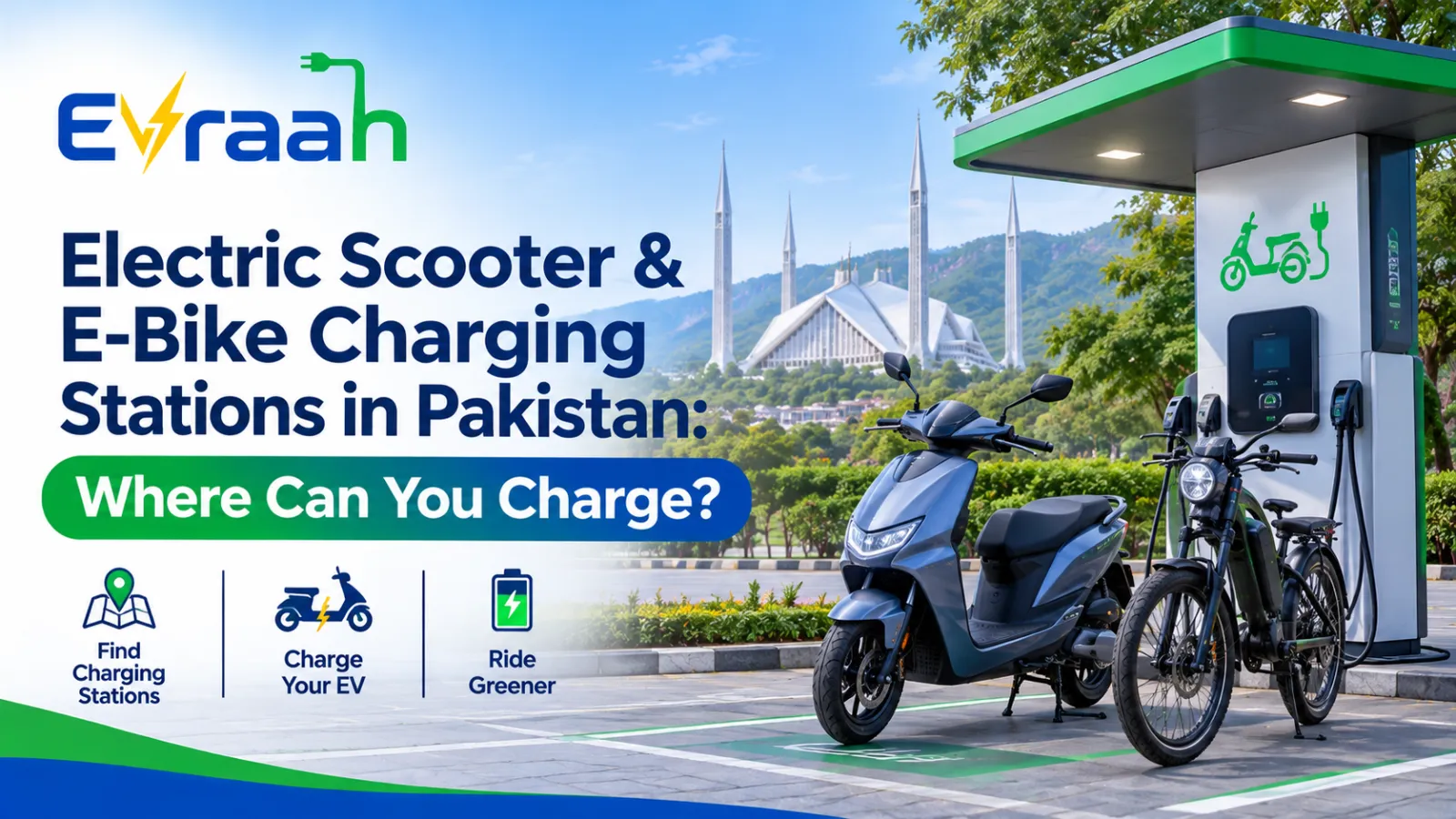
Electric Scooter & E-Bike Charging Stations in Pakistan: Where Can You Charge?
Short answer: in Pakistan, most electric scooters and e-bikes charge from an ordinary wall socket at home, at work or on campus. There is no verified network of public two-wheeler charging stations yet, and the CCS2, CHAdeMO and Type 2 chargers on the EVraah charging map are built for cars, so they generally do not suit a scooter battery. The closest public alternatives today are battery-swap pilots, such as the one in Faisalabad, and permission-based charging at workplaces and shops. Search results for “scooty charging station near me” mostly show car chargers for the same reason.
This guide gives the honest picture: where riders really charge, which public options exist, why a car charger usually will not work, what charging costs, how to stay safe, and how to use the EVraah map without wasting a trip. Where there is no verified data, we say so instead of guessing.
In this article
Where Can You Charge an Electric Scooter or E-Bike in Pakistan?
“Scooty” is the everyday word for a step-through electric scooter. In this guide it also covers electric motorcycles (often sold as “electric bikes”), pedal-assist e-bikes and kick scooters. Their batteries are small, so the principles are the same. These are the realistic options, from most to least practical:
| Where | Works today? | What to know |
|---|---|---|
| Home wall socket | Yes, the default | Use the original charger. This is how most riders charge. |
| Work, university or parking area | Yes, with permission | A second charge during the day is the easiest way to extend your range. |
| Battery-swap point | Only where a pilot exists | Works only with compatible batteries. See the swapping section below. |
| Café, gym or shop | A favour, not a network | Ask first and offer to pay for the electricity. |
| Dealer or service centre | Unverified | Some may allow a top-up. Ask before you ride over. |
| Public EV car charger | Generally no | Car connectors and car-sized power. See the section on car chargers. |
Is There an Electric Scooter Charging Station Near Me?
For most riders, the honest answer is: not a dedicated one. Pakistan’s public charging network is small and built around cars. In our count of EV chargers in Pakistan, EVraah has physically checked 69 public DC charging sites, and NEECA’s published list holds 233 provisional charger-registration entries once battery-swapping entries are excluded. Those figures describe car-focused charging. We are not aware of a verified national count of dedicated e-scooter or e-bike chargers.
NEECA’s list does include 24 battery-swapping entries, all identified as slot-based stations. Registration is not proof that a station is built or open, and we have not checked where they are, so treat them as a lead rather than a location.
Why is there a gap for two-wheelers?
- Their batteries are small, so an overnight home charge covers most days.
- We found no single connector standard that every scooter brand uses in Pakistan.
- Each charge sells little electricity, so the business case for an operator is thin.
Can You Charge a Scooter at an EV Car Charger?
Generally no. A station that charges cars is not automatically a station that charges your scooter.
| Dedicated two-wheeler charging | Public EV car charger | |
|---|---|---|
| Built for | Scooters, e-bikes and other light vehicles | Electric cars and SUVs |
| Connector | Maker-specific, or a standard socket with the supplied charger | CCS2, CHAdeMO, Type 2 AC; GB/T on some imports |
| Battery size served | A few hundred Wh to a few kWh | Tens of kWh |
| Can a scooter use it? | Only if the connector and charger match your model | Generally no |
| Where you find them | Swap-cabinet pilots, workplace sockets | Fuel-station, mall and motorway sites |
The scale explains it. A common scooter pack of 72 V and 30 Ah holds about 2.16 kWh, while the Deepal S07’s 66.8 kWh battery is roughly 30 times larger. Light electric vehicles also have their own charging standards (the IEC 61851-3 series), and we are not aware of an equivalent national connector standard for two-wheelers in Pakistan. In practice each brand’s own charger is the standard. Our connector guide covers what the car connectors are.
Do not use adapters, modified plugs or improvised wiring to force a scooter onto a car charger. A matching plug shape does not mean the voltage, current and safety communication are compatible.
How to Find Charging With the EVraah Map
The EVraah charging map offers a “Near me” view with a distance radius from 5 km to 50 km, filters for connector type, network, fast charging of 50 kW and above, stations reporting as available and sites open 24/7, a map and a list view, and directions to each station. The networks directory and city pages such as Lahore, Karachi, Islamabad, Rawalpindi, Multan and Faisalabad list the stations we track.
What riders should know before relying on it:
- The map is built around car charging. Its connector filters list CCS2, CHAdeMO and Type 2 AC, and it has no e-scooter or e-bike filter.
- Station data is user-submitted and periodically verified, so read availability and prices as a recent report, not a live feed.
- A station on the map does not mean it can charge your two-wheeler. Treat it as a car-charger directory and ask the operator before you travel.
If you know of a genuine two-wheeler charging or battery-swap point, contact EVraah. The station submission form asks about car connectors, so a direct message is the better route for two-wheeler locations.
Home Charging and Load-Shedding
For most owners, the home socket is the charging station. A few habits make it safer and more reliable:
- Use the original charger and a properly earthed socket in good condition.
- Plug straight into the wall. Avoid extension cords and multi-plug adapters, and charge one device per outlet.
- Charge somewhere cool, shaded and ventilated, on a hard, non-combustible surface, away from curtains, bedding and exits.
- Unplug when the battery is full, and ask building management first if you share circuits in an apartment.
Power cuts mean planning. Charge when supply is most reliable and top up whenever power is available instead of waiting for the battery to run low. If you want to charge from a UPS, inverter or solar system, ask your dealer first and check the system is rated for the charger’s load. Our guides on home EV charging and charging with solar panels explain the electrical basics, although they are written with cars in mind.
Charging at Work, University or the Shops
A wall socket at the office, campus or a friendly shop is the most useful “public charger” most riders have, but only if you treat it as a favour. Ask permission, offer to pay a small amount, use only your original charger and never run it through a shared extension board. Stay nearby, and do not park a charging scooter next to other vehicles: on 30 September 2026 a scooter battery reportedly exploded while charging at a university in Faisalabad, destroying a parked bus and affecting seven other scooters. No injuries were reported, and the cause had not been established. Do not use EV car bays at malls or fuel stations to charge a scooter.
Battery Swapping: The Closest Thing to a Two-Wheeler Station
Battery swapping lets you exchange an empty battery for a charged one in about a minute instead of waiting for it to recharge. It is the most realistic route to public stations for electric two-wheelers.
- Faisalabad pilot. In August 2026 the city launched its first public-sector e-bike battery-swapping station: two cabinets, 24 charging slots and five electric bikes, accessed through a subscription. Officials said they aim to install 50 cabinets across the city by December 2026. The fee, battery specifications and compatible motorcycles had not been disclosed at launch, and we could not confirm the current status.
- Swap-ready models. Some new motorcycles are sold in swap versions. Inverex GO’s August 2026 range includes swap variants with a claimed swap time of about 30 seconds.
- Regulation. Pakistan’s 2024 charging infrastructure and battery-swapping regulations cover swapping stations as well as charging stations.
The catch is compatibility. A swap cabinet built for one brand’s pack will not help another brand’s scooter, and these pilots are small and fast-moving. Check the operator’s latest announcements for locations, pricing and compatible models before planning a trip around one. Faisalabad’s city page lists the car chargers we track there.
Charging Time and Cost
At home the maths is simple: battery energy in kWh multiplied by your electricity rate per unit. Pack energy is volts × amp-hours ÷ 1,000, so a 72 V 30 Ah pack is 72 × 30 = 2,160 Wh, or about 2.16 kWh. Allow roughly 15% for charger losses, which puts a full charge from empty at about 2.5 kWh from the wall.
| Example model (claimed figures) | Pack | Claimed charging time |
|---|---|---|
| Inverex GO Rogue scooter | 72 V 30 Ah LFP, about 2.16 kWh | 5 to 6 hours at up to 10 A |
| EMOTO OTO3 NEXO | 76.8 V 27 Ah, 2.07 kWh | 3.5 to 4.5 hours |
Claimed times vary by model and charger, so check your owner’s manual; the EMOTO figures and the Inverex GO figures linked above come from launch announcements, not our tests.
For cost, use the home rate in our EV charging cost guide. At an illustrative Rs 50 per unit, 2.5 kWh costs about Rs 125 for a full charge, or roughly Rs 1.5 per km on an 85 km claimed range. That Rs 50 is not a quoted tariff. Your rate depends on your distribution company, slab, taxes and surcharges, so use the figure on your own bill. Public car-charger prices are per kWh and vary by site; the January 2025 cut in the tariff charging stations pay, from PKR 71 to PKR 39.70 per unit, is what operators pay, not what riders pay at a plug.
Battery Safety: What Every Rider Should Know
Most e-scooter batteries are lithium-ion (some budget models use lead-based packs). A damaged or defective lithium-ion battery can overheat and catch fire, and those fires burn hot and release toxic gases. Most batteries run for years without trouble, and a few habits keep it that way. These follow the NFPA’s e-bike and e-scooter advice:
- Use the battery and charger that were designed for your vehicle and came with it.
- Buy equipment tested by a recognised laboratory and follow the maker’s instructions.
- Store and charge away from exit doors and anything that can catch fire.
- Do not keep charging after the battery is full. Many fire-safety agencies also advise against unattended or overnight charging, so charge while you are awake and nearby where you can.
- Do not put lithium-ion batteries in household rubbish. Take them to a battery recycling point or ask the dealer.
Pakistan adds two points. Heat: avoid charging removable batteries in direct sunlight or leaving them in a hot parked vehicle, and do not cool a hot battery with water or ice. Monsoon and floods: if a battery or charger has been in floodwater, stop using it and have a qualified technician inspect it, because dry does not mean safe. Our battery lifespan guide and LFP vs NMC explainer cover chemistry and care.
Stop using the vehicle and move away if you notice swelling, leaking, discolouration, unusual heat, a strong odour, hissing or smoke. Do not touch a suspect battery. If it starts to burn, leave the area and call your local emergency number (Rescue 1122 operates in many areas). Do not try to fight the fire.
When buying, ask which safety standards the battery and charger were tested to. International references include UL 2271 (batteries for light electric vehicles), UL 2849 (e-bike electrical systems) and UN Regulation No. 136 (electric Category-L vehicles such as motorcycles and mopeds). They are not automatically Pakistani legal requirements, but a seller who can show test documents is a good sign.
What Is Changing Next
The direction is encouraging but slower than the headlines. The NEV Policy 2025–30 targets 30% of new vehicle sales from new-energy vehicles by 2030 and puts particular emphasis on two- and three-wheelers; see our guides to the 2030 EV target and the 2026–2031 EV policy. Subsidy and financing terms change between phases, so check the programme’s official channels. The policy also sets a target of 3,000 charging stations by 2030, which we discuss in our look at the future of the charging network. Watch whether swap pilots scale beyond Faisalabad, whether brands agree on shared batteries or connectors, and whether charging operators add two-wheeler points. We will update this guide as verified information appears.
Frequently Asked Questions
Where can I charge my electric scooter in Pakistan?
Most riders charge at home from a standard wall socket using the charger supplied with the scooter. Other options are workplaces and campuses (with permission), shops that agree to let you plug in, and battery-swap points where they exist.
Are there electric scooter charging stations near me?
A dedicated public network of e-scooter charging stations has not been verified in Pakistan. Searches for “scooty charging station near me” mostly show car chargers. Battery-swap pilots, such as the one in Faisalabad, are the closest public option.
Can I charge an electric scooter at an EV car charging station?
Generally no. Public EV stations use car connectors such as CCS2, CHAdeMO and Type 2 and are designed for much larger batteries. Do not use adapters or modified plugs to try.
Is there an e-bike charging station near me?
Pedal-assist e-bikes and electric motorcycles charge from a wall socket with their own charger. We have not verified a public e-bike charging network in Pakistan, so ask your dealer, workplace or a swap operator.
How long does it take to charge an electric scooter?
Launch announcements for current models claim about 5 to 6 hours on a standard charger for a 72 V 30 Ah pack, and 3.5 to 4.5 hours for some others. Your owner’s manual gives the correct figure for your model.
How much does it cost to charge an electric scooter in Pakistan?
Multiply the battery size in kWh by your electricity rate per unit and add a little for losses. A 72 V 30 Ah pack is about 2.16 kWh, so a full charge draws roughly 2.5 kWh from the wall. Use the rate on your own bill for the exact cost.
Is it safe to charge an electric scooter overnight?
Many fire-safety agencies advise against unattended lithium-ion charging. The safest approach is to charge while you are awake and nearby and unplug when full. If your routine needs overnight charging, use the original charger, a good wall socket without extension cords, a non-combustible surface and a spot away from exits and flammable items.
Conclusion: Electric Scooter Charging in Pakistan
If you ride an electric scooter or e-bike in Pakistan, your most dependable charging station is a safe, well-chosen wall socket and the habit of topping up before you need to. Public two-wheeler charging is in its early days: swap pilots are starting, brands do not share batteries or connectors, and the car-charging network on maps is not built for your battery. Use the EVraah charging map to see what public charging exists in your city, plan car trips with the route planner, and read our EV charging tips for more. We will update this page when verified two-wheeler charging appears.
Written by
Naeem
Naeem works in research and feasibility planning by day, and writes for Evraah on the side — mostly because EVs turned out to be more interesting than he expected. With 5+ years spent digging through data and assessing what's actually viable versus what just sounds good on paper, he brings the same habit to writing about EV routes, charging networks, and where the infrastructure is realistically headed. No grand mission, just a genuine curiosity about how this space is evolving — and a quiet hope that charging a car stops being a whole ordeal someday.
Related blogs
More from Charging Guides.
You may also like
 Buying Guides
BYD Sealion 8 Price in Pakistan: Expected Price, Specs & Launch Status
5 min read · 7 Nov 2026
 Buying Guides
BYD Sealion 5 Price in Pakistan 2026: Launch Status & Specs
5 min read · 6 Nov 2026
 Buying Guides
BYD Electric Car Prices in Pakistan (2026): Every Model Compared
5 min read · 29 Oct 2026