
Home EV Charging in Pakistan: A Practical Setup Guide
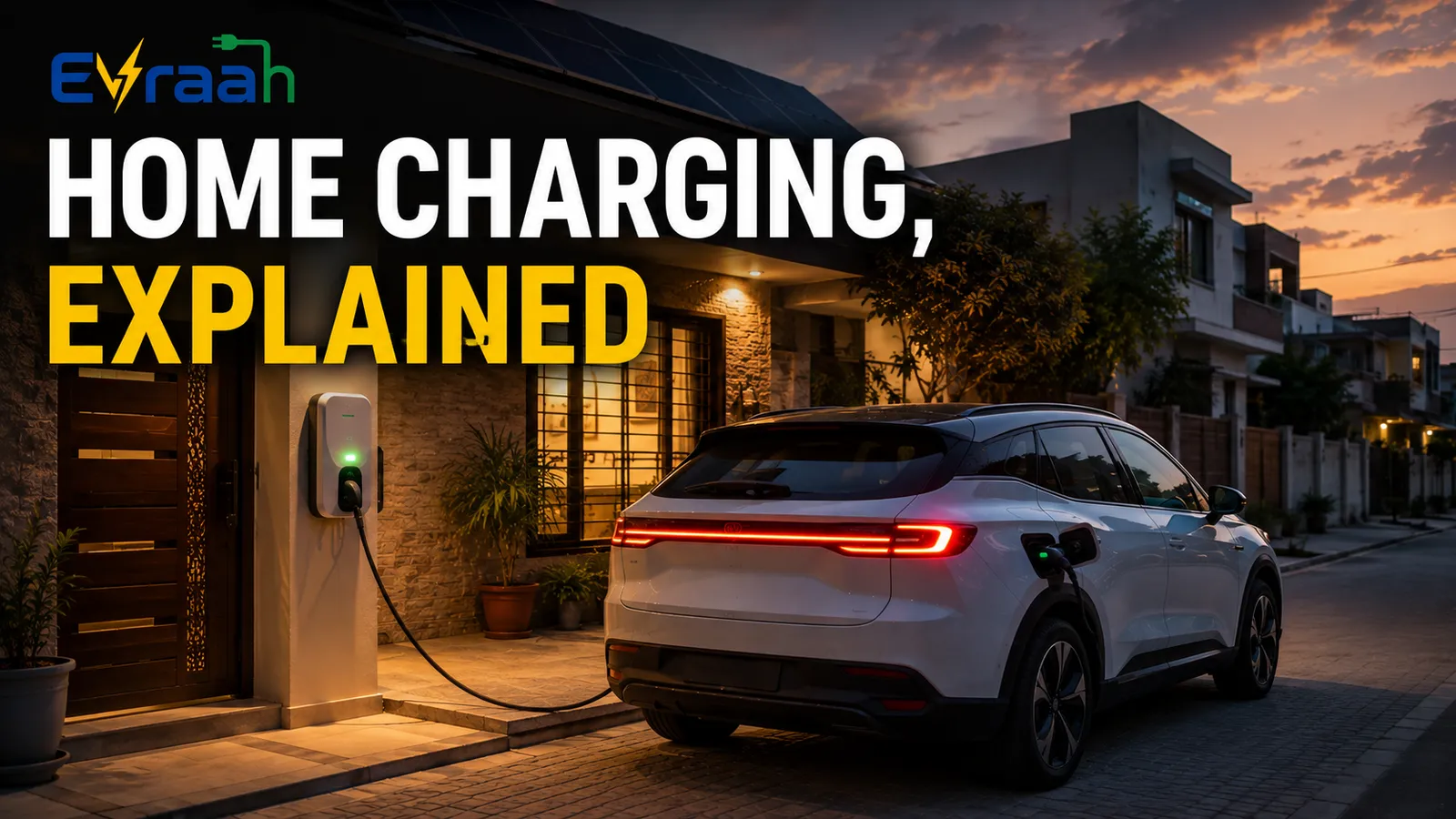
Imagine returning home after the evening commute, parking the car and plugging it in. While you eat, sleep and get ready for the next day, the vehicle quietly replaces the energy you used. By morning, it has enough charge for work, school runs and everyday errands.
That routine is one of the biggest conveniences of owning an electric car. But before it becomes effortless, there are practical questions to answer. Can your existing electrical supply handle the load? Do you need a wallbox? How long will charging take? What will it add to the electricity bill? And what happens during load shedding?
This guide explains home EV charging for Pakistani drivers without assuming that every home, apartment or vehicle is the same. The best setup is not necessarily the fastest one. It is the setup that safely provides the energy you need before your next drive.
What Is Home EV Charging?
Home EV charging means connecting an electric vehicle to an electricity supply at the property where it is parked. In most homes, the vehicle receives alternating current, or AC.
The energy path is straightforward:
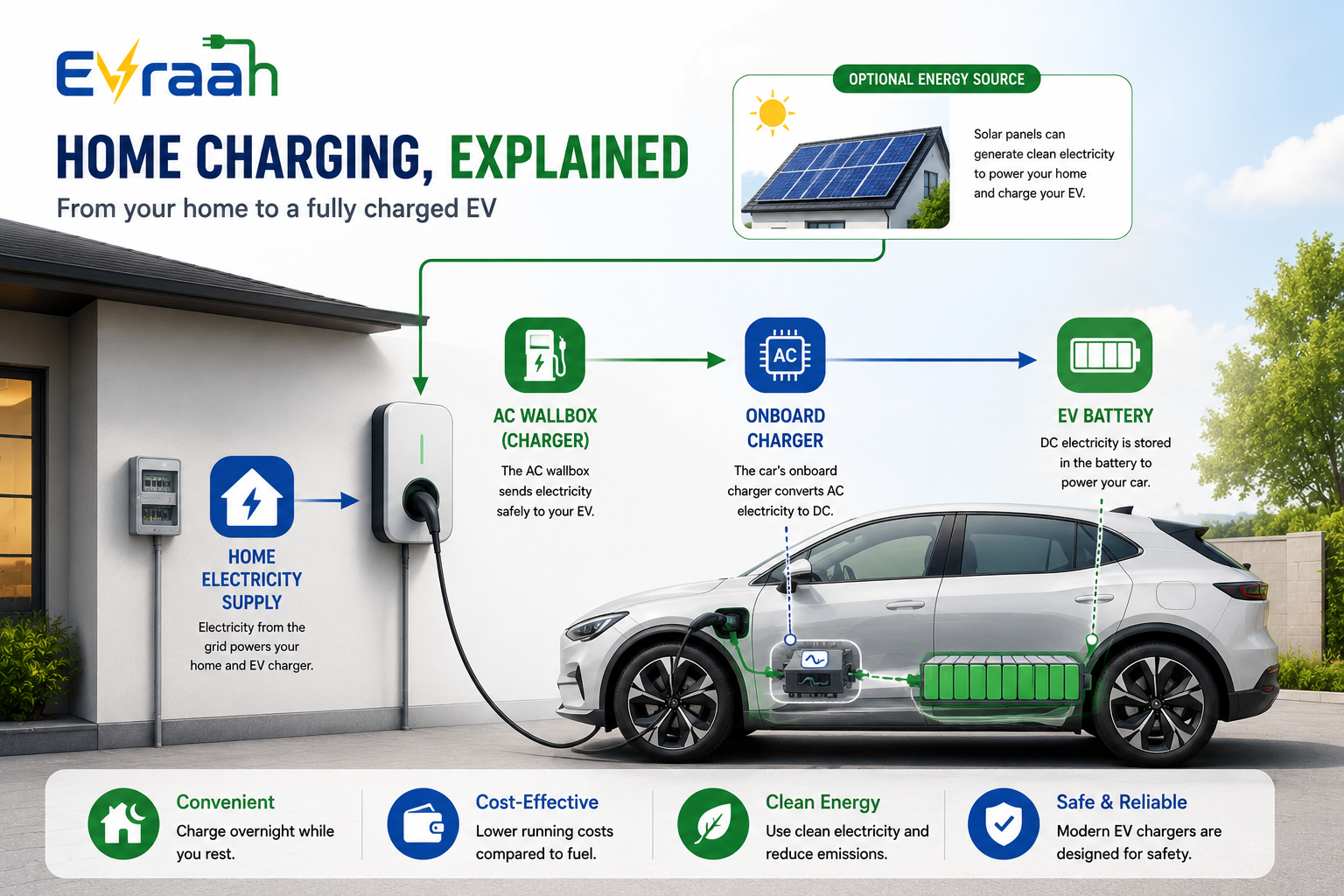
Household AC supply → charging equipment → vehicle’s onboard charger → DC electricity → battery
An EV battery stores direct current. During AC charging, the onboard charger inside the car converts household AC electricity into DC before it reaches the battery. This is why the vehicle’s onboard charging capacity matters: even if the wallbox can supply more power, the car will accept only what its onboard charger allows.
Most residential charging uses AC because it matches the electricity available at the property and suits a car that remains parked for several hours. Public DC fast charging works differently and is designed for shorter stops during a journey.
How Does an EV Home Charger Work?
People often call the wall-mounted unit a “charger,” although the main AC-to-DC conversion happens inside the vehicle. The wallbox is more accurately charging equipment that manages the safe delivery of electricity and communicates with the car.
A typical home setup involves:
- The property’s electrical supply
- A circuit sized for the intended charging load
- Appropriate circuit protection and earthing
- An AC wallbox or suitable portable charging unit
- A compatible charging cable and connector
- The car’s onboard AC charger
- The high-voltage battery and battery management system
Once connected, the equipment and vehicle complete safety checks before energy begins flowing. The car’s battery management system monitors factors such as temperature and state of charge, while the charging equipment controls the electrical connection.
The U.S. Department of Energy’s home-charging guidance recommends having a qualified electrician assess whether a property has enough electrical capacity and install additional circuits where required. Pakistani owners should likewise use a competent local professional familiar with the applicable wiring and protection requirements.
AC Home Charging vs DC Fast Charging
Both methods charge the same battery, but they are built for different situations.
| Factor | AC home charging | DC fast charging |
|---|---|---|
| Typical location | Home, office or destination parking | Public charging station, motorway or charging hub |
| Speed | Slower; suited to longer parking periods | Much faster; suited to shorter stops |
| Best use | Overnight and routine daily charging | Long journeys and urgent top-ups |
| Power conversion | Inside the vehicle’s onboard charger | Inside the charging station |
| Driver installation | Requires a suitable home electrical setup | No installation required by the visiting driver |
| Cost | Based on household electricity use and tariff | Based on the operator’s pricing model |
Installing DC fast charging at a normal residence is generally impractical. The equipment, grid connection, electrical capacity and cost are on a different scale from a residential AC wallbox. Home charging does not need to imitate a motorway charging stop because the car usually has all night to charge.
EVraah’s fast charging vs slow charging guide provides a deeper comparison for drivers deciding which method suits daily use and longer journeys.
How Long Does Home EV Charging Take?
There is no single home-charging time for every electric vehicle. The result depends on:
- Battery capacity
- The percentage at which charging begins
- The amount of energy you want to add
- Available power from the charging equipment
- The vehicle’s maximum AC charging rate
- Charging losses
- Battery temperature and system controls
A wallbox’s label shows its maximum possible output, not a promise that every car will charge at that rate. If a wallbox can supply 7 kW but the vehicle accepts a lower AC rate, the vehicle becomes the limiting factor. Electrical load management can also reduce power when the property is using electricity elsewhere.
Here is a simplified example. Suppose a driver wants to add 30 kWh of energy. At an ideal and constant 7 kW, the calculation is:
30 kWh ÷ 7 kW = approximately 4.3 hours
The real session would take longer because charging is not perfectly efficient and power may vary. The example explains the calculation; it is not a prediction for a specific EV.
Most daily sessions are smaller than a near-empty-to-full charge. If the car uses only part of its battery during the commute, the owner needs to replace that energy—not refill the entire pack every night.
Can You Charge an EV Using a Normal Wall Socket?
Some EVs include a portable charging unit that can connect to a suitable household outlet. That does not mean every socket is safe for hours of continuous charging.
EV charging creates a sustained electrical load. Socket condition, wiring size, earthing, circuit protection, other appliances on the circuit and the property’s total capacity all matter. A loose connection or ageing socket may overheat under a load that continues for many hours.
A portable unit may be useful for occasional or low-power charging when the outlet and circuit have been assessed. For regular daily use, a dedicated circuit and properly installed wallbox usually provide a more dependable arrangement.
Do not assume that an extension lead makes an unsuitable outlet suitable. Avoid improvised adapters, damaged cables and connections exposed to water. The official workplace-charging safety guidance from the Alternative Fuels Data Center similarly stresses suitable receptacles, dedicated protection and inspection by an electrician.
What Equipment Do You Need for Home EV Charging?
The exact equipment depends on the vehicle and property, but a sound installation normally includes the following.
A compatible AC wallbox
Choose equipment that supports the vehicle’s connector and required charging rate. Extra wallbox capacity will not make the car exceed its own AC limit, so check the vehicle documentation before paying for more power than it can use.
A dedicated electrical circuit
The charging load should not simply be added to an unknown or already overloaded household circuit. A professional should confirm the cable size, breaker, isolation, protective devices and available capacity.
Proper earthing and protection
Earthing and fault protection are essential parts of electrical safety. Requirements depend on the equipment, property and applicable standards, so they should be specified by the installer rather than guessed by the vehicle owner.
Safe cable routing
The cable should comfortably reach the charging port without being stretched, crushed by a door or left where people can trip over it. Outdoor equipment must be appropriate for the installation environment.
Optional smart features
Some wallboxes offer scheduling, energy monitoring, access control and load management. These can be useful, but the priority remains safe electrical design and compatibility with the vehicle.
How Much Does Home EV Charging Cost?
The energy calculation is simple:
Charging cost = electricity drawn from the property × applicable electricity rate
For example, if a charging session draws 20 kWh, multiply 20 by the rate that applies to those units on the household bill. This is a calculation method, not a national price estimate.
The actual cost can be affected by:
- The household tariff and taxes
- Total household consumption and any applicable billing structure
- Energy lost during charging
- The amount of energy added to the battery
- Time-of-use arrangements, where applicable
- Electricity supplied directly or indirectly by a solar system
It is important to separate the running cost of electricity from the one-time setup cost. Installing a wallbox may involve equipment, cabling, protection devices, labour, civil work or an electrical upgrade. Those costs vary by property and should be quoted after an assessment.
Is Home Charging Cheaper Than Public Charging?
Home EV charging can have a lower energy cost in some situations because the owner pays the applicable residential electricity cost rather than a public charging service price. It is not automatically cheaper for every household, particularly where higher total consumption affects the bill.
Public charging operators have additional costs. These may include high-power equipment, electrical upgrades, site rent, maintenance, software, payment processing, network operations and customer support. The public price reflects more than electricity alone.
Public DC charging also provides something a home wallbox cannot: a large amount of energy during a short travel stop. For many owners, the practical combination is home AC charging for ordinary driving and public fast charging for intercity journeys.
EVraah’s EV charging guide can help drivers understand where public charging fits alongside a home setup.
Home EV Charging in Pakistan: What Drivers Should Consider
Electricity supply and load shedding
If grid power is interrupted, charging stops because the vehicle is no longer receiving electricity. Many systems resume after supply returns, but behaviour varies by car and charging equipment. Owners should confirm how their setup handles interruptions rather than assume that every session will restart automatically.
A charging schedule should include a time buffer where outages are common. If the car must leave early with a specific charge level, beginning the session sooner may be more reliable than waiting until the last possible hour.
The property’s existing electrical load
An EV becomes another significant household load alongside air conditioners, water pumps, cooking equipment and other appliances. The installer should assess peak usage and available capacity, not just the wallbox in isolation.
Load-management equipment may help some homes by reducing charging power when other demand is high. Whether it is useful depends on the electrical setup and charger.
Older wiring and unsuitable parking arrangements
Some properties may need new cabling, protection or a dedicated route from the distribution board to the parking space. Long temporary cables running through doors or across shared areas are not a proper permanent solution.
Electricity bills
Charging shifts transport energy onto the household bill. Monitor the first few months of consumption and compare energy used for charging with distance driven. A smart wallbox or vehicle app may help, but billing data should remain the final reference for household cost.
Public charging as a backup
A home charger covers routine driving; it does not follow the car onto the motorway. Intercity drivers still need to confirm public charging locations, compatibility, access and backup options before leaving.
Before an intercity trip, consult EVraah’s Karachi-to-Lahore EV route guide and EV route-planning resources to prepare charging stops and alternatives.
Can Solar Panels Charge an EV?
Yes. Solar photovoltaic panels generate electricity that can contribute to the home’s load, including EV charging. The energy does not necessarily travel through a separate cable directly from the panel to the car. In a typical property system, solar generation, household consumption, the inverter, grid connection and any battery storage work together.
Whether the car is charged mainly by solar depends on:
- Solar-array output at that time
- The home’s other electricity demand
- Inverter capacity
- EV charging power
- Whether the car is parked during daylight hours
- The presence and usable capacity of stationary battery storage
- The system’s grid connection and control arrangement
Daytime charging can align the car’s demand with solar production. An owner who returns home after sunset may instead use electricity from the grid or a home battery, depending on the system.
Solar charging is not automatically free. Panels, inverters, batteries, wiring, maintenance and financing all have costs. The economics should be assessed for the complete household system rather than attributing every solar-generated unit to the car. The U.S. Department of Energy’s solar overview explains how photovoltaic technology converts sunlight into usable energy, but system design should be handled by a qualified local professional.
Home Charging for Apartment Residents
Apartment living can make EV ownership more complicated, especially when parking spaces are shared or not assigned. Before buying an EV, ask:
- Is there a permanent parking space where the car can charge?
- Will building management or the landlord allow installation?
- Where will the electrical supply originate?
- Can consumption be connected to the resident’s meter or billed separately?
- Is there a safe route for cabling?
- Who will pay for installation and future maintenance?
- Can several residents share a managed charging system?
- What happens if the resident changes parking spaces or moves out?
A shared AC charger may be more practical than separate units for every resident, but it needs access control, fair billing and rules for moving cars after charging. Renters should obtain written permission before making permanent electrical changes.
Drivers without dependable home or workplace charging can still own an EV, but public charging becomes a central part of the experience. That affects convenience and cost, so it should be evaluated before purchase—not discovered afterwards.
Does Home Charging Affect EV Battery Health?
All rechargeable batteries age with time and use. Home charging does not stop degradation, and fast charging does not automatically destroy a battery.
Battery ageing is influenced by several factors, including:
- Battery chemistry
- Temperature
- Time spent at very high or very low charge levels
- Charging power and frequency
- Driving and usage patterns
- The vehicle’s thermal and battery management systems
Lower-power AC charging generally creates less charging heat and is a sensible routine when the car will be parked for hours. However, the appropriate daily limit depends on the model and battery chemistry. Follow the manufacturer’s guidance instead of applying a fixed percentage taken from another vehicle.
Should You Charge Your EV to 100% Every Night?
Not necessarily. A driver using a modest portion of the battery each day may need only enough energy for the next commute plus a sensible reserve.
The correct limit depends on:
- The manufacturer’s recommendation
- Battery chemistry
- Expected daily distance
- Access to charging during the day
- Whether a longer journey is planned
Some vehicles recommend a lower everyday limit and a full charge before longer trips; others use different guidance. The owner’s manual and in-car charging settings should take priority.
How to Build a Practical Home-Charging Routine
For a driver with private parking, the basic routine can be simple:
Return home → park safely → connect the car → charge during the available window → leave with the energy needed for the next day
Different drivers can adapt it:
Daily city driver
Replace the energy used during the commute. A full charge may be unnecessary.
Heavy commuter
Use a properly sized AC setup and allow enough time for the larger daily energy requirement. Confirm that the property can support the load.
Weekend traveller
Charge to the manufacturer-recommended level before departure, then plan public charging where the trip exceeds available range.
Long-distance driver
Begin with adequate home charge and use verified DC fast chargers along the route. Keep a backup stop and sensible battery reserve.
Driver without private parking
Build a routine around workplace, shared residential or public charging. Calculate the time and cost before committing to the vehicle.
Home-Charging Safety Tips
- Have the property and planned circuit assessed by a qualified electrician.
- Use equipment compatible with the vehicle and intended electrical load.
- Avoid damaged plugs, connectors and cables.
- Do not use unsuitable extension leads or improvised adapters.
- Ensure the installation includes appropriate earthing and protection.
- Keep connectors dry and use equipment suited to the environment.
- Route cables so they are not stretched, crushed or a trip hazard.
- Do not overload a circuit shared with other heavy appliances.
- Follow the charger and vehicle manufacturer’s installation and operating instructions.
- Stop using equipment that becomes unusually hot, damaged or unreliable and have it inspected.
Safety-certified equipment and professional installation are key recommendations in the Alternative Fuels Data Center’s home-charging guidance.
Home Charging vs Public Charging
| Factor | Home AC charging | Public charging |
|---|---|---|
| Speed | Usually slower | Can include AC or high-power DC charging |
| Convenience | Very convenient when private parking is available | Useful away from home and during journeys |
| Cost | Based on the household tariff and consumption | Based on the operator’s pricing structure |
| Installation | Property owner or resident must arrange a suitable setup | No installation for the visiting driver |
| Accessibility | Limited to the property and parking arrangement | Depends on station location, access and availability |
| Best use | Routine daily charging | Travel, backup charging and drivers without home access |
| Long-distance suitability | Useful before departure and at the destination | DC fast charging is usually more practical during the journey |
Most owners benefit from treating these as complementary options. Home charging handles the quiet, routine work. Public charging extends the car’s reach when the journey goes beyond the daily pattern.
How EVraah Can Help
Home charging may cover much of an EV owner’s daily driving, but public infrastructure still matters. A family trip, motorway journey or unexpected detour can require charging away from home.
EVraah helps Pakistani drivers discover charging options and plan EV journeys. Use it to support route preparation, identify possible charging stops and build a backup plan before longer travel.
Readers interested in the wider transition can also explore EVraah’s Pakistan EV Target 2030 article to see how home and public infrastructure fit into the national electric-mobility picture.
Frequently Asked Questions
Can I charge my EV at home?
Yes, if you have suitable parking, compatible equipment and an electrical supply that can safely support the charging load.
How much does it cost to charge an EV at home?
Multiply the electricity drawn during charging by the rate that applies to those units. Include charging losses when estimating the total.
How long does home EV charging take?
It depends on battery size, energy required, wallbox power, the vehicle’s AC limit, charging losses and temperature.
Can I charge an EV from a normal socket?
Some vehicles support portable charging, but not every socket or circuit is suitable for a sustained EV load. Have the installation assessed first.
Is AC charging better for home use?
AC charging is usually the practical residential option because the car remains parked for hours. The appropriate setup depends on the home and vehicle.
Can solar panels charge an EV?
Yes. Solar generation can contribute to EV charging, subject to system output, other household demand, inverter capacity, storage and charging time.
Does home charging damage the battery?
Normal AC charging is a standard use case. Battery ageing depends on chemistry, temperature, charge levels, usage and vehicle controls.
Do I need a wallbox charger?
Not in every situation, but a dedicated wallbox can offer a safer and more convenient regular setup when correctly installed.
Can apartment residents install EV chargers?
Possibly, but parking rights, building permission, electrical access, metering and cable routing must be resolved first.
Do I still need public charging if I have a home charger?
Usually, yes, for journeys beyond the vehicle’s available range or when charging away from home becomes necessary.
A Home Charger Should Fit Your Life—not Just Your Car
Good home EV charging is not about buying the most powerful wallbox available. It is about creating a safe, reliable setup that matches the vehicle, the property’s electrical capacity and the driver’s actual routine.
For someone with private parking and predictable daily travel, plugging in at home can be one of the easiest parts of EV ownership. Apartment residents and drivers facing unreliable supply may need more planning or a mix of charging options.
Start with an electrical assessment, follow the vehicle manufacturer’s guidance and leave public DC charging for the situations where its speed is genuinely useful. When the journey extends beyond home, use EVraah to discover charging options and plan EV travel across Pakistan.
Related blogs
More from Charging Guides.
You may also like
 Pakistan EV News
Should You Buy an EV in Pakistan Now or Wait for the 2026–31 Auto Policy?
6 min read · 4 Oct 2026
 EV Basics
WLTP vs NEDC vs CLTC vs EPA: EV Range Explained for Pakistan
6 min read · 1 Oct 2026
 Buying Guides
Deepal S07 vs BYD Sealion 7: Detailed Comparison for Pakistan
5 min read · 20 Sept 2026