
How Long Does It Take to Charge an EV in Pakistan? Complete 2026 Guide
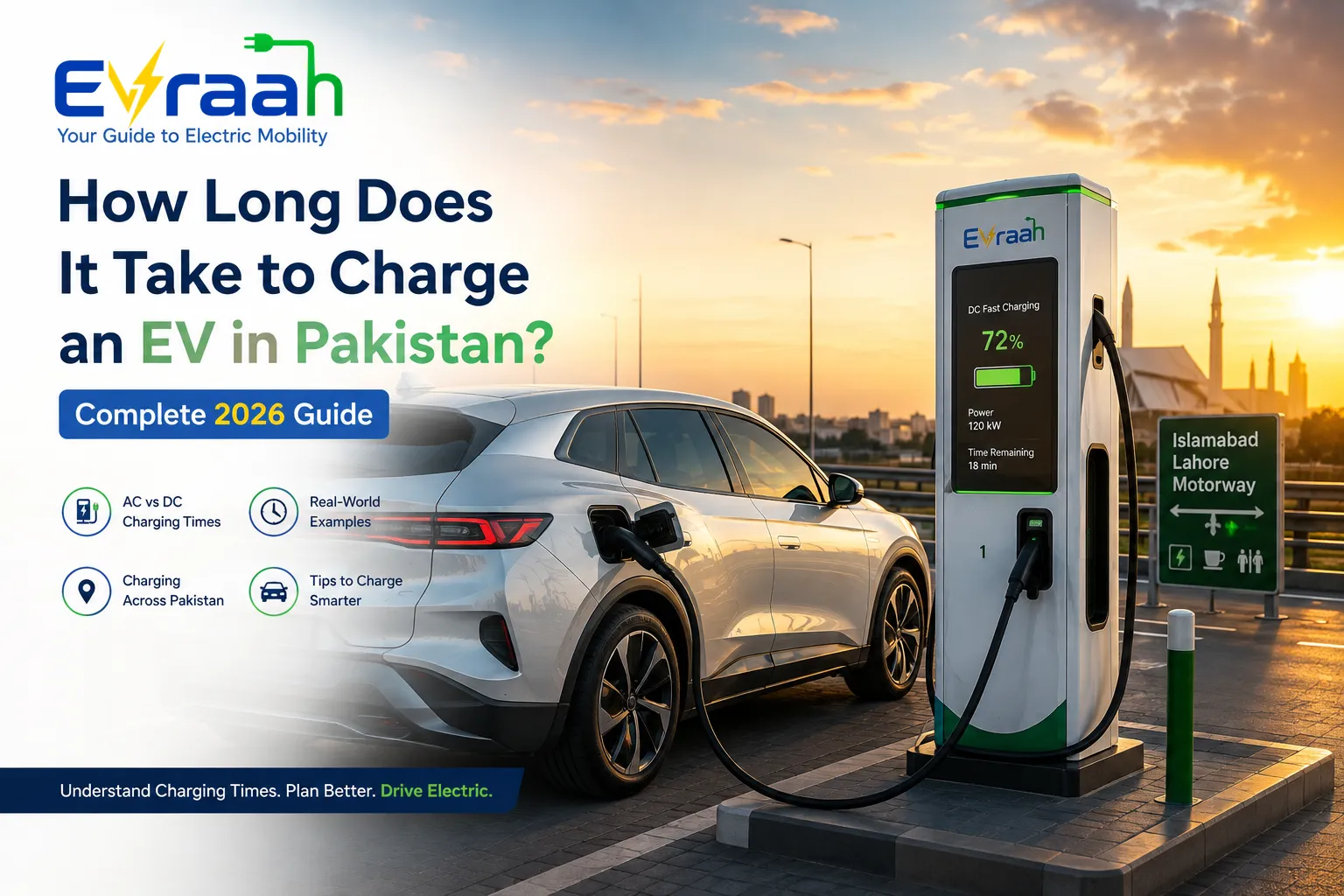
Quick answer: Most electric cars sold in Pakistan take 6–10 hours to charge fully on a home AC wallbox, or 25–60 minutes to reach 80% on a DC fast charger, depending on battery size and charger power. A basic 3-pin household socket is far slower — often 24–28 hours for a full charge — and isn't recommended for daily use.
Charging time isn't one fixed number. It depends on:
- Battery size — a 43 kWh MG4 EV Urban fills faster than an 82 kWh BYD Seal.
- Charger power — a 7 kW home wallbox is very different from a 150 kW public DC charger.
- The vehicle's charging limit — a car with a 7 kW onboard charger cannot take 22 kW simply because it is connected to a 22 kW AC charger.
- Battery state of charge — charging is usually faster at lower and middle battery percentages.
- Temperature — extreme heat or cold can cause the battery management system to reduce charging power.
- AC vs DC charging — DC fast charging can deliver much higher power directly to the battery.
This guide explains what Pakistani EV owners can realistically expect from popular electric vehicles from BYD, MG, Deepal, Kia and Hyundai.
Why EV Charging Time Isn't a Single Number
A simple way to estimate charging time is:
Charging time ≈ Energy needed (kWh) ÷ effective charging power (kW)
For example, if an EV needs around 40 kWh of energy and is connected to a 7.4 kW home charger, the theoretical charging time is around 5.4 hours.
Real charging is not quite that simple because charging power changes during a session. On DC fast chargers, an EV usually accepts its highest charging power during the middle part of the battery's state of charge and then gradually slows as the battery approaches full.
This is why manufacturers commonly publish 10–80% or 30–80% fast-charging times instead of 0–100% figures. The final 20% is normally much slower.
The Three Main Ways to Charge an EV in Pakistan
1. Home or Slow AC Charging
A portable charger connected to a household socket is one of the slowest ways to charge an electric vehicle.
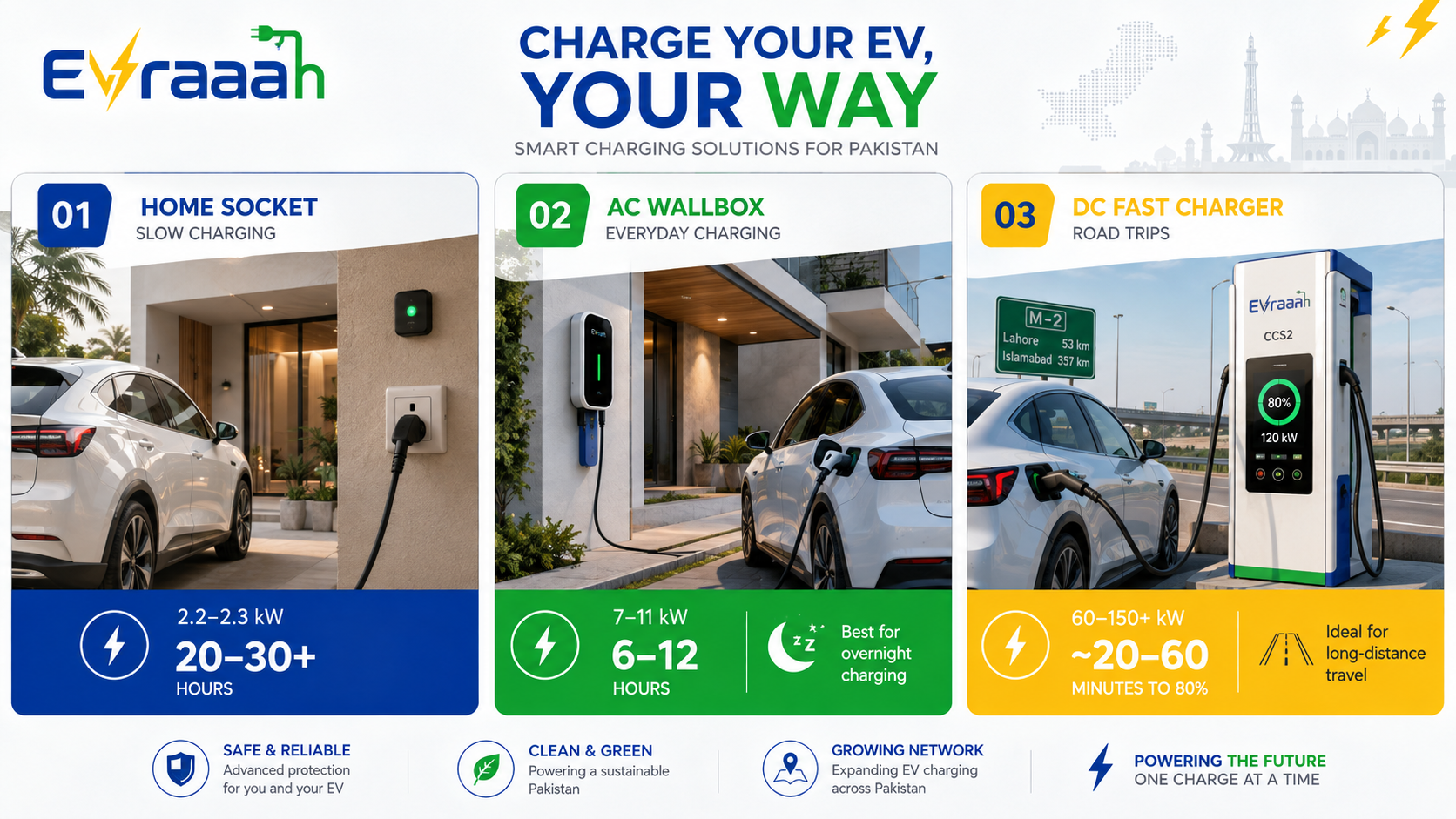
- A typical household connection may provide around 2.2–2.3 kW.
- A medium-sized EV battery can take well over 20 hours to fully recharge at this speed.
- A dedicated and properly earthed electrical circuit should be used for sustained EV charging.
- Extension leads and overloaded shared sockets should be avoided.
For regular EV ownership, a properly installed wallbox is normally a much better solution.
2. AC Wallbox Charging
A dedicated home or workplace wallbox is the most practical everyday charging option for many EV owners.
- 7 kW: Common for residential charging and suitable for many BYD and MG models.
- 11 kW: Faster three-phase AC charging supported by selected EVs. For example, the Kia EV5 Earth supports higher-power AC charging, while the MG ZS EV Long Range is listed with 11 kW AC charging capability.
- 22 kW: Some public chargers offer 22 kW AC, but the actual speed still depends on the vehicle's onboard charger.
The important point: the charger may be capable of delivering more power than your car can accept. Your EV's onboard charger determines the maximum AC charging speed.
3. DC Fast Charging
DC fast chargers bypass the vehicle's onboard AC charger and send high-power DC electricity directly to the battery.
- 30–60 kW: Useful for slower fast-charging EVs and older charging stations.
- 100–150 kW: Well suited to many newer BYD, MG, Deepal and Kia EVs.
- 150–350 kW: Designed for high-performance charging systems and vehicles capable of accepting very high DC charging power.
A 350 kW charging station does not mean every EV will charge at 350 kW. The actual charging speed is limited by whichever is lower: the charger's maximum output or the car's maximum DC charging capability.
For example, a BYD Atto 3 cannot take full advantage of a 350 kW charger if the vehicle's own DC charging limit is much lower. A vehicle based on an 800-volt platform, such as the Hyundai Ioniq 5, can make much better use of high-power DC charging.
EV Charging Time Comparison in Pakistan
The table below compares charging specifications for several EVs relevant to Pakistani buyers. Each vehicle name links directly to a source for the specifications.
| EV Model | Battery | AC Charging | DC Fast Charging | Approx. AC Time | Approx. Fast-Charge Time |
|---|---|---|---|---|---|
| BYD Atto 3 Extended Range | 60.5 kWh | 7 kW / 11 kW depending on specification | Up to 88 kW | About 9h 42m at 7 kW | About 44 min, 10–80% |
| BYD Seal | 82.56 kWh | 7 kW | Up to 150 kW | About 10 hours | About 30 min, 30–80% |
| MG4 EV Urban | 43 kWh | Up to 7 kW | DC rapid charging | About 7–9 hours | About 28 min, 10–80% |
| MG4 EV Excite / Essence | 51 / 64 kWh | Up to 7 kW | Up to 140 kW | About 8–11 hours | About 21–35 min, 10–80% |
| MG ZS EV Essence | 51.1 kWh | 7.4 kW | DC fast charging | About 6–7 hours | About 35–40 min to 80% |
| MG ZS EV Long Range | 72.6 kWh | 11 kW | DC fast charging | About 7–8 hours | About 35 min to 80% |
| Deepal S07 | 66.8 kWh | 7 kW / 11 kW depending on equipment | DC fast charging | About 8–12 hours | About 35 min, 30–80% |
| Kia EV5 Air | 64.2 kWh | 6.6 kW | Up to approximately 120 kW | About 9h 43m | About 1 hour, 10–80% |
| Kia EV5 Earth | 88.1 kWh | 11 kW | Up to 141 kW | About 8 hours | About 1h 12m, 10–80% |
| Hyundai Ioniq 5 | Depends on variant | Around 11 kW | High-power 800V DC charging | About 6–8 hours depending on battery | About 18 min, 10–80% |
Charging figures are normally measured under controlled conditions. Actual charging times can vary because of battery temperature, ambient temperature, charger output, battery state of charge, voltage conditions and the vehicle's charging software.
EV Charging in Pakistan: What Drivers Should Know
Home Charging Is Still the Most Practical Option
For many EV owners, home charging will cover most daily driving. Plugging the car in overnight means it can start the next day with sufficient range without requiring a visit to a public charging station.
AC charging is also generally more convenient for routine charging because the car can remain parked while charging for several hours.
Public EV Charging Is Expanding
Public charging infrastructure in Pakistan continues to develop, although availability and charging speed vary considerably by location.
You can review information about public EV charging prices and charging locations when comparing options for longer journeys.
Charging availability is generally stronger in major urban areas, while intercity and motorway charging requires more planning. This overview of EV charging stations in major Pakistani cities provides additional context on the developing network.
Motorway and Intercity EV Charging
Long-distance EV travel in Pakistan is becoming increasingly practical as more charging infrastructure is planned and installed along major routes.
Pakistan's EV charging network expansion plans include thousands of charging points and additional fast chargers on important motorway and highway corridors.
There have also been developments involving ultrafast EV charging stations on Pakistan's motorway network.
How to Plan a Long EV Journey
For motorway and intercity travel, you normally do not need to wait for your battery to reach 100% at every charging stop.
Charging from around 10% to 80% is usually much faster than charging from 80% to 100%, so shorter charging stops can make a long journey more efficient.
Before travelling, check EV charging stations on Pakistan's motorway and highway network and plan a backup charging stop where possible.
Evraah is designed to make this process easier by helping drivers discover charging stations, compare charger types and plan their electric journeys across Pakistan.
EV Charging Connector Compatibility
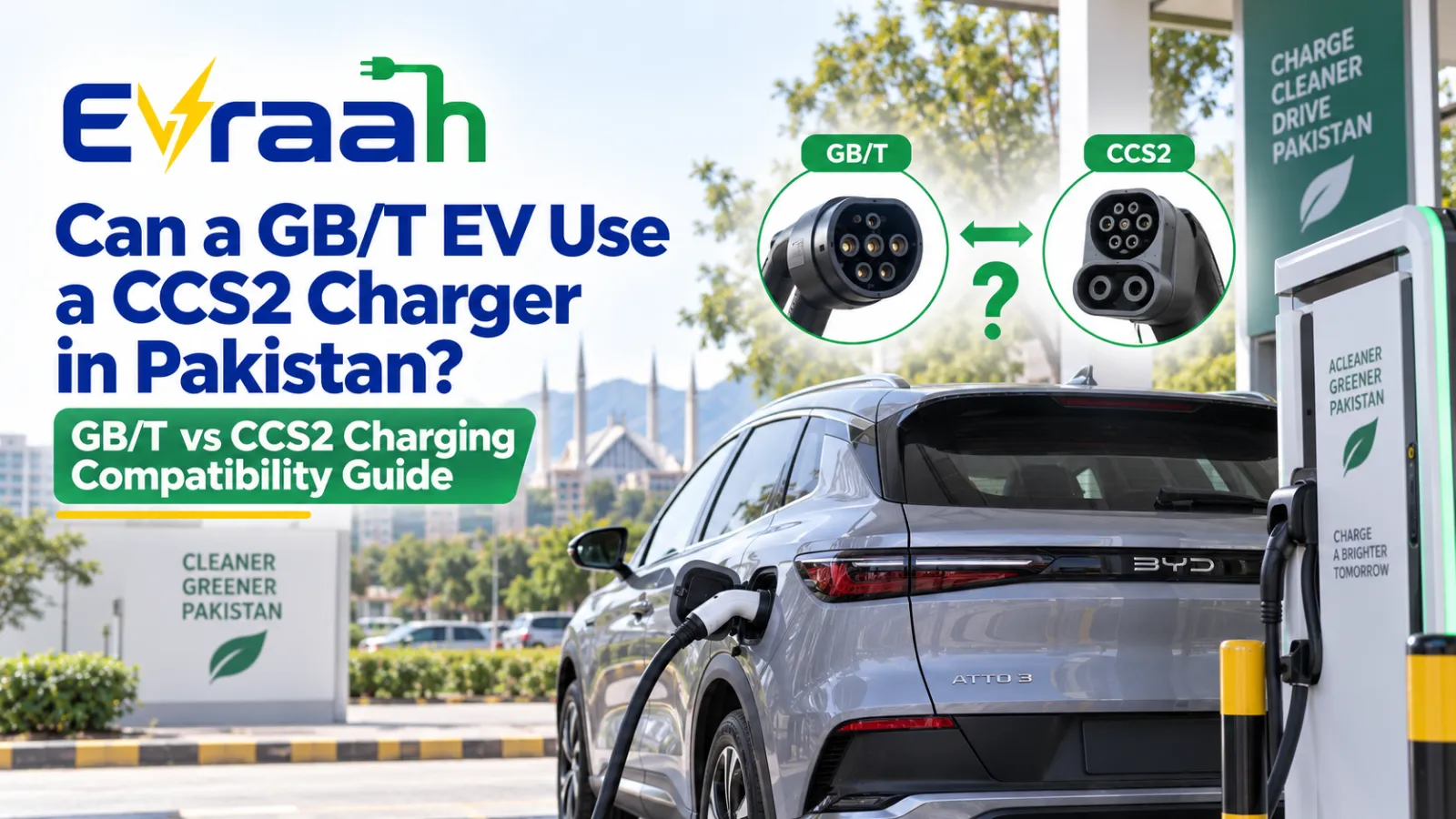
Connector type is just as important as charging speed. Many newer EVs from BYD, MG, Deepal and Kia use Type 2 for AC charging and CCS2 for DC fast charging.
Some imported EVs may instead use GB/T, CHAdeMO or other connector types, so drivers should always confirm that a charging station supports their vehicle before relying on it during a long trip.
If you are planning your next journey, Evraah can help you find EV charging stations in Islamabad, explore EV charging stations in Lahore, find EV charging stations in Karachi, or plan charging around Rawalpindi.
Frequently Asked Questions
How long does it take to fully charge an EV?
On a home AC wallbox, many EVs take around 6–10 hours for a full charge. On a DC fast charger, a typical 10–80% charging session can take approximately 25–60 minutes depending on the car and charger.
How long does an EV take to charge at home?
A 7 kW home wallbox can charge many electric cars overnight, usually within around 6–12 hours depending on battery size and starting charge level.
A normal household socket is considerably slower and can take more than 20 hours for larger EV batteries.
How long does an EV take to charge at a fast charger?
Many current EVs can reach approximately 80% in 25–60 minutes on a suitable DC fast charger.
Vehicles with advanced 800-volt charging systems can be considerably faster when connected to a compatible high-power charger.
Can an EV charge in 30 minutes?
Yes. Several modern EVs can gain a substantial amount of charge in around 30 minutes, although this usually refers to charging from roughly 10–80% or 30–80%, not from completely empty to 100%.
Is DC Fast Charging Bad for an EV Battery?
Occasional DC fast charging is normal and is what the technology is designed for. However, AC charging is generally preferable for routine overnight charging, while DC charging is particularly useful for motorway trips and situations where you need energy quickly.
How Long Does a BYD Take to Charge?
The BYD Atto 3 takes roughly 9–10 hours on a 7 kW home wallbox, while a suitable DC fast charger can provide a 10–80% charge in around 44 minutes.
The larger BYD Seal can charge considerably faster on DC, with approximately 30 minutes quoted for a 30–80% charging session.
How Long Does an MG EV Take to Charge?
The MG4 EV Urban can charge from around 10–80% in approximately 28 minutes on suitable DC fast charging, while a home AC charging session can take around 7–9 hours.
The MG ZS EV generally takes several hours on a home wallbox and roughly 35–40 minutes to reach around 80% using DC fast charging, depending on the variant.
How Long Does a Deepal EV Take to Charge?
The Deepal S07 is rated for approximately 35 minutes from 30–80% using DC fast charging. Home AC charging can take approximately 8–12 hours depending on the available charging power.
How Much Does EV Charging Cost in Pakistan?
Charging cost depends on whether you charge at home or use a commercial public charging station.
Home charging uses your normal electricity tariff, while public DC fast charging is normally priced at a higher per-kWh rate because of the charging equipment, location and operating costs.
Should I Charge My EV to 100% Every Day?
For many EVs, there is no need to charge to 100% every day. A lower daily charging limit can be sufficient for normal commuting, while a full charge can be useful before longer journeys.
Owners should follow the battery charging guidance provided by the manufacturer for their specific vehicle and battery chemistry.
Find Your Next EV Charging Station with Evraah
Whether you're charging overnight at home or planning a Lahore–Islamabad motorway journey, Evraah helps you find EV charging stations across Pakistan, compare charger types and plan your route before you leave.
Find your next charging stop with Evraah and make every electric journey easier to plan.
Related blogs
More from Charging Guides.
You may also like
 Pakistan EV News
Should You Buy an EV in Pakistan Now or Wait for the 2026–31 Auto Policy?
6 min read · 4 Oct 2026
 EV Basics
WLTP vs NEDC vs CLTC vs EPA: EV Range Explained for Pakistan
6 min read · 1 Oct 2026
 Buying Guides
Deepal S07 vs BYD Sealion 7: Detailed Comparison for Pakistan
5 min read · 20 Sept 2026