
Can You Charge an EV With Solar Panels in Pakistan?
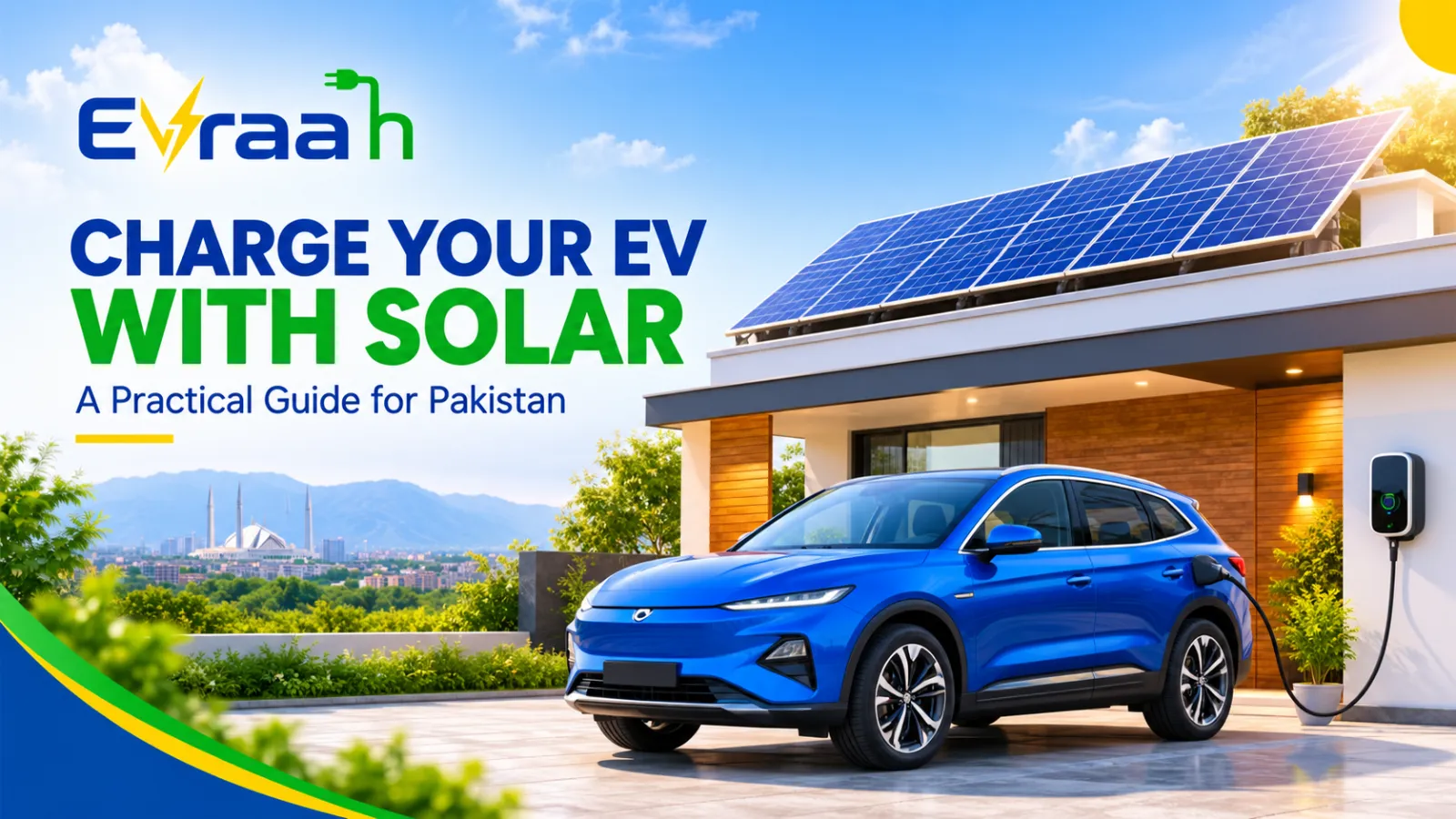
Yes, you can. A rooftop solar system can power an electric car the same way it powers your fridge or your AC: the car is simply another load on your home wiring. What changes is the economics. Since February 2026, new solar users in Pakistan are paid far less for exported units than they pay for imported ones, so when you charge matters almost as much as how big your system is.
This guide explains how solar EV charging works, what size system you need, what it costs and when it makes financial sense. The figures are illustrative, based on stated assumptions, and were last checked in October 2026. If you are still choosing a car, our list of electric cars available in Pakistan is a good place to start.
Can You Charge an EV With Solar Panels in Pakistan?
You can, and thousands of households already run an EV charger from a rooftop system. Solar panels do not plug into the car directly. They feed an inverter, the inverter feeds your home's electrical supply, and a home charger draws power from that supply to charge the battery. Your car cannot tell whether a unit came from the sun or from the grid.
The practical question is whether your solar output is available when the car is plugged in. Most Pakistani commuters park at night, while panels produce power between roughly 9 am and 4 pm. That timing gap shapes every decision below.
How Does Solar EV Charging Work?
- Solar panels produce DC electricity. Typical residential panels in Pakistan are around 550 W each.
- The inverter converts DC to AC for your home. On-grid inverters work only while the grid is live. Hybrid inverters can also manage a battery.
- Your home wiring and meter distribute that power to appliances, the EV charger and, when there is surplus, back to the grid.
- The home charger (an AC wallbox or the cable supplied with the car) feeds the vehicle. Our home EV charging guide covers charger types, wiring and safety.
- Optional battery storage saves daytime surplus for the evening and night.
One distinction trips up many buyers: solar capacity is measured in kW (how fast the system can produce power), while batteries are measured in kWh (how much energy they hold). A 5 kW system is not a 5 kWh battery.
How Many Solar Panels Do You Need to Charge an Electric Car?
There is no universal number. It depends on how far you drive, how efficient the car is and how much sun your roof gets. The method is simple:
- Estimate monthly energy: kilometres driven × the car's kWh per 100 km ÷ 100, plus about 10 percent for charging losses.
- Divide by the monthly output of one kW of panels. This guide assumes about 120 kWh per kW per month (around 4 kWh per kW per day on average). Sellers quote wider ranges, and winter output is lower.
- Round up for winter and dust.
Example: 1,000 km a month at 16 kWh per 100 km is 160 kWh. Add losses and you need about 175 kWh from the house supply. At 120 kWh per kW, that is roughly 1.5 kW of panels, so plan on about 2 kW, or four 550 W panels, to leave room for winter. A longer commute or a heavier car needs more.
Can a 5kW, 10kW or 15kW Solar System Charge an EV?
All three can. The real question is how much of the output your house already uses. If a 5 kW system only just covers your household, the car competes with your AC for the same sunshine.
| System | Illustrative monthly output | Typical price listings | EV charging fit |
|---|---|---|---|
| 5 kW | about 500 to 650 kWh | PKR 7 to 15 lakh depending on on-grid or hybrid | Fine for one EV if your home load is modest. Often needs 1 to 2 extra panels beyond the household plan. |
| 10 kW | about 1,100 to 1,500 kWh | PKR 9.5 to 12 lakh on-grid; PKR 15 to 18 lakh hybrid | Comfortably covers a household plus one EV. Most popular choice for EV owners with AC use. |
| 15 kW | about 1,700 to 1,900 kWh | Not verified for current prices | Suits large homes or two EVs. At this size, exports to the grid become likely. |
Output figures are estimates for typical Pakistani conditions. Listed prices come from installer and vendor price lists and vary by brand, city and exchange rate, so treat them as ranges, not quotes.
What Solar System Do You Need for 7 kW, 22 kW, 60 kW, 120 kW and 180 kW Chargers?
A charger's rating is the most power it can deliver at one moment, not the energy you use in a month. That gives two ways to size solar, and they produce very different answers.
- Matching full power: enough panels that the charger could run entirely on solar at midday. This is the bigger system.
- Matching energy: enough panels to supply the energy the charger actually delivers over a day, with the grid covering the rest. This is how most people size it.
| Charger | Typical setting | Panels to match full power* | Roof area for that array | Panels to supply 1 hour of full-power charging a day** |
|---|---|---|---|---|
| 7 kW (AC) | Home wallbox | about 16 (around 9 kW of panels) | roughly 42 m² | about 4 |
| 22 kW (AC) | Large home, office, small commercial site | about 50 (around 27 kW) | roughly 130 m² | about 10 |
| 60 kW (DC) | Commercial fast charger | about 137 (around 75 kW) | roughly 360 m² | about 28 |
| 120 kW (DC) | Commercial fast charger | about 273 (around 150 kW) | roughly 710 m² | about 55 |
| 180 kW (DC) | Highway or hub site | about 409 (around 225 kW) | roughly 1,060 m² | about 82 |
*Assumes 550 W panels and that real AC output at peak sun is about 80 percent of the panel rating, so each panel delivers roughly 0.44 kW. **Assumes about 4 kWh per kW of panels per day (about 2.2 kWh per 550 W panel), the same average used earlier. Roof area assumes about 2.6 m² per panel. These are planning estimates, not designs.
7 kW charger: a realistic home setup
This is the one most readers will use. You do not need 16 panels just for the car. A 5 to 10 kW household system with spare daytime output usually covers a few hours of charging, and the grid fills any gap when the charger pulls more than the panels produce. Not sure how long a session takes? See how long it takes to charge an EV in Pakistan. The bigger constraint is your electrical connection: a 7 kW charger running alongside an AC can exceed your sanctioned load or trip breakers, so have an electrician check the wiring and your DISCO connection.
22 kW charger: rarely worth it at home
A 22 kW AC charger needs a three-phase supply, and many cars cannot accept anything close to 22 kW on AC because their onboard charger is smaller. Check your car's AC limit before paying for the hardware, and read our comparison of fast and slow charging to see what you actually gain. Where it does make sense, such as an office or a small commercial site, plan for a large array or accept that the grid will supply most of the power.
60, 120 and 180 kW DC chargers: a commercial project
These are fast chargers for businesses, not homes. Matching their full power with rooftop or carport solar means hundreds of square metres of panels, which is why real sites do not try. Instead, solar offsets a share of the energy, the grid supplies the high power, and some sites add a battery to smooth demand. The grid connection, transformer and approvals matter more than panel count here, so get a load study from an electrical engineer and your DISCO before committing. If you are weighing locations, read where to install EV chargers in Pakistan, and check the steps for registering your EV charger with NEECA. The Prosumer Regulations are reported to apply to systems up to 1 MW, but confirm how they apply to a charging business.
The same rule holds at every size: solar saves money on the energy you use while the sun is up, so a charger that runs mostly in daylight benefits most. A fast charger used mainly in the evening gets far less from rooftop panels. In anonymised data from one public DC fast charger, about four in ten sessions started between 6 pm and midnight, well after solar output has faded.
On-Grid vs Hybrid vs Off-Grid Solar for EV Charging
| Setup | How it works | Best for EV charging | Limitation |
|---|---|---|---|
| On-grid | Panels feed the house and the grid; no battery | Daytime charging at home or work | Shuts off in a grid outage; night charging uses grid power |
| Hybrid | On-grid plus a battery and a hybrid inverter | Night charging from stored solar; backup during outages | Higher upfront cost; a battery holds limited energy |
| Off-grid | Panels and batteries only, no grid | Remote sites without reliable supply | Needs large batteries; rarely practical for regular EV charging |
For most urban homes, on-grid or hybrid makes sense. Off-grid is hard to justify just for a car.
How Much Does It Cost to Charge an EV With Solar Energy in Pakistan?
Sunlight is free, but the system is not. The cost of charging an EV with solar energy is really the cost of the extra panels, inverter capacity, installation and any battery, spread over the system's life. For a comparison with grid and public charging prices, see EV charging cost in Pakistan.
- Panels and inverter: a 10 kW on-grid system is listed at roughly PKR 9.5 to 12 lakh, which works out to about PKR 95,000 to 120,000 per kW installed. Extra panels for a car cost less per kW than a first system because the inverter and wiring are shared, but only if your inverter has headroom.
- Battery: the same vendor lists hybrid systems at PKR 15 to 18 lakh, roughly PKR 5 to 6 lakh more than on-grid.
- Charger: a home AC charger and installation are a separate cost.
- Ongoing: cleaning panels, occasional inverter service and a possible battery replacement years later.
Grid rates vary widely. Base residential rates under the current tariff run from about PKR 22 to 48 per unit for non-protected consumers, and taxes, fuel adjustments and surcharges add more. For the example below we use PKR 40 and PKR 60 per unit as all-in illustrations.
Solar Charging vs Grid Charging
| Factor | Solar (daytime, self-consumed) | Grid (home) |
|---|---|---|
| Cost per kWh | No energy bill; you pay back the system over time | Your slab rate plus taxes and adjustments |
| Upfront cost | High, unless you already have solar | Low (charger only) |
| Convenience | Best if the car is home by day | Works any time |
| Reliability | Depends on weather and season | Depends on supply and load-shedding |
| Night charging | Needs a battery or grid power | Normal |
How Much Money Can You Save?
Here is one transparent example. These are assumptions, not a promise of savings.
- Driving: 1,000 km a month; efficiency 16 kWh per 100 km; about 10 percent charging loss, so roughly 175 kWh a month from the house supply.
- Solar needed: about 2 kW of extra panels, at roughly PKR 95,000 to 120,000 per kW, so PKR 1.9 to 2.4 lakh.
- Grid rate: PKR 40 per unit (and PKR 60 as a second case). Export rate: PKR 11 per unit.
Charging from the grid: 175 × PKR 40 is about PKR 7,000 a month (about PKR 10,500 at PKR 60).
Charging from your own solar by day: the energy bill for those units is nil, so you avoid that PKR 7,000. The extra panels pay for themselves in roughly 2 to 3 years at PKR 40, or about 1.5 to 2 years at PKR 60. This ignores inverter upgrades, panel ageing, cleaning and winter shortfalls. For how this compares with petrol on a like-for-like basis, see the real running cost of an EV versus a petrol car.
The night-charging catch: if you export the same 175 units by day and import them at night, you earn about PKR 1,925 (175 × 11) but pay about PKR 7,000. That gap is why daytime charging matters so much under net billing.
Your results will differ with weather, roof orientation, household demand, vehicle efficiency, charger losses and your tariff.
Net Billing: What Changed in 2026
On 9 February 2026, NEPRA replaced one-to-one net metering with a net billing system under its Prosumer Regulations, 2026. Imports are billed at your tariff, while exports are bought at the national average energy purchase price. Reported figures for that buyback rate range from about PKR 8 to 13 per unit, and NEPRA can revise it, so confirm the current number with your DISCO. New agreements run for five years, and interconnection costs fall on the prosumer.
People with valid agreements signed under the old rules keep their original terms until expiry. The takeaway for EV owners is simple: a unit you use yourself is worth far more than a unit you export.
Can You Charge Your EV at Night Using Solar Panels?
Only with stored energy. A hybrid system with a battery can charge the car at night from daytime solar, but a typical household battery holds only a part of what a car pack does. Grid-connected systems without batteries do not deliver solar power after sunset; you draw from the grid, and any export credit you earned by day is worth far less.
On EV charging alone, a battery rarely pays back fast. In the example above, an extra PKR 5 to 6 lakh for storage against roughly PKR 5,000 of monthly savings would take more than six years. The case for batteries is stronger when you also want backup during outages and cheaper evening power for the house. Some larger connections also face time-of-use pricing with an evening peak window, so check what applies to you.
Which EVs in Pakistan Can Be Charged Using Solar Power?
All of them. Compatibility depends on the car's charging standard and the charger you install, not on where the electricity originates. Check whether your car uses a Type 2 or GB/T inlet for AC, and see our guide to EV charging connectors in Pakistan. Many Chinese models use GB/T, so it is worth knowing whether a GB/T EV can use a CCS2 charger before you rely on public stations. Home AC charging suits every car sold here, including the compact models in our guide to the cheapest electric cars in Pakistan.
Advantages and Limitations of Solar EV Charging
Advantages
- Long-term savings once the system has paid for itself.
- Protection from future tariff increases for the units you generate.
- More independence from the grid with a hybrid setup.
- Low-carbon driving in a country with a growing solar base.
Limitations
- Upfront investment, especially with a battery.
- Seasonal swings: winter, smog, dust and monsoon cloud cut output.
- Roof space and shading limit how many panels you can fit.
- Savings depend on charging by day, which does not suit every routine.
- Net billing and tariffs can change, and so can EV policy. Read our notes on the 2026-31 auto policy and EV tax relief before you decide.
Is Solar EV Charging Worth It in Pakistan?
- You already have solar and park at home by day: yes. Charge during sunlight hours and often nothing else is needed.
- You have solar but charge only at night: consider a timer, a daytime charge at work, or a battery, and compare the numbers before spending.
- You have no solar and drive about 1,000 km a month: a small system sized for the car can pay back in a few years, if your roof gets good sun and you can charge by day.
- You rent or have a shaded roof: grid charging is simpler. Use the EVraah charger map to find public stations when needed.
Frequently Asked Questions
Can I charge an electric car directly from solar panels?
Not directly. The panels power your home through an inverter, and the car charges from that supply through a home charger.
How many solar panels are needed to charge an EV?
It depends on your driving. As an illustration, about 1,000 km a month needs roughly four 550 W panels, allowing for winter.
Can a 5kW solar system charge an electric car?
Yes, if your household load leaves enough spare output. Many homes need a few extra panels.
Can I charge my EV at night with solar?
Only with a battery. Otherwise you use grid power at night.
Does net billing affect EV owners with solar?
Yes. Exported units are bought at a much lower rate than imported ones, so charging by day beats exporting and re-importing.
How many solar panels do I need for a 7 kW EV charger?
To run a 7 kW charger entirely on solar at midday you would need about 16 panels of 550 W. Most homes use fewer and let the grid cover the difference.
Is it cheaper to charge an EV with solar than from the grid?
Once the system is paid off, daytime solar charging has no energy bill. Before that, the answer depends on system cost and your grid rate.
Conclusion
So, can you charge an EV with solar panels in Pakistan? Yes, and daytime charging at home is where it pays best. Size the system for your actual kilometres, treat batteries as a separate decision and check the buyback rate with your DISCO. For trips beyond home charging, plan the route with the EVraah route planner.
Written by
Naeem
Naeem works in research and feasibility planning by day, and writes for Evraah on the side — mostly because EVs turned out to be more interesting than he expected. With 5+ years spent digging through data and assessing what's actually viable versus what just sounds good on paper, he brings the same habit to writing about EV routes, charging networks, and where the infrastructure is realistically headed. No grand mission, just a genuine curiosity about how this space is evolving — and a quiet hope that charging a car stops being a whole ordeal someday.
Related blogs
More from Charging Guides.
You may also like
 Buying Guides
Cheapest Electric Cars in Pakistan: Prices, Range and Charging Compared
5 min read · 11 Oct 2026
 Pakistan EV News
Should You Buy an EV in Pakistan Now or Wait for the 2026–31 Auto Policy?
6 min read · 4 Oct 2026
 EV Basics
WLTP vs NEDC vs CLTC vs EPA: EV Range Explained for Pakistan
6 min read · 1 Oct 2026