How Many EV Chargers Are There in Pakistan? Pakistan EV Chargers Report 2026
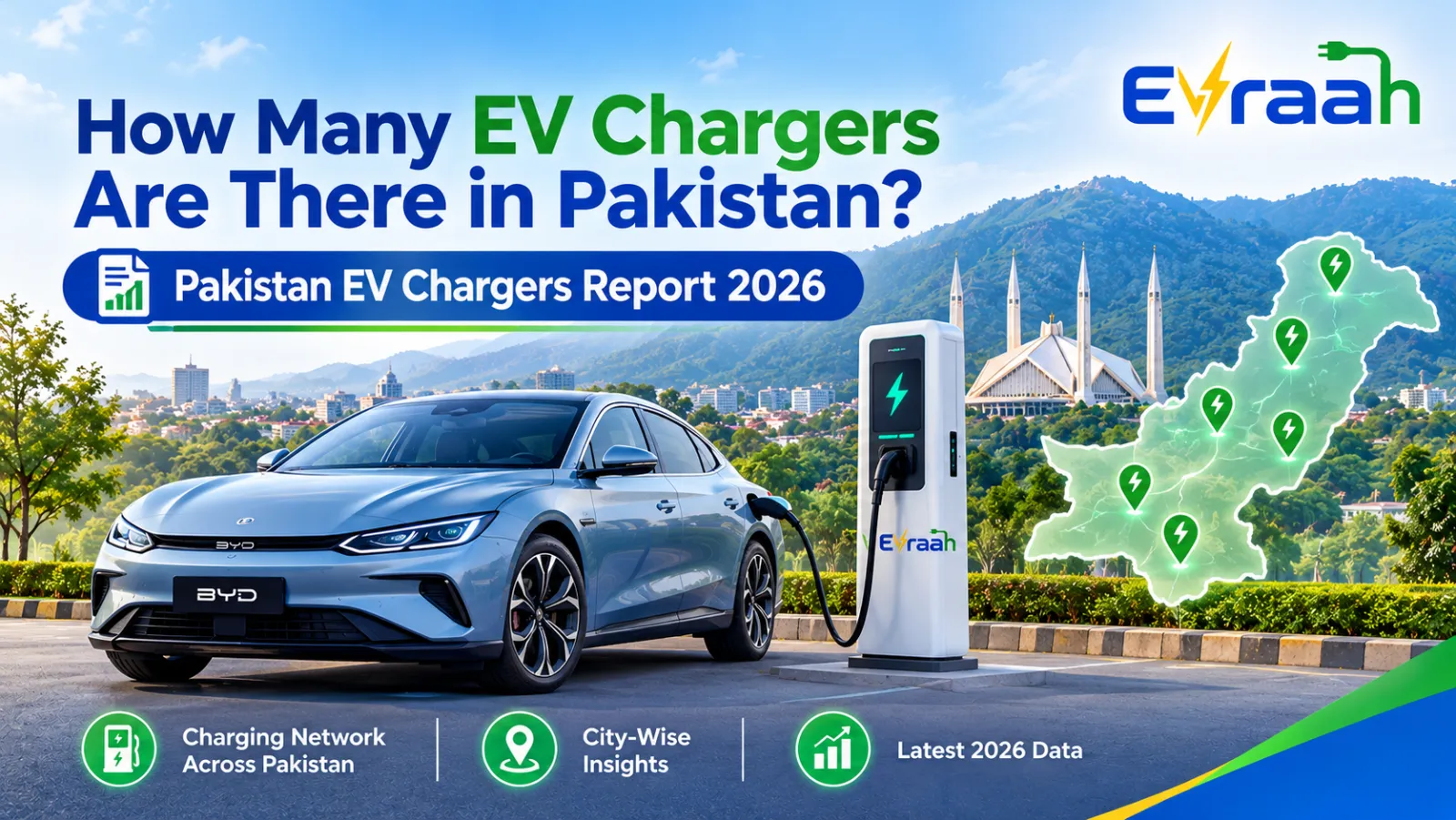
How many EV chargers are there in Pakistan? There is no single, regularly updated national count that confirms how many public chargers are installed and working. EVraah has physically checked 65 public DC charging sites. NEECA’s published list contains 233 provisional charger-registration entries after battery-swapping entries are excluded, while a third-party directory lists 104 DC entries, including 77 rated at 60 kW or above.
The figures tell different stories: EVraah’s count is based on site checks, NEECA’s is based on provisional certificates, and the directory records listings that have not been independently verified. They should not be added together or treated as a national total.
How the figures were counted
This report compares three datasets reviewed in early November 2026. They use different definitions, so each figure is useful for a different purpose.
| Source | Figure in this report | What it measures | Main limitation |
|---|---|---|---|
| EVraah station database | 65 DC sites | Public DC sites physically checked by EVraah; 134 charging bays in total | A verified dataset, but not a complete national census |
| NEECA published list | 233 charger entries; about 308 estimated units | Provisional registration records, excluding 24 battery-swapping entries | Records do not confirm that equipment is installed, operational or open to the public |
| Third-party directory | 104 DC entries; 77 rated at 60 kW or above | Directory listings, including user submissions | Unverified; includes private or unclear-access listings |
| NEECA figures reported in August 2026 | 222 facilities; 47 registered | A separate reported count of identified facilities and registered facilities | We have not reconciled these figures with the published list |
EVraah’s verified network
EVraah’s dataset contains 65 public DC fast-charging sites checked between September and October 2026. Each site is counted once, regardless of how many bays it has; together, the sites have 134 bays. Power is recorded as the maximum rated output, and prices reflect the information available when the site was checked.
This narrower count is useful for drivers looking for locations that have been checked, but it does not represent every charger in Pakistan. Visit the EVraah charging map to explore the verified sites. Operators planning new installations can also review where to install EV chargers in Pakistan.
What NEECA’s list shows
Under Pakistan’s 2024 charging infrastructure and battery-swapping regulations, charging stations are required to register with NEECA, including stations built earlier. NEECA publishes a list of EV charger and battery-swapping registrations. EVraah reviewed that list on 3 November 2026 and recounted its entries.
- 233 charger entries: the full list contains 257 entries. We excluded 24 battery-swapping entries, all identified as slot-based Eswap stations. The remaining records are not necessarily 233 unique sites; some locations may appear more than once.
- Provisional status: a certificate entry does not establish that the charger has been built, switched on, or made available to the public.
- Validity dates: 126 entries showed validity dates that had not passed on 3 November 2026; 107 showed earlier dates. Renewals may not be reflected in the published file.
- About 308 estimated units: this estimate treats a single-rated entry as one unit and expands entries that explicitly state multiple units. It excludes one entry rated in kWh and interprets one “50Kv” entry as 50 kW. A rating such as 120 kW may refer to a charger or a whole site, so the unit total is approximate.
- About 39.5 MW of calculated capacity: this is an estimate based on the ratings recorded in the list, not a measure of available public charging capacity. Two bus-depot registrations account for about 12.4 MW—roughly 31% of the calculated total.
- Registration timing is uncertain: certificate-number prefixes suggest 97 entries dated 2025 and 136 dated 2026 up to 14 September. The list has no registration-date field, so this should not be interpreted as growth in operating chargers.
For station owners, EVraah has a practical guide to registering an EV charger with NEECA.
What third-party directories add
Third party directory contains 174 charging entries across power ratings, including 104 entries labelled as DC. Of those DC entries, 77 are rated at 60 kW or above. The wider export also contains lower-power AC listings.
Directory coverage is useful as a cross-check, not as proof of public availability. About 38% of entries are marked personal or private, or have no operator listed. Some entries may also be outdated or based on driver submissions.
| Power rating | Third-party directory entries | Estimated NEECA units |
|---|---|---|
| 60 kW or above | 77 | 262 |
| Above 30 kW and below 60 kW | 8 | 20 |
| Exactly 30 kW | 13 | 6 |
| 22 kW or below | 69, including 55 at 7 kW | 20 |
| No rating listed | 7 | — |
| Total directory entries / estimated NEECA units | 174 | 308 |
Where chargers are listed
Lahore has the most sites in EVraah’s verified dataset, with Karachi and Islamabad next. NEECA’s entries also cluster in these three cities: Lahore, Karachi and Islamabad account for 112 of the 233 entries, or about 48%. The columns below are not directly interchangeable: they count verified sites, provisional registration entries and directory listings at a particular power rating.
| City or area | EVraah verified DC sites | NEECA entries | Third-party listings rated 60 kW+ |
|---|---|---|---|
| Lahore | 14 | 52 | 16 |
| Karachi | 13 | 32 | 8 |
| Islamabad | 8 | 28 | 10 |
| Faisalabad | 6 | 18 | 5 |
| Multan | 5 | 8 | 5 |
| Rawalpindi | 4 | 15 | 2 |
| Other towns and motorway sites | 15 | 80 | 31 |
| Total | 65 | 233 | 77 |
EVraah’s verified locations include the BYD charger at Pine Avenue in Lahore; Hubco at Dolmen Mall and Al-Madina CNG on the M-9 near Nooriabad; Hakla M-1 service areas, Aramco GO on Srinagar Highway and Go Green Avenue at Centaurus Mall in Islamabad; Painsra M-4 service areas near Faisalabad; and PSO Apex II near Multan. EVraah also has smaller verified coverage in Hyderabad, Sukkur, Nawabshah, Murree and Kharian.
NEECA city labels follow the published list and may not match the physical location; for example, two Bhera motorway entries are labelled Faisalabad. NEECA-attributed press figures have also reportedly placed Islamabad first with 78 chargers, but it is unclear whether that figure covers only the capital. See all EVraah city pages.
Networks and operators
Fuel-station networks are prominent in the public charging landscape. Some operate chargers themselves; others work with charging partners. Malls, vehicle brands and independent providers account for additional locations. Because the sources classify operators differently, these figures are best read as a comparison of recorded footprints—not market share.
| Operator or group | EVraah verified DC sites | NEECA entries | Third-party listings rated 60 kW+ |
|---|---|---|---|
| PSO-linked | 18 | 28 (16 standalone, 11 with Hubco, 1 with Malik) | 6 listed as PSO |
| Attock Petroleum | 7 | 16 | 2 |
| Hubco Green | 4 | Included in 11 PSO and Hubco entries | 17, including sites hosted at PSO and Attock stations |
| Shell Pakistan | 8 | 1 | 4 |
| Aramco / GO | 2 | — | 1 listed as Aramco |
| GO Petroleum | 1 | — | 1 |
| Go Green Avenue, including an affiliated Suzuki entry | Within independents | 10 | 4 |
| M-2 service areas (Indigost, Nova Spire, NHA EV Network) | Not yet checked | 5 | 4 |
| Wafi Energy Pakistan | Not classified separately | 20 | — |
| Flash / Malik Enterprise | Not classified separately | 15 | — |
| Eswap Technologies | Not classified separately | 11 | — |
| Orbit Energy | Not classified separately | — | 3 |
| Independent and other operators | 25 | Remaining entries not itemised | 35 |
By NEECA entries, the largest named groups are Wafi Energy Pakistan (20), Attock Petroleum (16), PSO standalone (16), Flash / Malik Enterprise (15), PSO and Hubco (11), and Eswap (11). Combining the three PSO-linked categories gives 28 provisional registrations and about 2.9 MW of calculated capacity. These figures do not show how often chargers are used or how much revenue operators earn. Explore the EVraah charging networks directory.
NEECA figures are provisional records grouped by the operator named in the list. EVraah classifies sites by network page, while third-party labels are unverified, so the categories do not align exactly. Eswap’s remaining 11 entries are rated 16–19.2 kW and are not labelled as swapping in the list.
Power ratings and connectors
Among EVraah’s 65 checked DC sites, the most common power ratings are 120 kW (22 sites) and 60 kW (16 sites). In NEECA’s estimated 308 units, 282 are rated above 30 kW. However, NEECA’s list has no AC/DC or connector field, so the power rating alone cannot confirm the charging technology.
CCS2 is the most common connector across EVraah’s verified sites: it appears at 63 of the 65 sites. The same dataset lists Type 2 at six sites, CHAdeMO at five, Type 1 at two and GB/T at none. Connector counts overlap because a site may offer more than one connector.
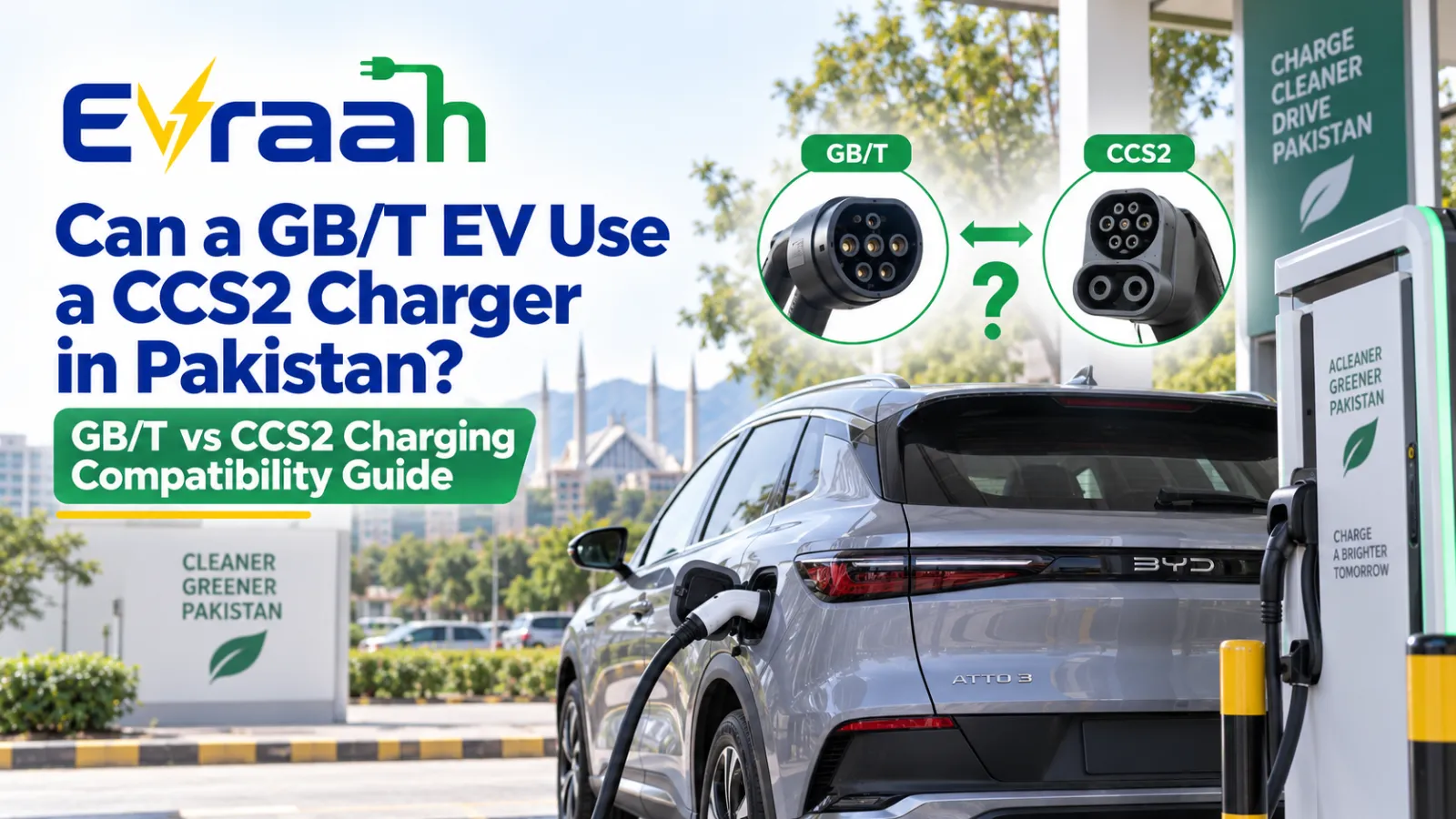
The third-party directory lists CCS2 at 112 of 174 entries, Type 2 at 62, CHAdeMO at 13 and GB/T at three. Drivers should check connector compatibility before setting out, particularly when driving an imported vehicle. See EVraah’s guides to EV charging connectors in Pakistan, cars that use CHAdeMO, and whether a GB/T car can use a CCS2 charger.
The NEECA list records three 360 kW entries: a Go Green Avenue site on the M-2 at Sukheki and two Daewoo bus depots. The motorway ratings need particular care; the third-party directory and NEECA list disagree on several M-2 sites, as detailed below.
Motorway charging: coverage and rating discrepancies
NEECA-attributed press figures reportedly count nine charging stations across the motorway network. EVraah has checked 16 listings on or just beside motorway corridors, including Hakla and Harro on the M-1; Bhera on the M-2; Painsra and Abdul Hakim on the M-4; Zahir Pir and approaches to Multan on the M-5; and Nooriabad on the M-9.
The figures are not directly comparable: EVraah counts each direction separately and includes some sites just off the motorway. For drivers, direction matters because most service-area chargers serve only one side of the road.
M-2 ultra-fast chargers: a discrepancy to check
A third-party directory lists four M-2 sites at 360 kW, while the NEECA list records corresponding sites at 240 kW. A July 2026 announcement quoted 360 kVA. EVraah has not yet physically checked these sites, so the ratings should be treated as unconfirmed until the equipment is verified.
| M-2 site | Third-party operator and rating | Listed price (PKR/kWh) | NEECA record |
|---|---|---|---|
| Chakri (Chakroi) North | Indigost; 360 kW DC | 130 | Indigost; 240 kW; validity 13 April 2026 |
| Kallar Kahar South | NHA EV Network; 360 kW DC | 120 | Indigost; 240 kW; validity 13 April 2026 |
| Kallar Kahar North | NHA EV Network; 360 kW DC | 130 | Nova Spire; 240 kW; validity 14 April 2026 |
| Sial North | NHA EV Network; 360 kW DC | 130 | Indigost; 240 kW; validity 13 April 2026 |
| Sial South | Not in third-party export | — | Nova Spire; 240 kW; validity 14 April 2026 |
Sources: third-party directory and NEECA list reviewed 3 November 2026. EVraah has not yet checked these sites. See the Lahore–Islamabad M-2 charging guide, the Karachi–Lahore charging playbook and the motorway charging guide.
How much does EV charging cost?
At EVraah-checked sites, public DC charging typically costs PKR 130–160 per kWh on motorways and PKR 80–120 per kWh in cities. The third-party directory shows a median listed price of PKR 120 per kWh for motorway DC entries and PKR 110 for DC entries in six large cities. These are listed prices, not a guaranteed quote for a future visit.
| Location | EVraah-checked typical price | Third-party directory prices |
|---|---|---|
| Motorways and service areas | PKR 130–160/kWh | Median PKR 120; range PKR 109–200, from 19 priced DC listings |
| Cities | PKR 80–120/kWh | Median PKR 110; range PKR 80–160, from 52 DC listings across six large cities |
Motorway charging often costs more, and drivers may have fewer alternatives nearby. Prices can change, so check the station details before travelling. For a fuller cost breakdown, see EV charging costs in Pakistan and the comparison of EV versus petrol running costs.
Policy targets and the pace of expansion
Pakistan’s NEV Policy 2025–30 targets 3,000 charging stations by 2030. The stated annual pathway is 240, 380, 550, 800 and 1,030 stations. The policy target is a useful benchmark, but it cannot be compared directly with the three datasets in this report because they count different things.
| Policy or regulatory measure | What the available source says |
|---|---|
| Charging-station target | 3,000 stations by 2030, with annual figures of 240, 380, 550, 800 and 1,030 |
| Motorway spacing | Official documents refer to 120 km, 105 km and 50 km spacing; the launch statement cites 105 km |
| Electricity tariff for charging stations | The Power Division announced a reduction from PKR 71 to PKR 39.70 per unit in January 2025; see the announcement and the NEPRA decision |
| Registration | The cited rules describe a one-off PKR 50,000 fee and a decision within 15 working days, alongside annual inspection fees and escalating fines |
No published count reviewed for this report clearly confirms whether the first-year target of 240 public stations for FY2025–26 was met. That does not prove the target was missed; the available counts cannot be compared cleanly. Announced plans include 46 new charging and battery-swapping facilities and a wider roadmap for 3,000 stations, while reporting identifies power connections, meters and no-objection certificates as implementation hurdles. Announcements should not be treated as completed installations.
The next annual target in the stated pathway is 380 stations for FY2026–27. Tracking progress will require a consistent register that separates planned projects from installed, operational public chargers. See EVraah’s analysis of Pakistan’s future charging network, the 2030 EV target and what the 2026–2031 EV policy may mean for buyers.
What the findings mean
For EV drivers
- In Lahore, Karachi and Islamabad, public DC charging is a useful backup, but home charging remains worth planning for where available. See the home charging guide.
- For long-distance travel, check charger availability in both directions and confirm the connector before leaving. EVraah’s route planner can help plan a route.
- Budget for higher charging prices on motorways than in cities, and check the current station price before travelling.
- Do not assume a NEECA entry means a charger is working. Check its latest verification details and contact the operator when possible.
For charging operators and investors
- Registration totals alone are not a reliable way to estimate demand. Site-level usage, uptime, public access and grid capacity are more useful for investment decisions.
- Coverage outside the largest cities and along long-distance routes remains an area to investigate, particularly where drivers have few alternatives.
- Grid connections, meters and approvals can delay projects. These constraints need to be considered alongside land, utilisation and charging equipment costs.
- Capacity figures can be skewed by large private or bus-depot installations. Public charging capacity should be reported separately from private fleet capacity.
For EV owners, the immediate issue is whether a compatible charger is available and working when needed. For policymakers and investors, the larger gap is consistent reporting: Pakistan needs data that distinguishes registered, installed, operational and publicly accessible chargers.
Find verified chargers with EVraah
Use the EVraah charging map to browse verified locations and filter by connector or network. For intercity travel, open the route planner. If you know of a charger missing from the map, submit a station so its details can be reviewed.
Frequently asked questions
How many EV chargers are there in Pakistan?
There is no confirmed live national total. EVraah has checked 65 public DC charging sites. NEECA’s published list has 233 charger-registration entries after battery-swapping entries are excluded, with about 308 estimated units. A third-party directory lists 104 DC entries, including 77 rated at 60 kW or above.
Do NEECA registrations mean the chargers are operating?
No. The published list records provisional certificates. An entry does not prove that a charger is installed, switched on or open to the public.
How many chargers are registered with NEECA?
EVraah counted 233 charger entries in NEECA’s published list after excluding 24 battery-swapping entries. A separate report in August 2026 cited 47 registered facilities out of 222 identified facilities. The figures have not been reconciled.
Which city has the most EV chargers?
Lahore leads EVraah’s verified dataset with 14 DC sites and also has the most entries in the NEECA list, with 52. These figures represent different types of records.
Are there EV chargers on Pakistan’s motorways?
EVraah has checked sites on or near the M-1, M-2, M-4, M-5 and M-9. Most service-area chargers serve one direction only, so check the location and direction before travelling.
Which connector is most common at EVraah-verified sites?
CCS2 appears at 63 of the 65 checked sites. The dataset also includes Type 2, CHAdeMO and Type 1 connectors; none of the checked sites lists GB/T.
How much does public EV charging cost in Pakistan?
At EVraah-checked sites, DC charging typically costs PKR 130–160 per kWh on motorways and PKR 80–120 per kWh in cities. Prices can change, so check the station listing before travelling.
Where are the fastest chargers in Pakistan?
A third-party directory lists M-2 service-area chargers at 360 kW, while the NEECA list shows corresponding entries at 240 kW. EVraah has not yet verified these ratings, so they should be treated as unconfirmed.
What is Pakistan’s EV charging target?
The NEV Policy 2025–30 sets a target of 3,000 charging stations by 2030.
Sources and dates: NEECA charging infrastructure and battery-swapping regulations (2024); NEECA published registration list, reviewed 3 November 2026; NEV Policy 2025–30; Power Division tariff announcement (January 2025); NEPRA decision (April 2025); EVraah station database, extract dated 2 November 2026; third-party charger directory export retrieved 2 November 2026; published reporting cited in the relevant sections. Figures reflect the datasets and dates stated in the article and may change as records are updated.
Written by
Naeem
Naeem works in research and feasibility planning by day, and writes for Evraah on the side — mostly because EVs turned out to be more interesting than he expected. With 5+ years spent digging through data and assessing what's actually viable versus what just sounds good on paper, he brings the same habit to writing about EV routes, charging networks, and where the infrastructure is realistically headed. No grand mission, just a genuine curiosity about how this space is evolving — and a quiet hope that charging a car stops being a whole ordeal someday.
Related blogs
More from Charging Guides.
You may also like
 Buying Guides
BYD Electric Car Prices in Pakistan (2026): Every Model Compared
5 min read · 29 Oct 2026
 Buying Guides
Deepal S07 Price in Pakistan (2026): Specifications, Range and Features
5 min read · 27 Oct 2026
 Buying Guides
BYD Sealion 7 Price in Pakistan 2026: Specs & Features
5 min read · 25 Oct 2026