Can a GB/T EV Use a CCS2 Charger in Pakistan? Complete Compatibility Guide
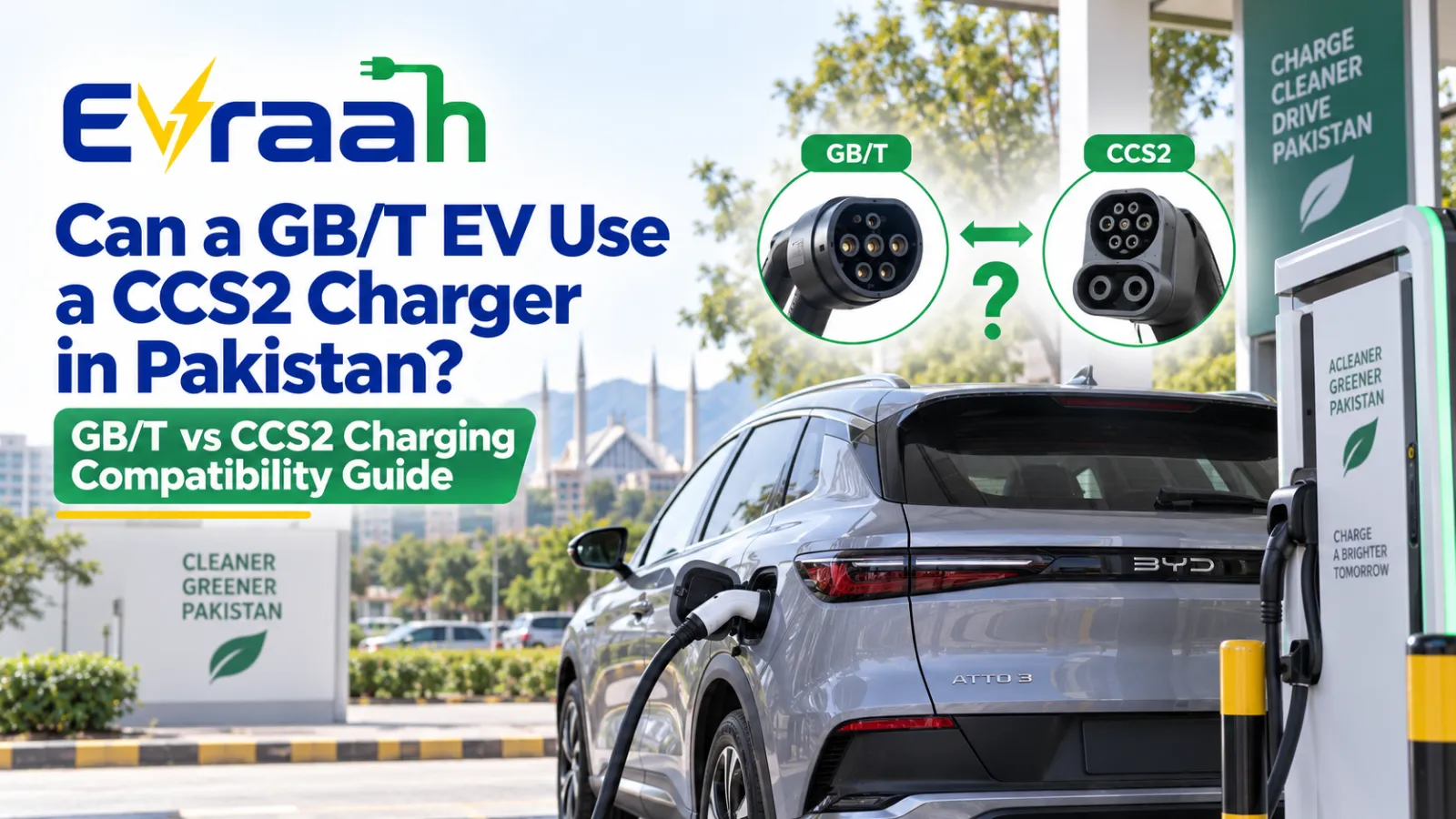
Can a GB/T EV Use a CCS2 Charger in Pakistan?
Pakistan's electric vehicle market is growing quickly, and a large number of new EV buyers are choosing Chinese electric cars because of their competitive prices, modern features, and increasing availability.
However, one technical question creates confusion among many Pakistani EV owners:
Can a Chinese electric vehicle with a GB/T charging port use a CCS2 charger in Pakistan?
The answer is not simply yes or no.
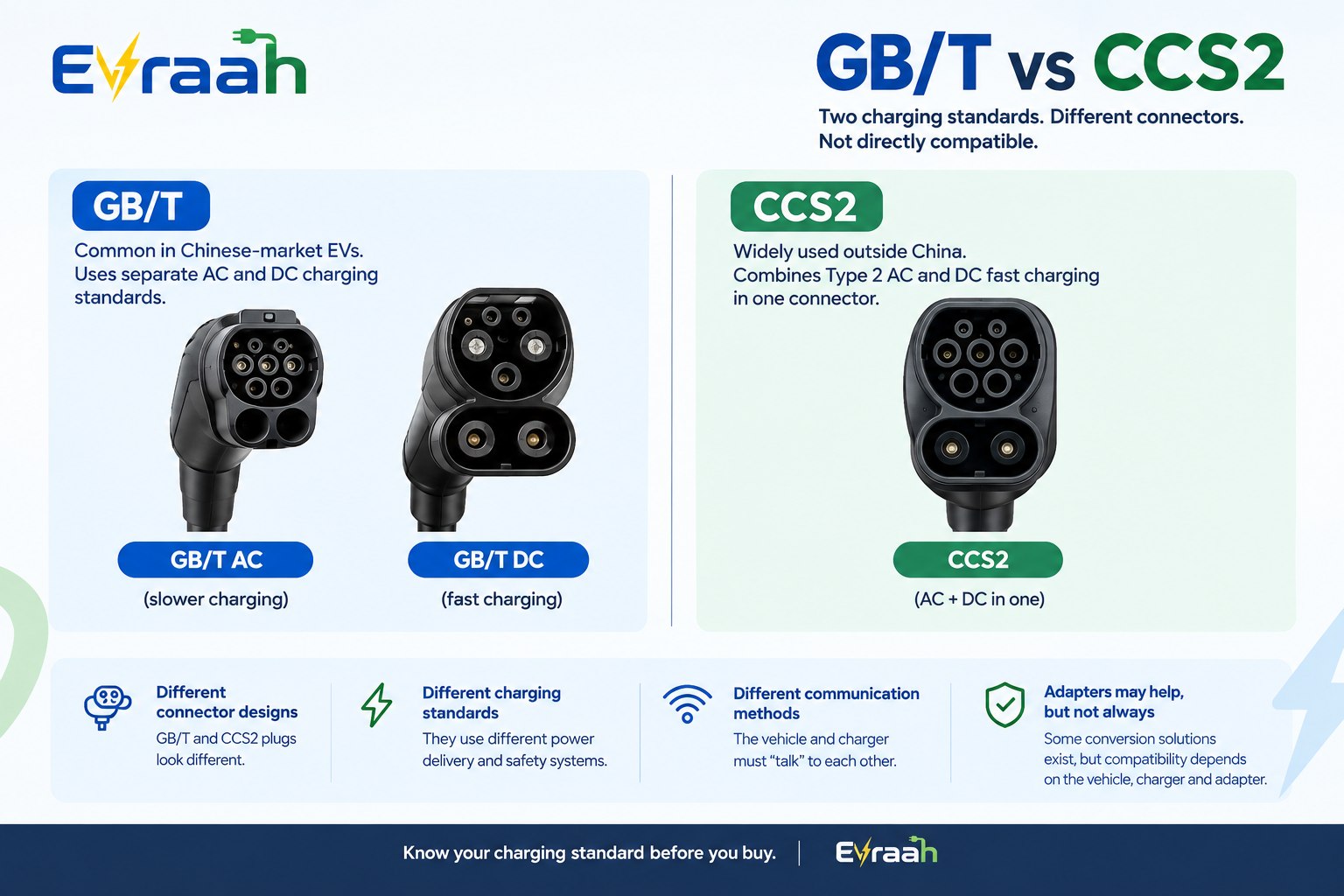
A GB/T EV usually cannot directly connect to a CCS2 charger, because both systems use different connector designs, charging standards, and communication methods. However, in some cases, specially designed conversion solutions may allow limited compatibility depending on the vehicle model, charger system, and adapter technology.
For anyone planning to buy an imported Chinese EV, understanding charging standards is just as important as checking battery range, price, and features.
Before selecting an EV, it is useful to understand the available electric cars in Pakistan and the charging technology they support.
This guide explains GB/T and CCS2 compatibility, charging connectors, adapters, and what Pakistani EV owners should know before purchasing a Chinese-market electric vehicle.
GB/T EV Quick Facts
- Common in Chinese-market EVs
- Uses separate AC and DC charging standards
- Usually needs GB/T-compatible chargers
- Direct CCS2 charging is normally unavailable
Understanding EV Charging Standards
Unlike petrol vehicles where every car uses the same fuel pump, electric vehicles use different charging standards.
An EV charging system includes:
- Physical connector design
- Electrical power delivery
- Communication between vehicle and charger
- Battery management system compatibility
A charger and vehicle must communicate before electricity starts flowing.
This means charging compatibility is not only about whether a plug physically fits.
Two connectors may look similar but still fail to charge because the vehicle and charger cannot exchange the required information.
What Is GB/T Charging?
GB/T is the electric vehicle charging standard developed in China.
It is widely used in Chinese domestic electric vehicles because China has developed one of the world's largest EV markets.
Many Chinese-market EVs use GB/T charging systems, including vehicles from manufacturers such as:
- BYD
- Geely
- Changan
- Chery
- NIO
- Great Wall Motors
However, an important point is often misunderstood:
GB/T is not one single charging connector.
There are separate standards for:
- GB/T AC charging
- GB/T DC fast charging
These systems have different purposes and technical characteristics.
GB/T AC Charging Explained
GB/T AC charging is designed for slower charging applications.
Common uses include:
- Home charging
- Office charging
- Overnight charging
With AC charging, electricity enters the vehicle as alternating current. The vehicle's onboard charger converts it into DC power that is stored inside the battery.
Charging speed depends on:
- Vehicle onboard charger capacity
- Electrical supply
- Charging equipment
For daily city driving, AC charging is often sufficient because most EV owners can recharge overnight.
Owners who install home charging should also understand the basics of home EV charging in Pakistan before setting up their charging point.
GB/T DC Fast Charging Explained
GB/T DC charging is used for faster charging.
Unlike AC charging, DC fast charging sends electricity directly to the battery system.
DC charging requires:
- Different connector hardware
- Higher power management
- Vehicle-charger communication
This is where compatibility problems appear between Chinese-market EVs and international charging networks.
A GB/T DC vehicle is designed to communicate with GB/T DC chargers.
A CCS2 charger expects a CCS2-compatible vehicle.
What Is CCS2 Charging?
CCS2 stands for:
Combined Charging System Type 2
It is one of the most widely used charging standards outside China.
CCS2 combines:
- Type 2 AC charging
- Additional DC fast charging pins
This allows one charging port design to support both normal charging and fast charging.
CCS2 is commonly used in:
- Europe
- Australia
- Middle East markets
- International EV models
Many global EV manufacturers use CCS2 because it has become a common international standard.
For Pakistani buyers, understanding EV charging connectors including CCS2, Type 2 and CHAdeMO helps avoid unexpected charging problems.
GB/T vs CCS2: Main Differences
| Feature | GB/T | CCS2 |
|---|---|---|
| Origin | China | Europe |
| AC Charging | GB/T AC | Type 2 AC |
| DC Charging | GB/T DC | CCS2 DC |
| Main Market | China | Europe & International Markets |
| Physical Connector | Different design | Different design |
| Direct Compatibility | Usually unavailable | Depends on vehicle |
The main difference is that both standards were developed separately.
A vehicle built for one system does not automatically support the other.
Can a GB/T EV Directly Use a CCS2 Charger?
Generally, No.
A GB/T electric vehicle cannot normally plug directly into a CCS2 charging station and start charging.
There are three major reasons.
1. Different Physical Connectors
The first difference is the charging port design.
A CCS2 charging gun is designed for CCS2 vehicle inlets.
A GB/T vehicle uses a different inlet configuration.
Without a compatible conversion system, the charger and vehicle cannot connect properly.
2. Different Communication Protocols
Modern EV charging requires digital communication.
Before charging begins, the charger and vehicle exchange information such as:
- Battery condition
- Required voltage
- Charging current
- Charging limits
- Battery temperature
If communication fails, charging will not begin.
This is why a simple plug converter is usually not enough.
3. Different Charging Hardware
The vehicle's charging controller and battery management system must support the charging method.
A GB/T vehicle is designed around GB/T communication requirements.
A CCS2 charger expects CCS2 communication.
Can a GB/T EV Use a CCS2 Charger With an Adapter?
This is where many EV owners become confused.
The answer is:
Sometimes, but it depends on the vehicle and adapter technology.
Some GB/T-to-CCS2 adapters are available internationally.
However, not every adapter works with every EV.
Compatibility depends on:
- Vehicle model
- Battery system
- Charging controller
- Adapter electronics
- Charger manufacturer
- Software support
A basic mechanical adapter that only changes the plug shape usually cannot solve communication differences.
Advanced adapters may include electronic conversion systems that translate communication between charging standards.
Before Buying a Chinese EV Check:
- Charging port type
- Public charger compatibility
- Home charging options
- Local service support
What Should Pakistani EV Buyers Check Before Buying a Chinese EV?
Before purchasing an imported Chinese electric car, buyers should confirm:
1. Charging Port Type
Ask:
- Does the vehicle use GB/T AC?
- Does it use GB/T DC?
- Does the export version use CCS2?
Do not assume every Chinese EV uses the same charging system.
2. Availability of Compatible Chargers
Check whether chargers available in your city support your vehicle.
EVraah's EV charging station map can help owners identify available charging locations and plan routes.
3. Home Charging Options
For many GB/T EV owners in Pakistan, home charging becomes the main solution.
Home charging works well for:
- Daily commuting
- Office travel
- City driving
GB/T EV Ownership and Public Charging in Pakistan
Pakistan's charging infrastructure is still developing.
Many public charging locations are expanding, but connector availability can vary.
Before travelling, EV owners should check:
- Charger connector type
- Location
- Charging speed
- Network availability
EV drivers can use tools such as the EV route planner to plan longer journeys with charging stops.
Why Charging Standards Matter During EV Road Trips
Charging compatibility becomes especially important during intercity travel.
Examples include:
- Lahore to Islamabad
- Karachi to Hyderabad
- Islamabad to northern areas
A petrol car can normally find fuel easily, but EV drivers need more planning.
Before a long trip, check:
- Battery percentage
- Available chargers
- Connector compatibility
- Charging time
EVraah also covers guides such as EV charging stations on Pakistan motorways to help drivers understand highway charging options.
Does GB/T Mean You Should Avoid a Chinese EV?
Not necessarily.
A GB/T EV can still be a practical choice if:
- You can charge at home
- Your daily driving distance is predictable
- You mainly drive within cities
- Service support is available
However, buyers who regularly travel long distances should carefully evaluate charging compatibility.
The charging standard should be considered alongside:
- Battery size
- Real-world range
- Warranty
- Spare parts
- Service network
Future of EV Charging Standards in Pakistan
Pakistan's EV ecosystem is still developing.
As adoption increases, charging networks may expand with:
- More CCS2 chargers
- Multi-standard charging stations
- Better support for imported EVs
Understanding charging standards today will help buyers make better decisions as the market grows.
For anyone comparing electric vehicles, resources like best electric cars in Pakistan can help compare available options.
Frequently Asked Questions
Can GB/T EV use CCS2 charger in Pakistan?
Usually, no. A GB/T EV cannot directly use a CCS2 charger because the connector design and communication systems are different. Some vehicles may support specialised conversion solutions.
Is GB/T the same as CCS2?
No. GB/T and CCS2 are different EV charging standards developed for different markets.
Can a GB/T to CCS2 adapter work?
Some adapters may work with specific vehicles, but compatibility depends on the vehicle model, charging hardware, and adapter technology.
Do all Chinese electric cars use GB/T?
No. Chinese manufacturers also produce export vehicles with CCS2 charging systems depending on the destination market.
Is home charging better for GB/T EV owners in Pakistan?
For many owners, yes. Home charging provides a reliable option for daily commuting without depending on public charging infrastructure.
Key Ownership Reminder
Battery range and features matter, but charging compatibility can decide how convenient an EV is in daily use.
Best Practice
Confirm the charging standard before purchase instead of assuming every Chinese EV supports the same charger.
Final Thoughts
The question "Can a GB/T EV use a CCS2 charger in Pakistan?" requires more than a simple yes or no answer.
GB/T and CCS2 are different charging ecosystems. A GB/T EV generally cannot directly use a CCS2 charger because of differences in connector design, communication protocols, and charging hardware.
For Pakistani buyers considering a Chinese electric vehicle, checking the charging standard before purchase is essential.
A vehicle's battery range and features matter, but charging compatibility can determine how convenient EV ownership becomes.
As Pakistan's EV infrastructure grows, understanding charging standards will help owners choose vehicles that match their driving needs and charging environment.
Written by
Shams
Shams is the dev quietly keeping Evraah's routes calculating and chargers actually showing up on the map — no pressure, just the entire backend. By day (and honestly most nights) he's deep in code, breaking things to understand them, then fixing them before anyone notices. He also writes for Evraah on the tech side of EVs — routing logic, real-time data, and why "smart" charging is 10x harder to build than it looks. Powered by caffeine, dark mode, and a mild personality clash with every third-party API he's ever integrated.
Related blogs
More from Charging Guides.
EV Chargers in Islamabad: Locations, Costs & Complete Guide
Best Places to Install EV Chargers in Pakistan: A Business & Investment Guide
EV Chargers in Lahore: Locations, Charging Networks, Costs & 2026 Guide
You may also like
 Buying Guides
Deepal S07 vs BYD Sealion 7: Detailed Comparison for Pakistan
5 min read · 20 Sept 2026
 Buying Guides
BYD Atto 2 vs MG4 Urban: Price, Range, Features & Which EV Makes More Sense in Pakistan?
6 min read · 19 Sept 2026
 EV Basics
EV Maintenance Cost in Pakistan 2026: Complete Service & Repair Guide
6 min read · 18 Sept 2026