
Fast Charging vs Slow Charging: Which Is Better for Your EV?
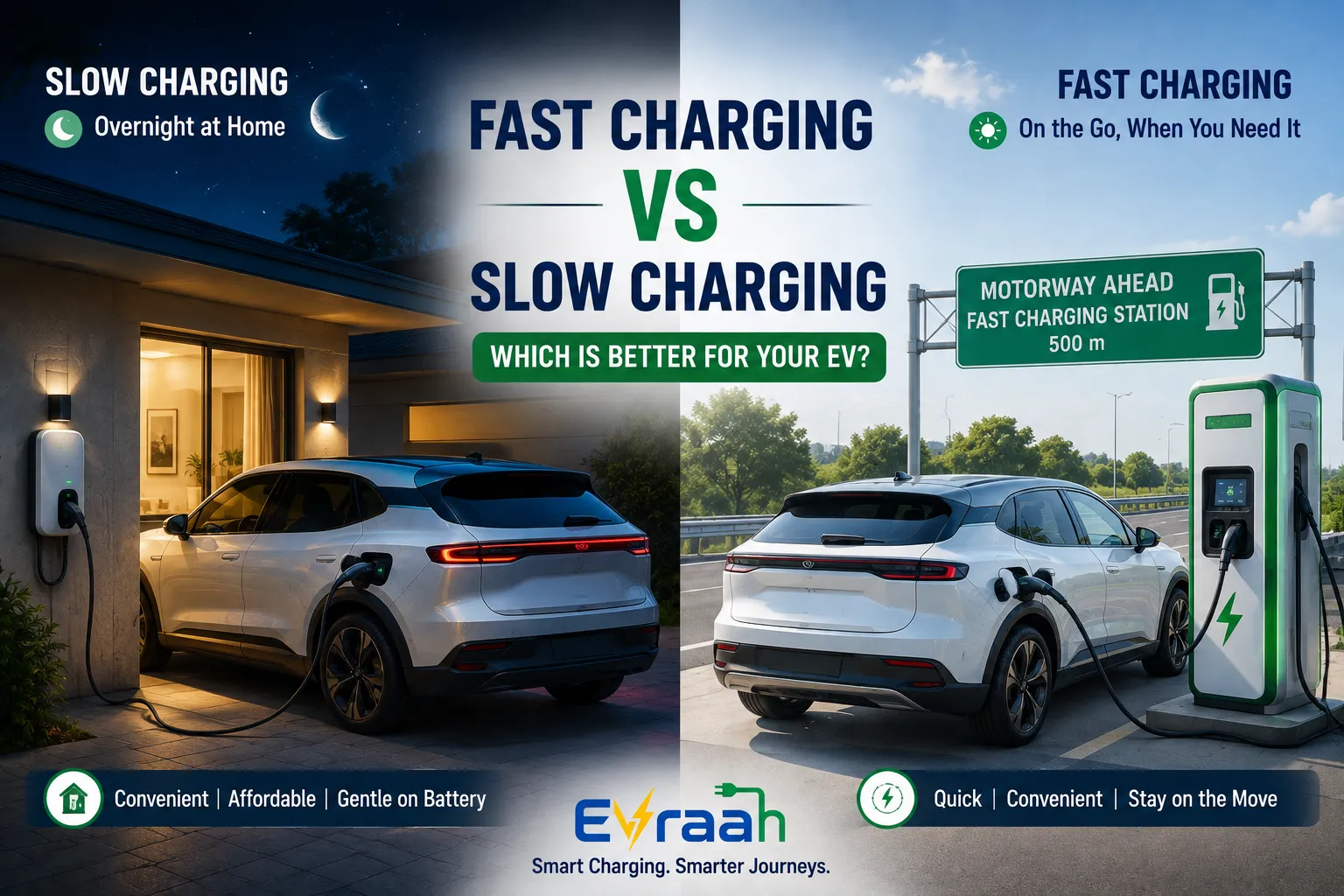
You arrive home after work with 40% battery left. The car will sit in the driveway all night, so there is no urgency. A few days later, you are driving from Lahore to Islamabad and want to spend as little time as possible at a charging stop. The same EV now has two very different charging needs.
That is the simplest way to understand fast charging vs slow charging: neither is automatically better. Slow AC charging usually fits daily life because the car is parked for hours anyway. DC fast charging is valuable when waiting matters, especially on motorway and intercity journeys.
For Pakistani EV owners, the right choice also depends on home parking, electricity supply, public-charger availability, weather and the routes you regularly drive. This guide explains how both methods work, what they cost, how they may affect battery health and when each one makes sense.
What Is Fast EV Charging?
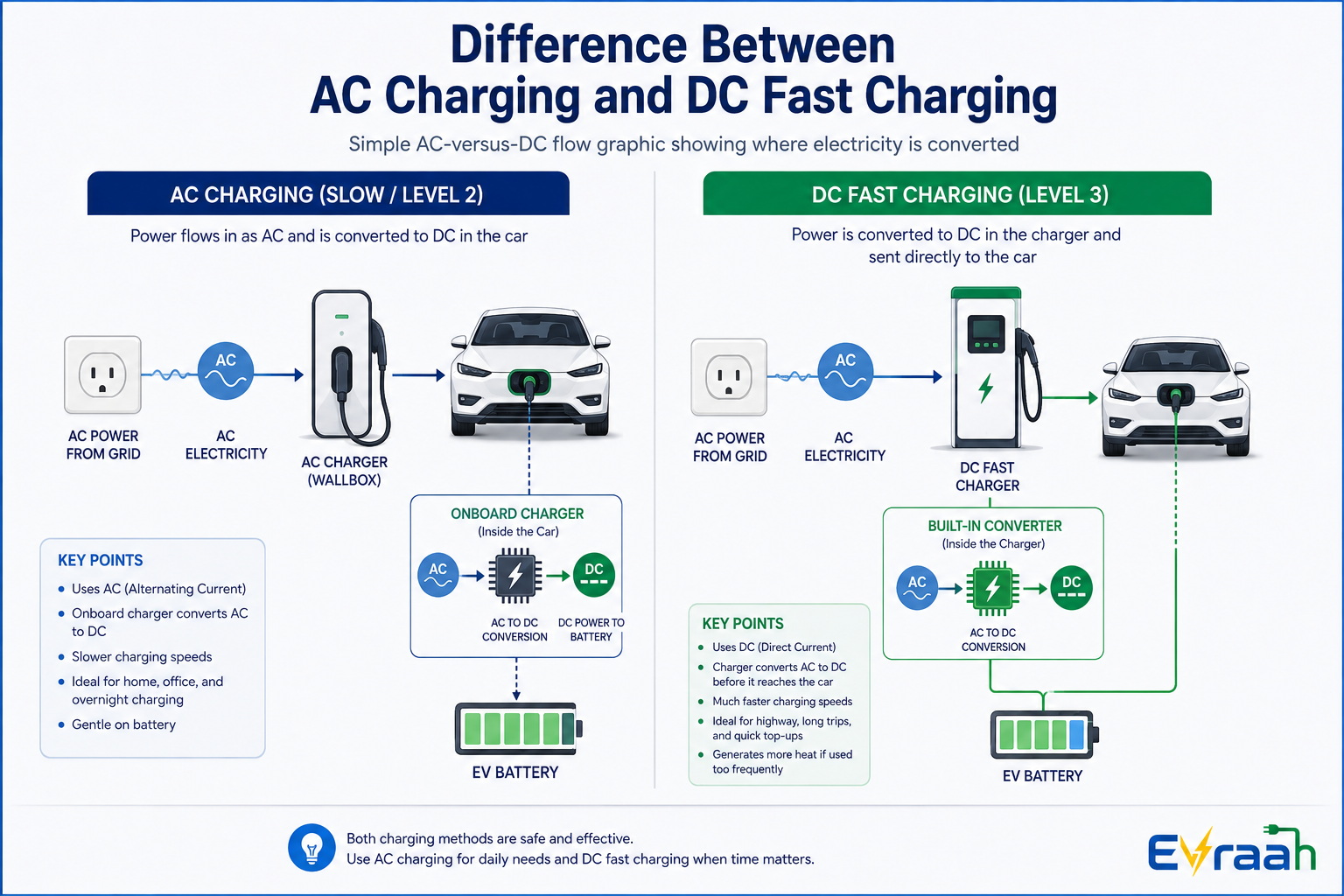
Fast EV charging usually refers to DC fast charging. Electricity from the grid is converted to direct current inside the charging station and delivered to the battery. This bypasses the car’s onboard AC charger, allowing the station to provide much more power than a typical home setup.
The number printed on a charger is only its maximum output. A vehicle will not automatically take the full amount. The actual charging speed is limited by whichever is lower: the charger’s available power or the car’s maximum DC charging capability. Battery temperature, state of charge and the vehicle’s charging curve also affect the result.
Charging is often quickest when the battery is at a lower or middle state of charge. As it fills, the car usually reduces power to manage heat and protect the cells. This is why the final part of a fast-charging session can take disproportionately longer than the earlier part.
DC fast charging is most useful when:
- You are travelling between cities.
- You need to continue a journey soon.
- You do not have dependable home or workplace charging.
- A quick top-up can comfortably get you to your destination or next charger.
The U.S. Department of Energy’s charging guide also treats DC charging as the highest-power public option, but exact charging time varies widely by vehicle and station.
What Is Slow EV Charging?
“Slow charging” generally means charging through an AC supply. The charger provides alternating current, and the vehicle’s onboard charger converts it into the direct current stored in the battery.
AC charging covers more than one speed. A basic portable charger connected to a suitable outlet may add energy slowly, while a dedicated wall charger can provide substantially more power. In both cases, the vehicle’s onboard AC charger sets the maximum it can accept.
This method works well at home, at an office or anywhere the car remains parked for several hours. The important question is not, “How quickly can the car charge?” but, “Will it have enough energy by the time I need it?”
For many drivers, plugging in after the evening commute and leaving with the required charge the next morning is more convenient than making a separate visit to a public station. Any home charger should be installed on an appropriate circuit by a qualified electrician; high-power charging is not a job for an improvised extension lead.
Fast Charging vs Slow Charging: Key Differences
| Factor | Slow AC charging | DC fast charging |
|---|---|---|
| Charging speed | Lower; designed for longer parking periods | Higher; designed for shorter stops |
| Common locations | Homes, offices, hotels and some public car parks | Motorways, highways, service areas and urban charging hubs |
| Typical use | Routine charging while parked | Road trips, urgent top-ups and drivers without home charging |
| Vehicle limit | Onboard AC charger capacity | Maximum DC charge rate and charging curve |
| Convenience | High when the car can remain plugged in | High when the driver needs energy quickly |
| Cost | Often lower at home, depending on the applicable tariff | Often higher because the operator must recover equipment, site and service costs |
| Battery considerations | Lower charging power generally produces less charging heat | Repeated high-power charging can create more heat and battery stress, depending on the vehicle and conditions |
| Installation | Home equipment requires suitable wiring, protection and professional installation | Large commercial equipment and electrical infrastructure |
| Best use case | Daily commuting and overnight or workplace charging | Long-distance travel and time-sensitive charging |
Does Fast Charging Damage an EV Battery?
Occasional fast charging does not automatically damage an EV battery. Modern EVs use a battery management system to monitor temperature, voltage and charging power. The car can reduce the rate when conditions are not suitable.
The more accurate concern is long-term stress. High charging power can generate additional heat, and heat is one of the factors associated with battery ageing. Research on fast-charging cells also identifies mechanisms such as lithium plating as a challenge when charging conditions are too aggressive. Vehicle cooling systems, battery chemistry and charging controls are therefore important.
In Pakistan’s summer heat, thermal management deserves particular attention. A hot battery may charge more slowly because the vehicle is protecting itself. Some EVs can precondition the battery before a fast-charging stop; others manage temperature automatically once connected. Follow the instructions for your model rather than applying a universal rule from another vehicle.
Using a fast charger on an occasional motorway journey is different from depending on high-power DC charging for nearly every session. If home or office AC charging is practical, it is usually a sensible routine, with fast charging kept available for days when speed matters. That approach is also consistent with manufacturer guidance such as Tesla’s battery-health advice, although the correct charging limit and routine depend on battery chemistry and the manufacturer.
Slow charging does not stop battery degradation. Batteries age with time and use regardless of charging method. The aim is to avoid unnecessary stress, not to treat normal charging as something dangerous.
Which Is Cheaper: Fast or Slow Charging?
Home AC charging is often the lower-cost option because you pay the applicable household electricity tariff rather than a public charging service price. The actual cost will depend on your tariff, taxes, time of use if relevant, charging losses and how much energy the battery receives.
Public AC charging may be priced differently. A property may charge per kilowatt-hour, per session, by parking time or as part of another service. Some sites may provide charging as an amenity, but drivers should confirm the terms rather than assume it is free.
Public DC fast charging often costs more because the operator must pay for high-power equipment, electrical upgrades, site rent, maintenance, software, payment processing and customer support. Pricing can also vary by location and charging network.
A simple comparison uses this formula:
Estimated charging cost = energy added in kWh × applicable price per kWh
Allow for charging losses when comparing the energy drawn from the grid with the increase shown in the battery. If an operator uses session or time-based fees, include those as well.
Fast Charging in Pakistan: What Drivers Should Consider
The practical value of DC fast charging in Pakistan is strongest on intercity routes. A driver moving between Karachi and Hyderabad, Lahore and Islamabad, or other major cities needs charging in the right place—not simply somewhere within the destination city.
Public infrastructure is developing, but availability can differ by route. A station listing does not guarantee that the charger is operating, accessible, unoccupied or compatible with the vehicle. Before starting a long trip:
- Verify the charger’s location and access hours.
- Check the connector required by your EV.
- Confirm the charger’s current operating status where possible.
- Identify an alternative charging stop.
- Leave enough battery reserve to handle a detour or unavailable charger.
- Expect charging speed to change in very hot conditions or at a high state of charge.
EVraah can help drivers discover EV charging options and plan journeys around Pakistan. For motorway travel, use route planning as a live pre-trip task rather than relying on a station list saved months earlier.
How Long Does an EV Take to Charge?
There is no universal EV charging time. Six factors matter most:
- Battery size: A larger battery needs more energy for the same percentage increase.
- Starting charge: Adding energy from 20% to 60% is not the same task as charging from 20% to 100%.
- Charger power: A higher-rated charger may supply more power, but only if the car can accept it.
- Vehicle capability: The onboard AC charger and DC charge limit are vehicle-specific.
- Temperature: A very hot or cold battery may charge more slowly while the car manages temperature.
- Charging curve: DC power normally changes during the session and often tapers as the battery fills.
Consider a simplified example. Raising a 60 kWh battery from 20% to 80% means adding about 36 kWh before accounting for losses. At an ideal, constant 7 kW, that energy would take a little over five hours. At an ideal, constant 60 kW, it would take about 36 minutes. Real sessions take longer because power is not always constant and some energy is lost during charging.
This example is useful for understanding the calculation, not predicting a specific car. Always check the charging specifications and real-world behaviour of the model you drive or plan to buy.
Which Charging Method Fits Your Routine?
Daily city commute
If the car covers a manageable daily distance and can remain plugged in overnight, AC charging is usually the easiest option. You may only need to replace the energy used that day rather than charge from low to full.
Homeowner with private parking
A properly installed home charger offers the most control. You can schedule charging, monitor energy use and start most mornings with the charge level you need.
Apartment resident
The best option depends on parking access and building approval. A shared AC charger at home or work may be more practical than relying on DC charging, but some residents will need public charging until building infrastructure improves.
Office charging
AC charging suits a car parked through the working day. Even a moderate rate can add useful range over several hours without requiring a special trip.
Weekend and motorway travel
Start with sufficient charge from home when possible, then use DC fast charging for efficient top-ups along the route. Charging only as much as needed to reach the next reliable stop or destination can be quicker than waiting for a very high percentage.
No access to home charging
A mix may work best: slower public or workplace AC charging when the car will be parked, and DC fast charging when time is limited. Compare convenience and total cost before choosing an EV, because public charging will be central to the ownership experience.
How to Charge an EV Efficiently
- Charge while the car would otherwise be parked, such as overnight or during work.
- Use DC fast charging when it saves meaningful journey time, not simply because it is available.
- Plan long trips before departure and verify each public charging stop.
- Keep enough reserve to reach a backup charger if the primary site is unavailable.
- Check connector compatibility and the vehicle’s AC and DC charging limits.
- Compare total charging cost, including parking, session or time-based fees.
- Avoid leaving the vehicle at a very low or very high state of charge for extended periods if the manufacturer advises against it.
- Follow the charging-limit and battery-care guidance written for your specific model.
Fast Charging vs Slow Charging: Which Should You Choose?
For most EV owners, the answer is both.
Use slow AC charging for the ordinary rhythm of daily driving: at home overnight, at the office or anywhere the car will remain parked. Use DC fast charging when it solves a real time or distance problem, particularly during intercity and motorway travel.
The best setup is not the one with the highest number on the charger. It is the one that gives you enough energy, at the right time and place, without unnecessary cost or inconvenience.
Frequently Asked Questions
Is fast charging bad for EV batteries?
Not automatically. Occasional DC fast charging is a normal use case, but frequent high-power charging can add heat and stress. Follow the manufacturer’s guidance for your vehicle.
Is slow charging better for battery health?
Lower-power AC charging generally creates less charging heat, making it a sensible routine when practical. It does not prevent normal battery ageing.
Is fast charging more expensive?
It often costs more than home charging because public operators must recover equipment, site and service costs. Actual pricing varies by operator and location.
Can I charge an EV at home in Pakistan?
Yes, if you have suitable parking and a safe electrical installation. Ask a qualified electrician to assess the circuit and install any dedicated equipment.
How long does an EV take to charge?
It depends on battery size, starting charge, charger power, vehicle capability, temperature and the charging curve. There is no single time for every EV.
Can I use fast charging every day?
Some drivers do, but it may cost more and can expose the battery to more heat. Use AC charging when convenient and follow the vehicle maker’s recommendations.
Which charging method is best for long-distance travel?
DC fast charging is normally the practical choice during a long trip. AC charging is useful before departure, at the destination or during an overnight stay.
What is the difference between AC and DC charging?
With AC charging, the car’s onboard charger converts electricity for the battery. A DC fast charger performs that conversion in the station and supplies DC power directly to the vehicle.
A Practical Charging Strategy for Pakistani EV Drivers
Fast and slow charging are tools for different moments. AC charging usually offers the most convenient routine when a car stays parked for hours. DC fast charging makes electric travel more flexible when the journey cannot wait.
Build your routine around where the car naturally sits, keep fast charging available for longer trips, and follow the battery guidance for your model. Before travelling, use EVraah to explore charging options, check the route and plan a backup stop.
Related blogs
More from EV Basics.
WLTP vs NEDC vs CLTC vs EPA: EV Range Explained for Pakistan
EV Maintenance Cost in Pakistan 2026: Complete Service & Repair Guide
EV Battery Guide for Pakistan: Lifespan, Degradation, Charging & Replacement Cost
You may also like
 Pakistan EV News
Should You Buy an EV in Pakistan Now or Wait for the 2026–31 Auto Policy?
6 min read · 4 Oct 2026
 Charging Guides
10 EV Charging Tips for New Drivers in Pakistan
5 min read · 30 Sept 2026
 Charging Guides
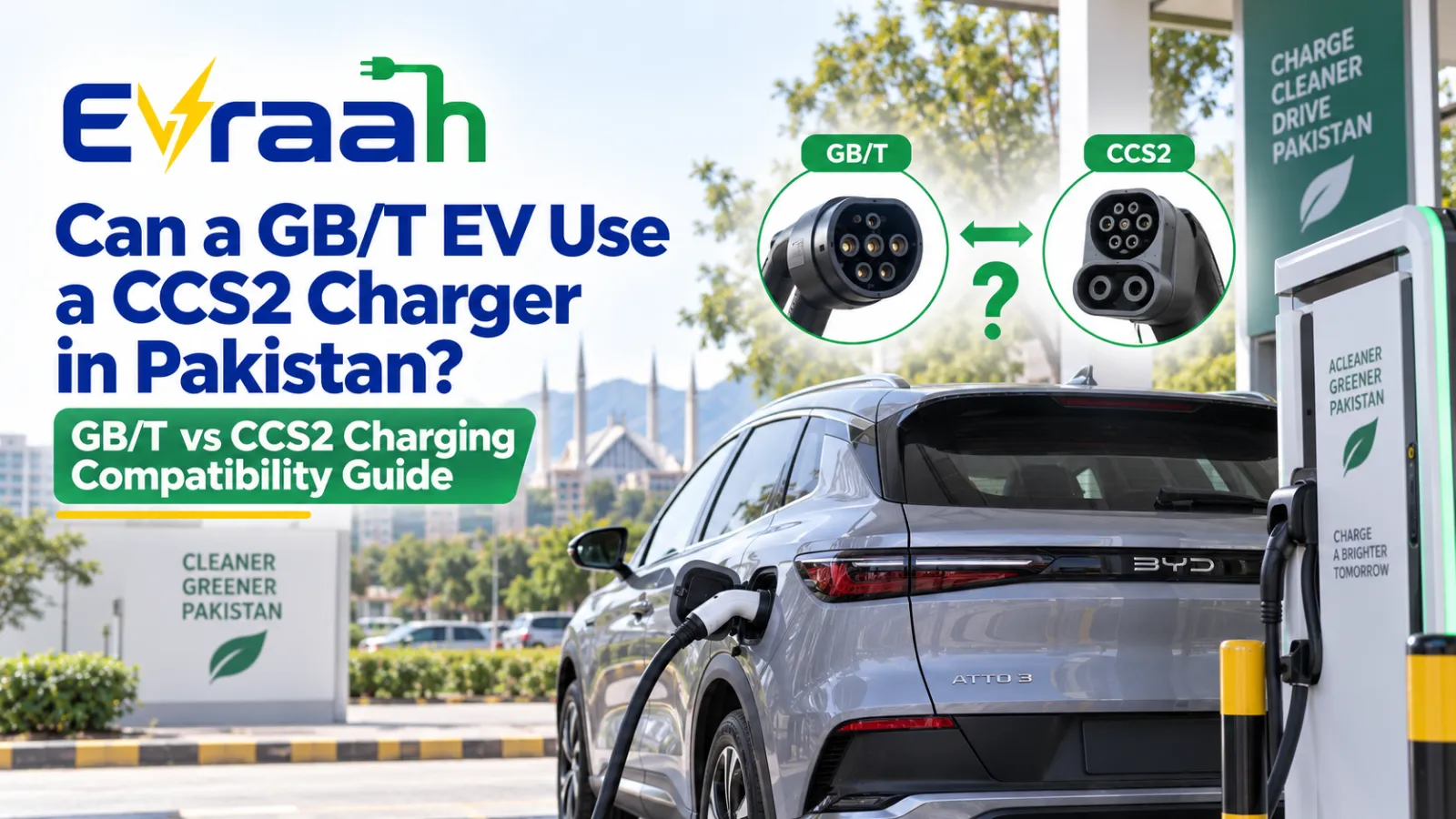
Can a GB/T EV Use a CCS2 Charger in Pakistan? Complete Compatibility Guide
5 min read · 22 Sept 2026