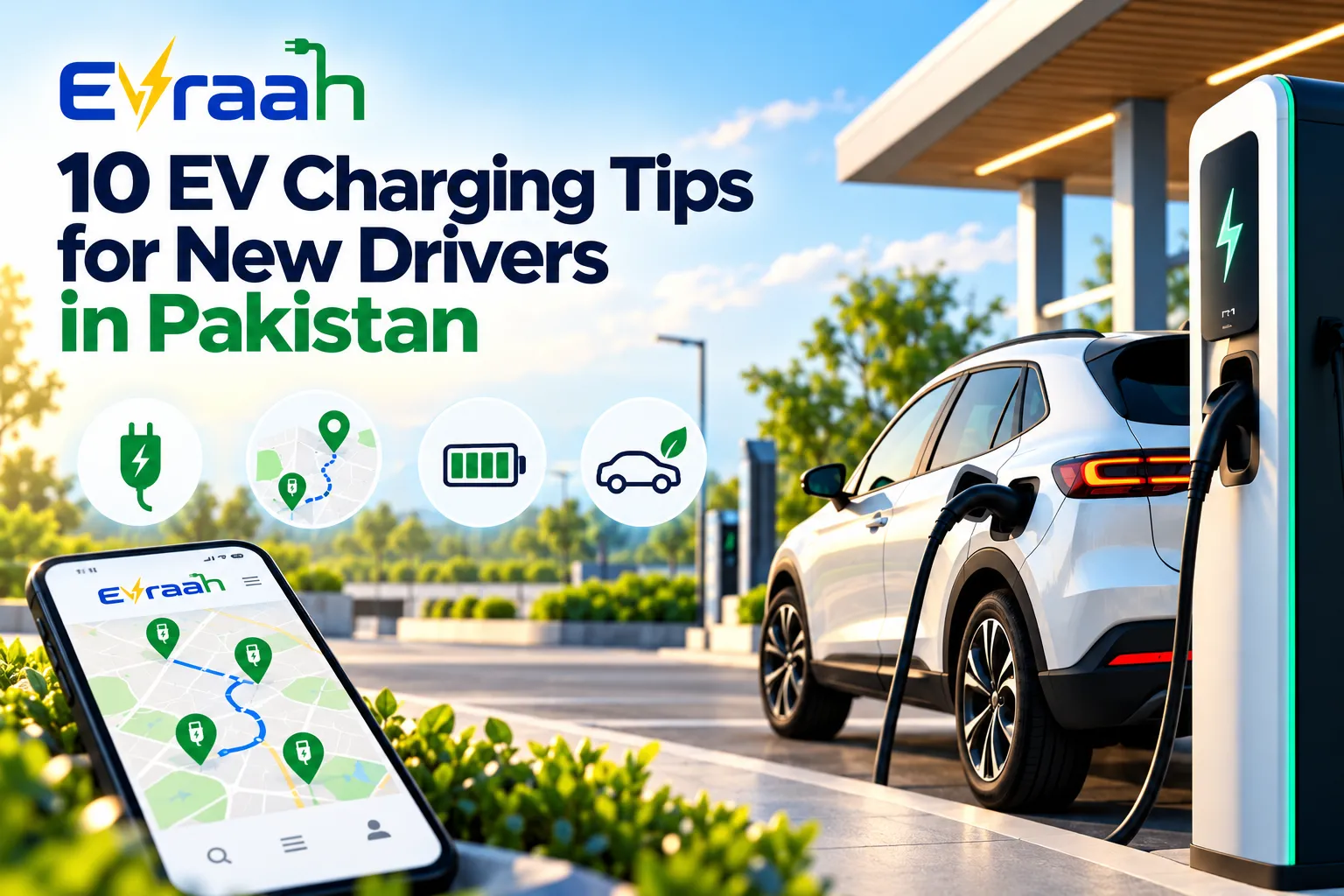
10 EV Charging Tips for New Drivers in Pakistan
Quick answer
If you've just bought your first EV in Pakistan, focus on four things: plan your charging stops before you leave, know which connector your car uses, find verified public chargers instead of guessing, and charge smartly so you spend less time plugged in. EVraah, Pakistan's EV charging station locator and route planner, helps with all four.
Switching to an electric vehicle in Pakistan gets more practical every month, with more models on the road and more public chargers appearing in cities and along motorways. But charging works differently from filling up with petrol, and new drivers tend to trip up on the same handful of things: where to plug in, which connector fits, what it will cost and whether the charger will be free when they arrive.
These 10 tips cover what Pakistani EV owners should know to make charging smooth, whether you're commuting in Karachi, driving between Lahore and Islamabad, or heading north for a weekend.
In this guide
- 1. Plan your route before you leave
- 2. Know your EV's range and charging limit
- 3. Know your connector type
- 4. Find verified charging stations
- 5. Charge at home when possible
- 6. Don't charge to 100% every day
- 7. Understand AC vs DC charging
- 8. Drive efficiently
- 9. Charge, don't park
- 10. Master EV charging etiquette
1. Plan your route before you leave
This is the single most important habit for a new EV driver. Pakistan's public charging network is growing, but it is not as dense as the petrol station network. Whether you're driving within a city, taking the M-2 between Lahore and Islamabad or heading toward the hills, planning your stops in advance prevents detours and range anxiety.
The EVraah Route Planner helps you work out where to charge along your trip before you're on the road, rather than hoping a charger turns up.
- Check the charging stations along your route before leaving
- Pick at least one backup stop in case your first choice is busy or out of service
- Prefer shorter top-ups, for example from a low battery to around 80%, over waiting for a full 100% at every stop
2. Know your EV's range and charging limit
Every EV has two numbers worth knowing: how far it goes on a full battery, and the fastest it can charge. Real-world range is usually lower than the brochure figure, especially at motorway speeds, with the AC running or with a full car.
- Battery size: a larger battery generally means more range between stops
- DC charging limit: if your car can only accept a certain DC rate, a more powerful charger will not charge it any faster
- Onboard AC charger: your car's AC limit works the same way. A higher-rated AC charger cannot push more power than your car's onboard charger accepts
The slower of the car and the charger sets the pace. Check your owner's manual for both figures, and see our guide on how long it takes to charge an EV in Pakistan for more detail.
3. Know your connector type
Not every plug fits every car. Connector standards vary between manufacturers, so confirm which one your EV uses before you drive to a station.
| Connector | Type of charging | Good to know |
|---|---|---|
| Type 2 | AC | Standard for home wallboxes and public AC chargers |
| CCS2 | DC fast (also carries AC) | Common on modern EVs and public fast chargers |
| GB/T | AC and DC | Used by many Chinese-standard vehicles and not directly interchangeable with CCS2 |
| CHAdeMO | DC fast | Mostly found on older imported models |
4. Find verified charging stations
Pakistan's charging landscape includes several operators, among them PSO EV Charging, Shell Recharge, HUBCO Green, GO/Aramco and Attock Petroleum, each with its own stations, app and pricing. The EVraah map brings verified stations together in one place, and the networks directory helps you compare operators.
Exploring a specific area? Start with the city pages for Karachi, Islamabad and Lahore, or browse the full cities directory. Whichever station you choose, confirm the connector and check the operator's current price before you arrive.
5. Charge at home when possible
Home charging is the most practical and usually the cheapest option for routine EV use. Plug in overnight and you'll leave with a full battery most mornings, with no queue and no detour. What you pay depends on your electricity tariff, so check your own bill.
Curious what home charging actually costs? See our EV charging cost guide.
6. Don't charge to 100% every day
For daily driving, charging to around 80% is generally recommended for lithium-ion battery health. It also leaves room for regenerative braking to store captured energy.
- Charge to about 80% for routine use
- Charge to 100% before a long intercity or motorway trip when you need maximum range
- On DC fast chargers, charging slows as the battery fills, so stopping near 80% and driving on is usually faster overall
- Follow your manufacturer's guidance for your specific vehicle and battery chemistry
7. Understand AC vs DC charging
| Charging type | Speed | Best for |
|---|---|---|
| Home AC wallbox | Slower, gentle on the battery | Overnight routine charging |
| Public AC | Moderate | Workplace or destination charging while you shop or eat |
| DC fast charger | Fastest | Motorway trips and quick top-ups |
Use AC for everyday charging and save DC fast charging for when you need energy quickly. Occasional DC fast charging is normal and is what the technology is designed for, but follow your manufacturer's guidance. Our charging time guide explains how long each type takes.
8. Drive efficiently to maximise range
- Accelerate smoothly and avoid harsh braking
- Use eco mode where available
- Keep your tyres properly inflated, because under-inflated tyres waste energy
- Use regenerative braking in stop-and-go traffic in cities like Lahore and Karachi
- In Pakistan's summer heat, remember that air conditioning also draws power, so build extra margin into longer trips
9. Charge, don't park
Charging bays are for cars that are actively charging. Don't park in one because it's convenient, even if you drive an EV, and free the bay as soon as your session is done.
- Return to your car before charging finishes so you can move on quickly
- Set a phone timer if you're charging while running errands or eating
This matters even more while public chargers are limited compared with the number of EVs on the road.
10. Master EV charging etiquette
As more EVs join Pakistani roads, demand at public chargers will grow. A few simple habits keep charging working for everyone:
- Don't stay plugged in longer than you need
- Never unplug another driver's vehicle without permission
- If someone is waiting, wrap up promptly
- Have a backup station in mind so you're not stuck if the first one is busy
Plan your next EV journey with EVraah
Whether you're charging overnight at home or planning the Lahore–Islamabad motorway run, EVraah helps you find charging stations across Pakistan, compare networks and plan your route before you leave.
Open the charging map Plan a routeFrequently asked questions
How do I find EV charging stations in Pakistan?
Use the EVraah map to find verified stations, then use the route planner to plan stops before you leave.
Can I charge my EV at home in Pakistan?
Yes. A properly installed wallbox on a dedicated, earthed circuit is the best way to charge at home, and many drivers charge overnight. Avoid extension leads and shared sockets.
How much does public EV charging cost in Pakistan?
It depends on the operator. Older flat-rate figures such as Rs 94/kWh are outdated after NEPRA deregulation in April 2025, so check the network's current rate. Our charging cost guide explains how pricing works.
What connector does my EV use?
Common standards include Type 2 for AC, and CCS2, GB/T or CHAdeMO for DC. It depends on your model, so check your manual and read our GB/T and CCS2 compatibility guide.
Should I charge my EV to 100% every day?
For daily use, around 80% is generally recommended for battery health. Charge to 100% before long journeys when you need maximum range, and follow your manufacturer's guidance.
Is DC fast charging bad for my battery?
Occasional DC fast charging is normal and is what the technology is designed for. For everyday charging, slower AC is gentler, so save DC for trips and quick top-ups.
Written by
Naeem
Naeem works in research and feasibility planning by day, and writes for Evraah on the side — mostly because EVs turned out to be more interesting than he expected. With 5+ years spent digging through data and assessing what's actually viable versus what just sounds good on paper, he brings the same habit to writing about EV routes, charging networks, and where the infrastructure is realistically headed. No grand mission, just a genuine curiosity about how this space is evolving — and a quiet hope that charging a car stops being a whole ordeal someday.
Related blogs
More from Charging Guides.
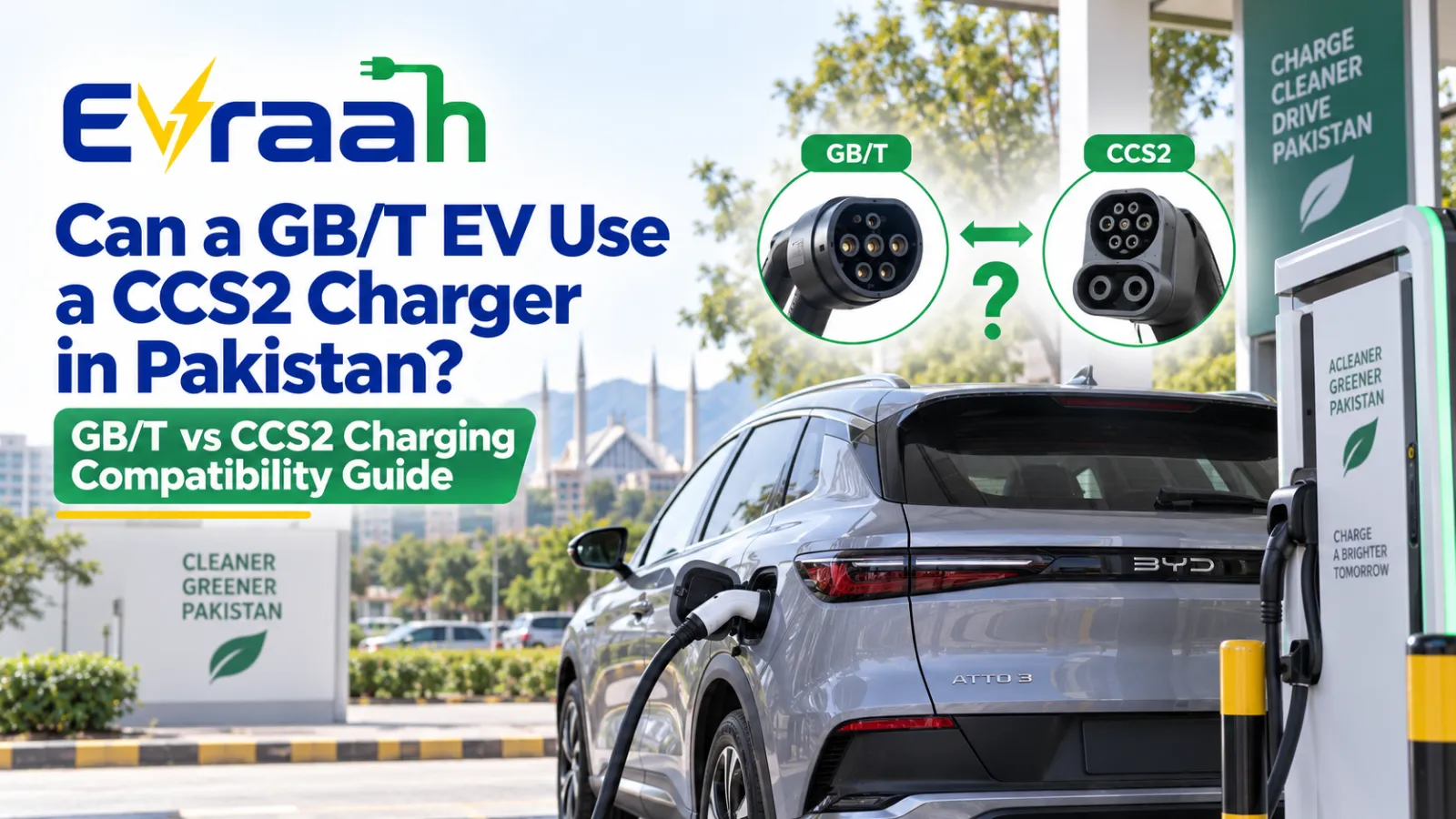
Can a GB/T EV Use a CCS2 Charger in Pakistan? Complete Compatibility Guide
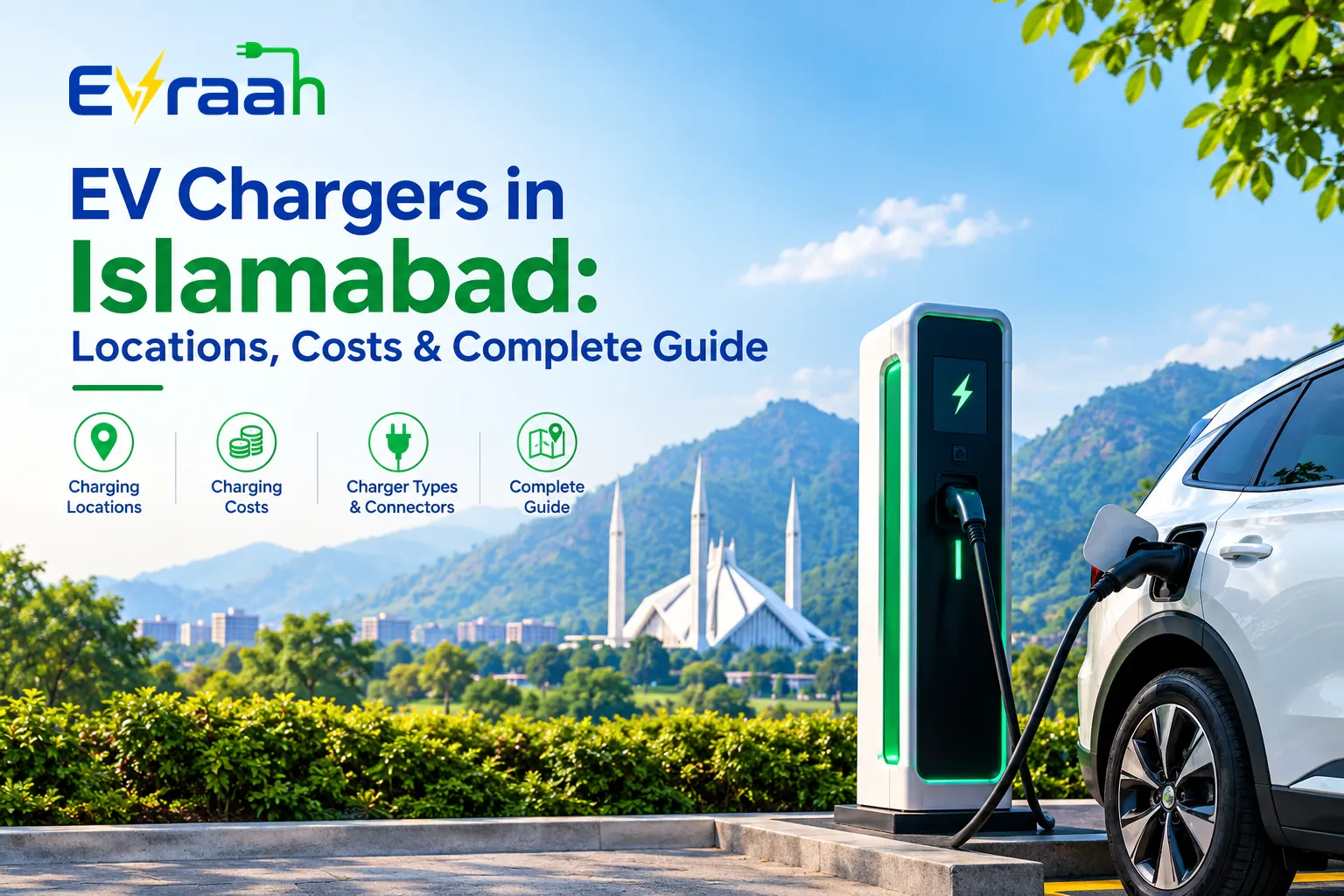
EV Chargers in Islamabad: Locations, Costs & Complete Guide
Best Places to Install EV Chargers in Pakistan: A Business & Investment Guide
You may also like
 Buying Guides
Deepal S07 vs BYD Sealion 7: Detailed Comparison for Pakistan
5 min read · 20 Sept 2026
 Buying Guides
BYD Atto 2 vs MG4 Urban: Price, Range, Features & Which EV Makes More Sense in Pakistan?
6 min read · 19 Sept 2026
 EV Basics
EV Maintenance Cost in Pakistan 2026: Complete Service & Repair Guide
6 min read · 18 Sept 2026