Pakistan EV Target 2030: What the 30% Goal Means for Drivers
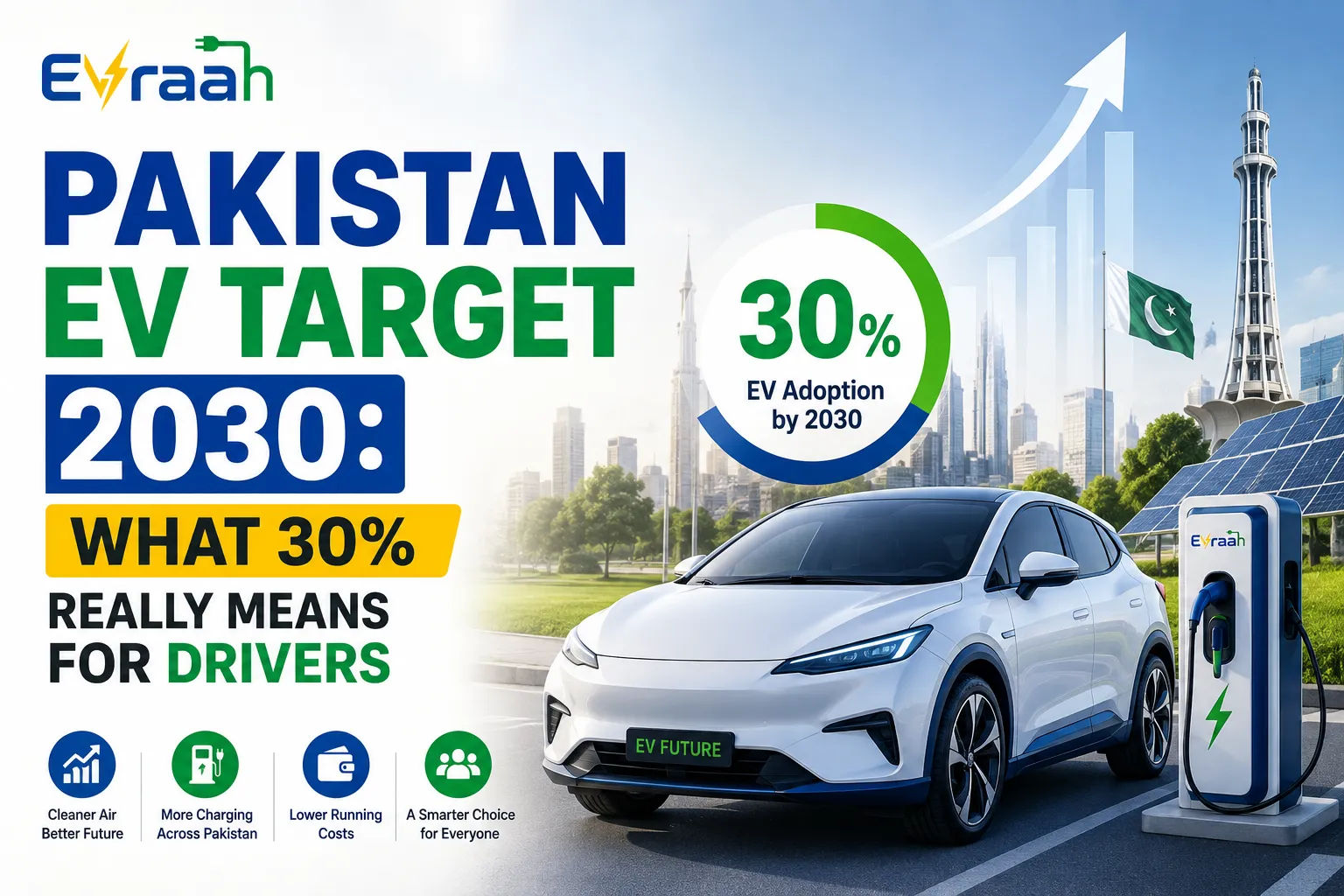
Pakistan’s transition to electric mobility now has a clear national benchmark. Under the New Energy Vehicle Policy 2025–30, the government wants new energy vehicles to account for 30% of all new vehicle sales by 2030.
That is a significant target, but it is often described incorrectly. Pakistan is not promising that 30% of every vehicle already on the road will become electric within the next few years. Instead, the policy focuses on the vehicles people and businesses buy in 2030.
For drivers, the real value of the policy will not be measured by the headline alone. It will depend on whether electric vehicles become easier to finance, whether reliable charging reaches more cities and motorways, and whether locally assembled models offer dependable batteries, warranties and after-sales support.
The 30% Target in Plain English
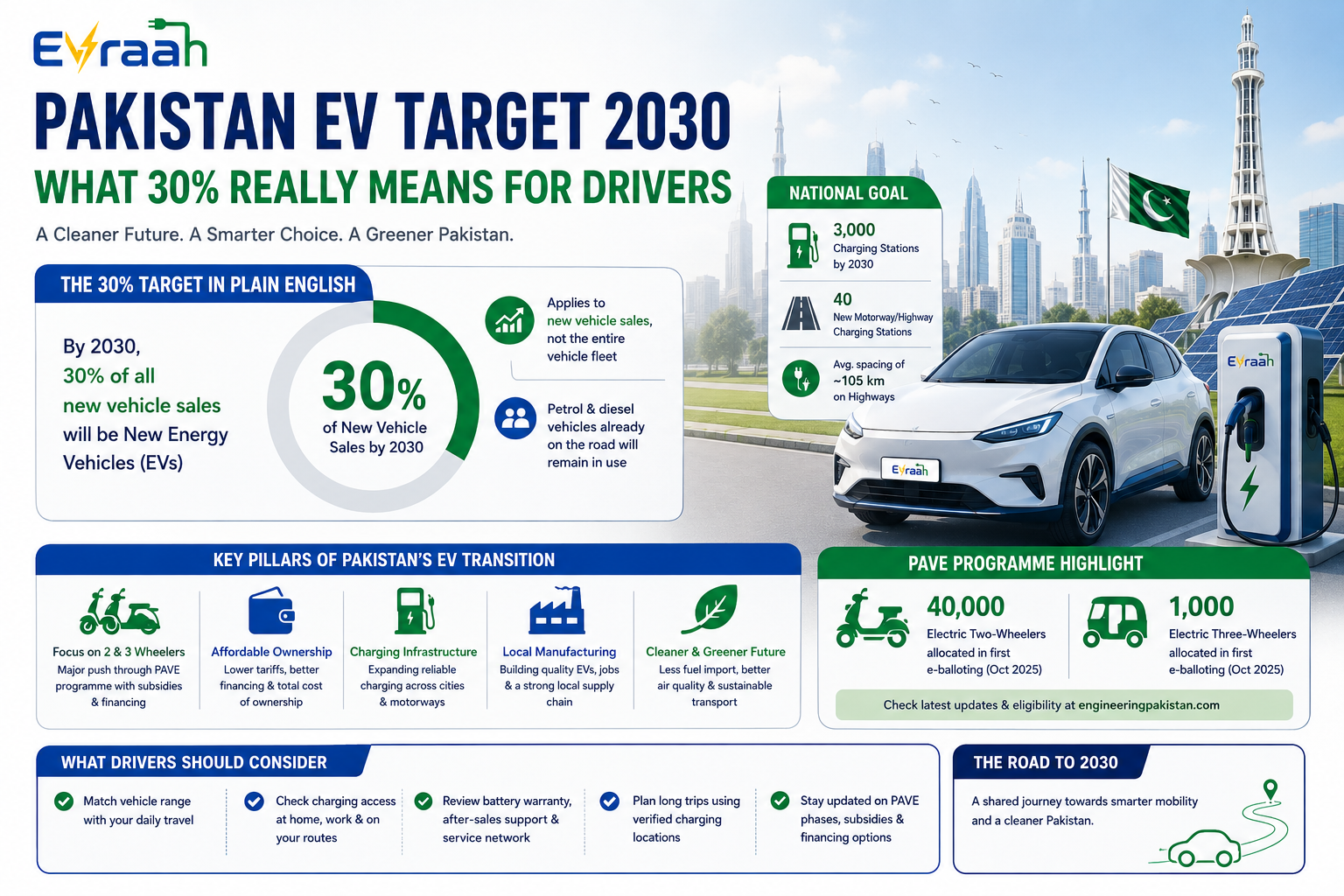
The policy’s target applies to new vehicle sales. If Pakistan reaches the goal, three out of every ten new vehicles sold in 2030 would be new energy vehicles. Petrol and diesel vehicles already in use would remain part of the national fleet.
This distinction matters because changing new sales is much faster than replacing the entire vehicle population. Even if electric vehicle sales rise sharply, Pakistan’s overall fleet will continue to include conventional vehicles for many years.
The policy uses the term “new energy vehicle” as part of a wider transport strategy. Its objectives include reducing dependence on imported fuel, improving urban air quality, encouraging local industry and using available electricity more productively.
Why Electric Motorcycles and Rickshaws Matter Most
Electric cars receive much of the public attention, but two- and three-wheelers are likely to determine whether Pakistan comes close to the 2030 target. Motorcycles and rickshaws are widely used for commuting, deliveries and commercial transport, and many operate on predictable daily routes.
These vehicles also require smaller batteries than passenger cars. Many users can charge at home, at work or at a depot, while battery swapping may be suitable for vehicles that need to stay on the road for longer hours.
The Pakistan Accelerated Vehicle Electrification programme, commonly known as PAVE, reflects this priority. The government allocated Rs9 billion in FY 2025–26 to support electric two- and three-wheelers. During the first PAVE e-balloting in October 2025, 40,000 electric two-wheelers and 1,000 electric three-wheelers were allocated to successful applicants.
Subsidy amounts and eligibility rules can change between phases. Prospective buyers should therefore check the latest PAVE updates from the Engineering Development Board before choosing a model or arranging financing.
Passenger EVs Face a Different Challenge
Electric cars, vans and buses are also part of Pakistan’s transition, but their adoption depends on a different set of conditions. Purchase price is only one factor. Buyers also consider financing costs, battery warranties, resale value, spare parts, maintenance support and access to charging.
Home charging can make ownership convenient for drivers with dedicated parking. The situation is more difficult for residents of apartments or shared buildings where installing a private charger may require permission, new wiring or a separate metering arrangement.
Intercity travel creates another test. A passenger EV may be suitable for daily urban driving, but motorway confidence depends on working chargers at practical intervals. Drivers need accurate locations, compatible connectors and reliable backup options—not simply a national installation target.
Pakistan’s Charging Plan: Target Versus Reality
The official NEV Policy 2025–30 targets 3,000 charging stations nationwide by 2030. The government’s policy announcement also outlines an initial motorway and highway plan for 40 new charging stations, with an average spacing of approximately 105 kilometres.
The policy also supports battery swapping, vehicle-to-grid trials and the inclusion of EV charging in new building codes. These measures could improve access for city drivers while making longer routes more practical.
However, a planned charger is not the same as an operational charger. A useful national network requires dependable electricity, suitable connectors, clear access, maintenance support and accurate status information. Charger uptime will matter as much as the number of sites installed.
EV owners should continue planning motorway journeys around verified stations. Before leaving, confirm that each intended stop is accessible and compatible with the vehicle, and identify an alternative whenever the distance between chargers is significant. EVraah can support charger discovery and EV route planning as Pakistan’s network develops.
Lower Charging Tariffs Could Encourage Investment
The Power Division announced a reduction in the EV charging-station tariff from Rs71 per unit to Rs39.70 per unit. The change is intended to improve the commercial case for companies that install and operate public chargers.
The tariff paid by an operator should not be confused with the final amount charged to a driver. Public charging prices may also reflect equipment costs, site rent, maintenance, payment systems and the operator’s service margin.
Even so, a more workable input tariff can encourage investment and competition. For drivers, the best outcome would be more reliable charging locations with transparent prices rather than a race to install poorly maintained equipment.
Local Manufacturing Must Deliver More Than Assembly
The policy encourages local production through tariff support, concessions and industry-development measures. Greater localisation could reduce exposure to exchange-rate changes, improve spare-parts availability and create technical jobs.
Local assembly alone will not guarantee a successful market. Buyers need vehicles that meet clear safety standards and provide realistic information about range, charging time, battery life and replacement cost.
Manufacturers will also need dependable dealership and service networks. This is especially important for electric motorcycles and rickshaws, where weak warranties or limited battery support could quickly damage consumer confidence.
How to Judge Progress Towards 2030
The 30% sales target is useful, but it should not be the only measure of progress. Pakistan’s electric mobility transition should also be judged by the number of chargers that are actually working, the cities and routes they cover, and the experience of drivers who depend on them.
Other useful indicators include affordable financing, certified vehicle quality, battery warranty claims, after-sales coverage, local component production and safe systems for used batteries.
Transparent reporting will be essential. Official updates should clearly separate announced projects, installed chargers and fully operational public stations. The same clarity is needed for vehicle subsidies, approved models and delivery timelines.
What the Policy Means for Someone Buying an EV Today
The 2030 target is a positive signal, but it should not replace individual research. Before buying an EV, compare the vehicle’s real-world range with your daily travel, confirm where it can be charged and review the battery warranty carefully.
If you regularly travel between cities, check the charging network on those specific routes. A charger planned for the future does not solve a journey today. Keep a practical battery reserve and identify backup charging options before departure.
Buyers considering PAVE support should use current official information. Application windows, financing routes and subsidy terms may change, and an older announcement may no longer reflect the active phase.
Frequently Asked Questions
Will 30% of all vehicles in Pakistan be electric by 2030?
No. The target is for EVs to represent 30% of new vehicle sales by 2030.
Does the policy ban petrol and diesel vehicles?
No. It promotes EV adoption but does not itself ban petrol or diesel vehicles.
Which vehicles receive the most attention?
Electric motorcycles and rickshaws are a major focus of the PAVE programme.
What is the PAVE programme?
PAVE supports eligible electric two- and three-wheeler buyers through subsidies and financing.
How many charging stations are planned?
The policy targets 3,000 stations nationwide by 2030, including 40 new motorway and highway sites.
Pakistan’s EV Target Will Be Decided by Execution
Pakistan’s 30% target gives the electric mobility sector a clear direction. Two- and three-wheelers may produce the quickest gains, while passenger EV adoption will depend on affordability, financing and charging confidence.
The next few years will show whether policy announcements become dependable services for drivers. Reliable chargers, transparent information, safe vehicles and strong after-sales support will matter more than the headline number alone.
EVraah will continue helping Pakistani drivers understand electric vehicles, discover charging options and plan EV journeys with greater confidence.
Related blogs
More from Pakistan EV News.
Should You Buy an EV in Pakistan Now or Wait for the 2026–31 Auto Policy?
Pakistan's New Auto Policy Could Give EVs a Major Tax Boost