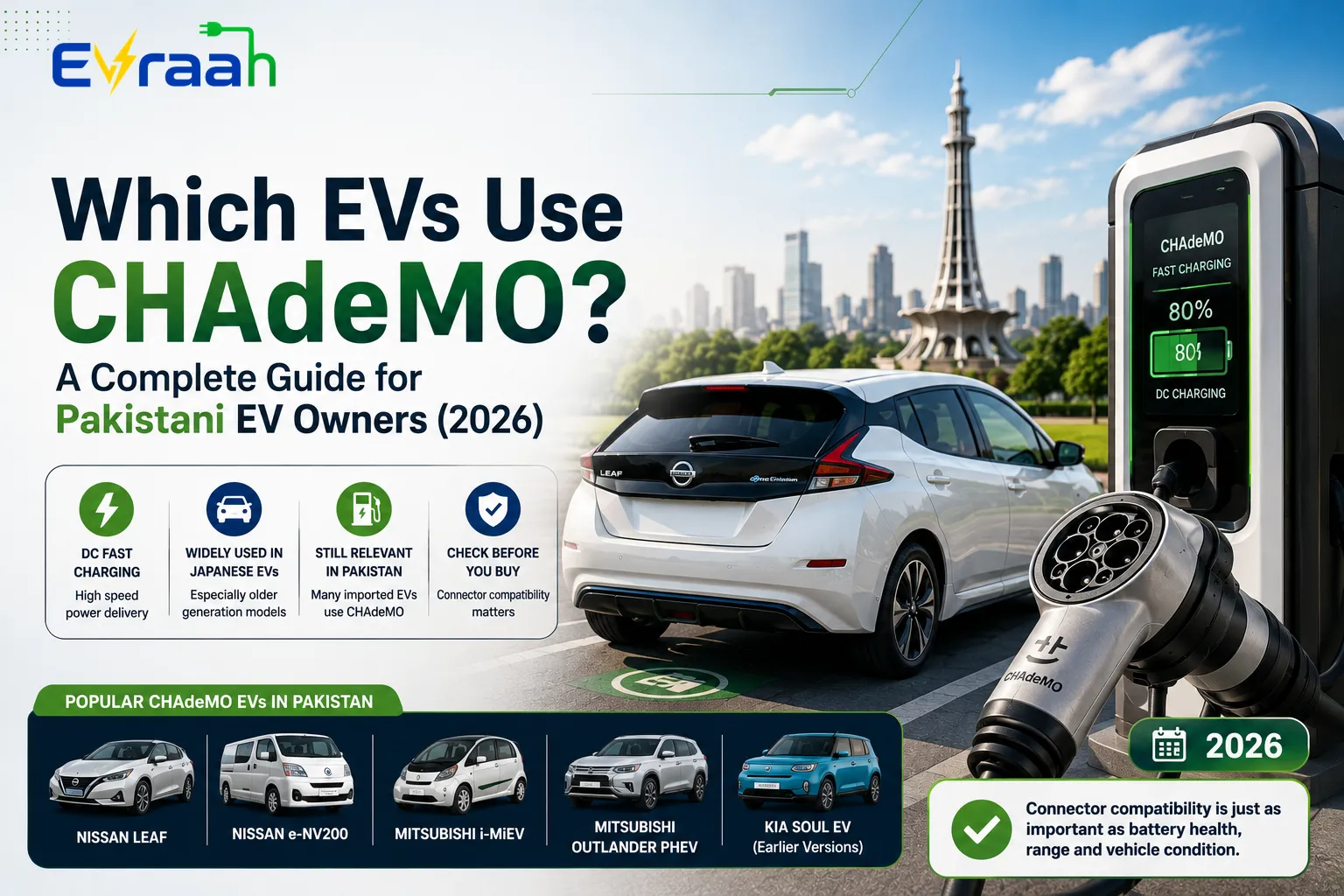
Which EVs Use CHAdeMO? A Complete Guide for Pakistani EV Owners (2026)
Which EVs Use CHAdeMO?
If you are shopping for a used Japanese electric car in Pakistan, there is a good chance you will come across the term CHAdeMO. It is especially common on imported Nissan Leaf models and other older Japanese EVs.
But there is an important question to answer before buying one: where will you charge it?
CHAdeMO is a DC fast-charging standard developed in Japan. It remains in use today, but the newer EV market is increasingly built around CCS2. That difference matters in Pakistan, where the public charging network includes a mix of older imported EVs and newer models using different connectors.
For a used EV buyer, the charging connector should be checked alongside battery health, range, condition and service history. A car may be perfectly capable of fast charging, but that does not mean every public fast charger can charge it.
Here is what you need to know about CHAdeMO EVs, the cars that use them, and whether buying one still makes sense in Pakistan in 2026.
What Is a CHAdeMO Connector?
CHAdeMO is a DC fast-charging standard for electric vehicles. The name refers both to the charging technology and the organisation responsible for developing and maintaining the protocol. CHAdeMO allows the vehicle and charger to communicate with each other while DC electricity is delivered directly to the battery.
This is different from normal AC charging. With AC charging, electricity is converted by the vehicle's onboard charger before reaching the battery. With DC fast charging, the conversion happens inside the charging equipment, allowing considerably higher charging power.
| Charging Type | Typical Use | Where Conversion Happens |
|---|---|---|
| Type 2 AC | Home, office and destination charging | Inside the vehicle |
| CHAdeMO DC | Public fast charging | Inside the charging station |
| CCS2 DC | Public fast charging | Inside the charging station |
So, when someone says an EV "has CHAdeMO", they are normally talking about its DC fast-charging inlet. The car may still use a separate connector, such as Type 2, for AC charging.
How Does CHAdeMO Charging Work?
The process is fairly straightforward from the driver's perspective.
- Connect the CHAdeMO plug to the vehicle.
- The charger and vehicle establish communication.
- The vehicle reports charging requirements and limits.
- The charger supplies DC electricity directly to the battery.
- The charging power changes according to battery temperature, state of charge and the vehicle's charging limits.
One important point is that a 150 kW or 180 kW charger does not automatically mean your car will charge at 150 kW or 180 kW. The vehicle decides how much power it can accept.
For example, many older Nissan Leaf variants have considerably lower DC charging limits than modern EVs. Plugging one into a more powerful charger does not remove the vehicle's own charging limit.
Which EVs Use CHAdeMO?
CHAdeMO was widely adopted by Japanese manufacturers during the early development of mass-market electric vehicles. As a result, many of the CHAdeMO cars found in Pakistan today are imported used vehicles from Japan or other Asian markets.
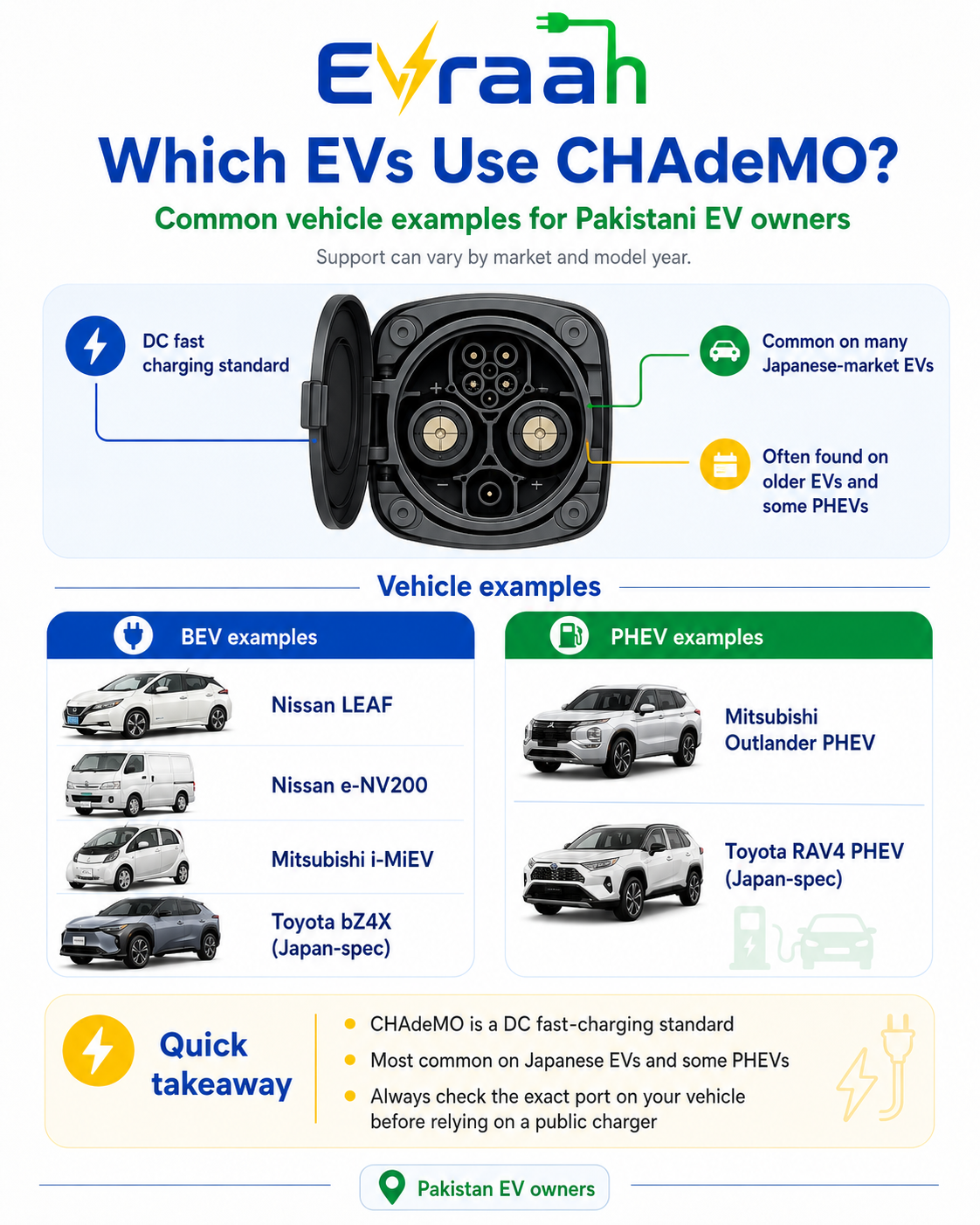
Some of the better-known CHAdeMO-equipped EVs include:
| EV | CHAdeMO | Typical DC Charging | Important Note |
|---|---|---|---|
| Nissan Leaf | Yes | Varies by battery and model year | One of the most common CHAdeMO EVs in Pakistan |
| Nissan e-NV200 | Yes, on many versions | Typically around 50 kW | Electric van based on Nissan's early EV technology |
| Mitsubishi i-MiEV | Yes, on many versions | Typically around 40–50 kW | One of the early mass-market battery EVs |
| Mitsubishi Outlander PHEV | Yes, on some versions | Typically lower than full BEVs | Specification depends on model year and market |
| Kia Soul EV | Yes, on earlier versions | Varies by generation | Later generations moved toward CCS |
| Peugeot iOn | Yes | Typically around 40–50 kW | Closely related to the Mitsubishi i-MiEV |
| Citroën C-Zero | Yes | Typically around 40–50 kW | Shares its platform with the i-MiEV and iOn |
Always check the exact vehicle. Charging equipment can differ by production year, market, trim and battery version. This is particularly important when buying an imported EV because the badge alone does not always tell you exactly what charging hardware is fitted.
Nissan Leaf: The CHAdeMO EV Most Pakistani Buyers Know
If you ask which EVs use CHAdeMO, the Nissan Leaf is probably the most important example for Pakistan.
The Leaf was one of the first mass-market electric cars and helped establish CHAdeMO as a major DC fast-charging standard. Nissan's own charging information identifies CHAdeMO as the fast-charging connector used by the Leaf in markets where that standard is supported.
Several Leaf battery versions have appeared in the used-import market, including:
- 24 kWh Leaf
- 30 kWh Leaf
- 40 kWh Leaf
- 62 kWh Leaf e+
These cars should not be treated as identical. Battery capacity, charging performance, range and other specifications vary between generations and versions.
If you are considering a used Nissan Leaf in Pakistan, check:
- Battery state of health (SOH)
- Remaining battery capacity
- Model year and generation
- Actual charging ports fitted to the car
- DC fast-charging capability
- Availability of compatible public chargers on your normal routes
Which Mitsubishi EVs Use CHAdeMO?
Mitsubishi i-MiEV
The Mitsubishi i-MiEV was an early mass-market battery-electric car and is associated with CHAdeMO DC fast charging. The same basic platform was also sold under other brands.
Those related models include:
- Peugeot iOn
- Citroën C-Zero
Because these vehicles are now older, battery condition and charging availability can matter more than the headline specifications.
Mitsubishi Outlander PHEV
Some Mitsubishi Outlander PHEV versions also use CHAdeMO for DC fast charging.
This is a slightly different case because the Outlander PHEV is a plug-in hybrid, not a pure battery-electric vehicle. Its battery is smaller than that of a typical modern BEV, so its DC charging capability is also different.
If you are buying an imported Outlander PHEV, check the exact model year and market specification before assuming it has CHAdeMO.
Other Electric Cars That Use CHAdeMO
CHAdeMO appeared on a number of early EVs from Japanese and European manufacturers. Besides the Nissan and Mitsubishi models mentioned above, notable examples include the first-generation Kia Soul EV, Peugeot iOn and Citroën C-Zero.
Some vehicles can also use CHAdeMO through an adapter, but that does not make them factory CHAdeMO vehicles. Tesla is a good example: certain older Tesla vehicles could use CHAdeMO through a dedicated adapter in compatible markets.
For buyers, it is better to separate three things:
- Factory CHAdeMO support
- Adapter-based compatibility
- Actual charger availability
They are not the same thing.
CHAdeMO vs CCS2: What's the Difference?
CHAdeMO and CCS2 both support DC fast charging, but they use different connectors and communication systems.
| Feature | CHAdeMO | CCS2 |
|---|---|---|
| Primary use | DC fast charging | DC fast charging |
| Origin | Japan | Europe-led international standard |
| Common on | Older Japanese EVs | Many newer EVs |
| Common Pakistani examples | Nissan Leaf and other Japanese imports | Many newer EV models and public chargers |
| Physical connector | CHAdeMO | CCS2 |
For a Pakistani EV owner, the practical difference is simple: the connector on your car needs to match the connector supported by the charger.
EVraah's EV charging connectors guide goes into more detail on CCS2, Type 2, CHAdeMO and other charging standards used in Pakistan.
Can a CHAdeMO EV Use a CCS2 Charger?
Not directly.
CHAdeMO and CCS2 use different physical connectors and communication systems. You cannot simply take a CCS2 charging cable and plug it into a CHAdeMO vehicle.
Adapters do exist in some markets, but compatibility is not guaranteed across every combination of vehicle and charger. It can depend on:
- The vehicle
- The charger
- The adapter
- Charging communication
- Regional requirements
- Whether the charger operator permits adapter use
For normal ownership, the safest approach is to check the actual connector before relying on a public charger.
An adapter should not be treated as a universal solution to a charging-network problem.
Is CHAdeMO Still Relevant in 2026?
This is where the picture gets more interesting.
CHAdeMO is not a dead technology. The CHAdeMO Association released CHAdeMO protocol 2.1 in June 2026, with provisions including higher charging power, improved safety requirements and Plug and Charge functionality. The association says the latest protocol supports charging power up to 800 kW with the specified configuration.
However, that does not mean most new passenger EVs are moving back to CHAdeMO.
In many markets, new EVs have increasingly adopted CCS-based charging, while China has its own GB/T ecosystem and North America has moved heavily toward NACS.
For Pakistan, the situation is more complicated because the country has a significant population of imported used Japanese EVs alongside newer models from manufacturers using CCS2.
So the right question is not simply:
"Is CHAdeMO outdated?"
The better question is:
"Can I reliably charge my CHAdeMO EV where I actually drive?"
CHAdeMO Charging in Pakistan
Pakistan's charging infrastructure is evolving quickly, and connector availability is not uniform across every network.
EVraah's current network data shows why checking the connector matters. For example, the PSO network currently lists CCS2 and Type 2 AC connectors, while the wider EVraah network directory lists Total PARCO as supporting both CCS2 and CHAdeMO.
That means a CHAdeMO driver cannot simply assume that the nearest fast charger will work with their car.
Before heading to a public charger, check:
- Connector type
- DC or AC charging
- Charger power
- Current station status
- Whether the charger is accessible to your vehicle
EVraah's charging network directory can be useful for comparing connector types and network coverage before planning a trip.
Why Connector Compatibility Matters on Long EV Trips
Connector compatibility becomes much more important once you leave your home city.
Imagine driving a Nissan Leaf from Karachi toward Lahore. Having enough battery range is only part of the problem. You also need a compatible charger at the point where you expect to stop.
A CCS2-only station does not solve the problem for a CHAdeMO vehicle.
That is why EV route planning should consider vehicle connector, charging location, distance, available power and battery reserve together.
EVraah's route planner is designed around this type of charging-aware planning, rather than treating an EV trip like a normal petrol-car journey.
For a practical example, see EVraah's Karachi to Lahore EV charging playbook.
Planning a Trip With a CHAdeMO EV in Pakistan
If you own a CHAdeMO vehicle and are planning an intercity trip, do not leave charging until you are almost out of battery.
Before leaving:
- Check the charging stations along your route.
- Confirm that they actually have CHAdeMO.
- Check the latest operating status.
- Identify at least one backup option where possible.
- Keep a reasonable battery reserve.
- Consider weather, traffic, speed and air-conditioning use.
EVraah's road-trip guidance recommends checking station status, connector compatibility and charging capacity shortly before departure because Pakistan's charging network can change.
For everyday city driving, the situation is usually easier. If you can charge at home overnight, you may rarely need a DC fast charger at all.
Can You Install a CHAdeMO Charger at Home?
Technically, private DC fast-charging equipment can be installed, but a dedicated CHAdeMO fast charger is generally far more expensive and demanding than a normal home AC wallbox.
DC fast charging requires substantially more electrical infrastructure and specialised equipment. For most homeowners, AC charging is the more practical option.
For overnight charging, the car can simply remain plugged in while you sleep.
If you are new to home charging, EVraah's home EV charging setup guide covers the practical side of installing and using an EV charger at home.
Advantages of CHAdeMO
- Well-established DC fast-charging technology
- Widely used by older Japanese EVs
- Strong compatibility with vehicles such as the Nissan Leaf
- Still supported by existing charging infrastructure
- The standard itself continues to be developed
Limitations of CHAdeMO
- Fewer newer passenger EVs are launching with CHAdeMO
- CCS2 is increasingly common on newer EVs
- Charger availability can vary significantly by location
- Some charging networks may be CCS2-only
- Long-distance planning requires more attention to connector compatibility
Should You Buy a CHAdeMO EV in Pakistan?
There is no universal yes or no answer.
A CHAdeMO EV can make sense if:
- You mainly drive around one city.
- You have reliable home charging.
- You are buying a well-maintained used Nissan Leaf or similar EV.
- You have confirmed compatible public chargers nearby.
- You are comfortable checking charging compatibility before longer trips.
A CCS2 EV may make more sense if:
- You frequently travel between cities.
- You depend heavily on public DC fast charging.
- You want access to a growing number of newer charging networks.
- You are buying a newer EV rather than an older Japanese import.
The connector should not be the only factor in your decision. Battery health, actual range, vehicle condition, parts availability and charging access all matter.
What to Check Before Buying a Used CHAdeMO EV
1. Check the actual charging port
Do not rely solely on the seller's description. Look at the vehicle and confirm which AC and DC connectors are physically fitted.
2. Check battery health
On an older EV, battery condition can have a much bigger impact on ownership than the charging connector itself.
Ask for:
- Battery SOH
- Remaining capacity
- Diagnostic report where available
- Real-world range
- Charging behaviour
3. Check where you will charge
Before paying for the car, identify the chargers you are realistically going to use.
Ask yourself:
- Can I charge at home?
- Is there a compatible fast charger near my home or workplace?
- Are there compatible chargers on my regular intercity routes?
- What will I do if my preferred charger is unavailable?
4. Check the model year and exact specification
Imported cars can vary by market and production year. Never assume that every vehicle carrying the same model name has exactly the same charging hardware.
CHAdeMO EVs: Frequently Asked Questions
Which EVs use CHAdeMO?
Well-known CHAdeMO-equipped EVs include the Nissan Leaf, Nissan e-NV200, Mitsubishi i-MiEV, some Mitsubishi Outlander PHEV versions, early Kia Soul EV models, Peugeot iOn and Citroën C-Zero. Exact specifications can vary by market and model year.
Does the Nissan Leaf use CHAdeMO?
Yes. Nissan Leaf models equipped with DC fast charging use CHAdeMO, although the exact charging capability varies between Leaf generations and battery versions.
Is CHAdeMO better than CCS2?
Neither is universally better. CHAdeMO is a mature DC fast-charging standard with a large installed base, while CCS2 is increasingly common on newer EVs and charging networks. For a Pakistani buyer, the more useful question is which connector is available on the routes you actually use.
Can a CHAdeMO EV charge at a CCS2 station?
Not directly. CHAdeMO and CCS2 use different physical connectors and communication systems. Some adapters exist, but compatibility should be confirmed for the specific vehicle and charger.
Are CHAdeMO chargers available in Pakistan?
Yes, CHAdeMO charging infrastructure exists in Pakistan, but availability varies by network and location. EVraah's current network directory lists CHAdeMO support on some networks, while other major networks are currently CCS2-focused. Always check the station's connector before travelling.
Is CHAdeMO still relevant in 2026?
Yes, particularly for existing Japanese EVs. The CHAdeMO Association is still developing the standard, including its 2026 protocol 2.1 release. However, Pakistani buyers should also recognise that CCS2 is becoming increasingly important in the newer EV and public-charging market.
Should I buy a CHAdeMO EV in Pakistan?
You can, especially if you have home charging and mainly drive locally. If you regularly travel long distances and rely heavily on public fast charging, a CCS2 vehicle may offer more convenient access to newer charging infrastructure.
Can I install a CHAdeMO charger at home?
It is technically possible, but dedicated DC fast charging is usually much more expensive and infrastructure-intensive than installing an AC home charger. For most owners, overnight AC charging is the more practical solution.
Final Verdict: Are CHAdeMO EVs Still Worth Buying in Pakistan?
Yes—but you should buy the car with its charging network in mind.
CHAdeMO remains relevant because thousands of existing EVs, particularly Japanese imports, still depend on it. The standard itself is also still being developed. At the same time, CCS2 is becoming increasingly important across newer EVs and public charging networks.
For someone buying a used Nissan Leaf in Pakistan, CHAdeMO should not automatically be considered a deal-breaker. If you can charge at home and have compatible public chargers available when you need them, the car can still be a practical option.
For frequent intercity drivers, however, connector compatibility deserves much more attention. A charger being nearby is not enough. It needs to have the right connector, the right charging type and suitable availability.
That is ultimately the lesson with CHAdeMO: the best EV is not simply the one with the longest range or fastest charging speed. It is the one you can reliably charge where you actually drive.
Before buying an imported EV in Pakistan, check the connector, battery health, real-world range and charging options together. A few minutes of research before purchase can save you a lot of frustration later.
Written by
Naeem
Naeem works in research and feasibility planning by day, and writes for Evraah on the side — mostly because EVs turned out to be more interesting than he expected. With 5+ years spent digging through data and assessing what's actually viable versus what just sounds good on paper, he brings the same habit to writing about EV routes, charging networks, and where the infrastructure is realistically headed. No grand mission, just a genuine curiosity about how this space is evolving — and a quiet hope that charging a car stops being a whole ordeal someday.
Related blogs
More from EV Basics.
WLTP vs NEDC vs CLTC vs EPA: EV Range Explained for Pakistan
EV Maintenance Cost in Pakistan 2026: Complete Service & Repair Guide
EV Battery Guide for Pakistan: Lifespan, Degradation, Charging & Replacement Cost
You may also like
 Pakistan EV News
Should You Buy an EV in Pakistan Now or Wait for the 2026–31 Auto Policy?
6 min read · 4 Oct 2026
 Charging Guides
10 EV Charging Tips for New Drivers in Pakistan
5 min read · 30 Sept 2026
 Charging Guides
Can a GB/T EV Use a CCS2 Charger in Pakistan? Complete Compatibility Guide
5 min read · 22 Sept 2026