EV vs Petrol Car: Real Running Cost in Pakistan
EV vs Petrol Car
For most Pakistani drivers, an electric car is cheaper to run than a petrol car when charged mainly at home. The saving depends on electricity price, charging losses, vehicle efficiency, public-charging use and the petrol car's real fuel economy.
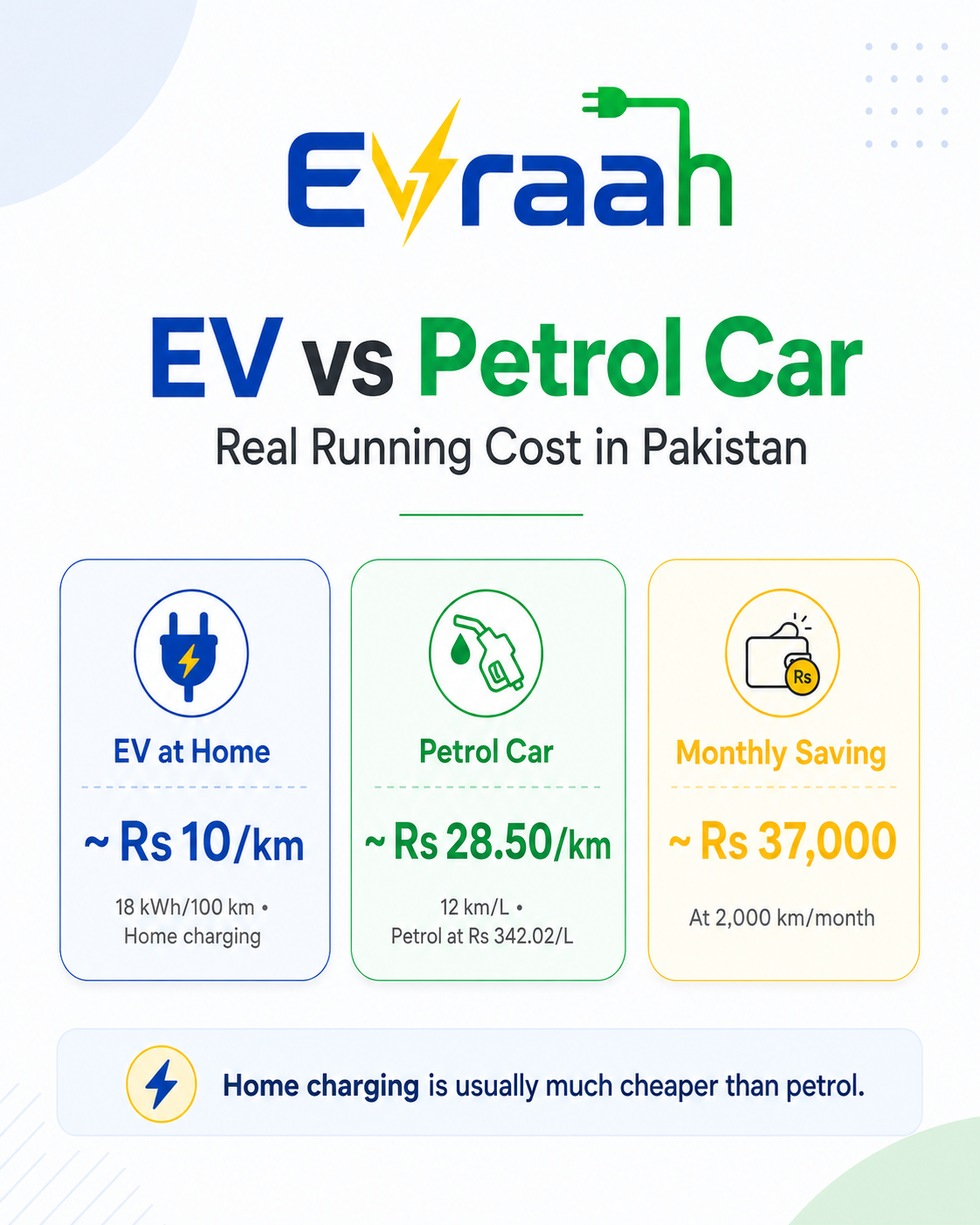
Using a representative EV consuming 18 kWh/100 km, 90% charging efficiency and home electricity at Rs 50/kWh, energy costs about Rs 10/km. A petrol car returning 12 km/L costs about Rs 28.50/km at a petrol price of Rs 342.02/L effective 29 August 2026. The latest price revision was reported by The Express Tribune.
Public DC charging changes the calculation. EVraah's EV charging cost in Pakistan guide uses a broad planning range of roughly Rs 110–150/kWh for public DC fast charging. At those rates, the same EV costs about Rs 22–30/km.
EV vs Petrol Running Cost: Quick Comparison
|
EV • Home Charging
Rs 10/km
18 kWh/100 km, 90% charging efficiency and Rs 50/kWh.
|
Petrol • 12 km/L
Rs 28.50/km
Calculated using petrol at Rs 342.02 per litre.
|
Energy Break-Even
Rs 142.50/kWh
Break-even against a petrol car returning 12 km/L.
|
| Assumption | EV | Petrol |
|---|---|---|
| Efficiency | 18 kWh/100 km | 12 km/L |
| Charging efficiency | 90% | — |
| Energy purchased | 20 kWh/100 km | — |
| Home electricity | Rs 50/kWh | — |
| Public DC | Rs 110–150/kWh | — |
| Petrol price | — | Rs 342.02/L |
What Does an EV Actually Cost Per Kilometer in Pakistan?
The EV running cost in Pakistan depends mainly on how many kWh the vehicle consumes per 100 km and how much you pay for each kWh. If you are still learning how AC and DC charging differ, EVraah's fast charging vs slow charging guide explains the difference.
Charging losses should also be included. If an EV uses 18 kWh from its battery over 100 km, more than 18 kWh normally has to be drawn from the electricity supply. Energy can be lost through charging equipment, power conversion and battery conditioning.
The National Renewable Energy Laboratory includes charging losses when estimating electricity requirements for electric vehicles.
| Electricity Price | Cost per 100 km | Cost per Km |
|---|---|---|
| Rs 40/kWh | Rs 800 | Rs 8.00 |
| Rs 50/kWh | Rs 1,000 | Rs 10.00 |
| Rs 65/kWh | Rs 1,300 | Rs 13.00 |
| Rs 110/kWh | Rs 2,200 | Rs 22.00 |
| Rs 150/kWh | Rs 3,000 | Rs 30.00 |
What Does a Petrol Car Cost Per Kilometer?
At Rs 342.02/L, the petrol car cost per km in Pakistan depends directly on the vehicle's real fuel average.
| Fuel Economy | Petrol Cost per Km |
|---|---|
| 10 km/L | Rs 34.20 |
| 12 km/L | Rs 28.50 |
| 15 km/L | Rs 22.80 |
| 16 km/L | Rs 21.38 |
A fair electric vehicle vs petrol car comparison should use similarly sized vehicles. Comparing a large petrol SUV with a compact EV can exaggerate the apparent saving, while comparing an efficient petrol hatchback with a large electric SUV can make the EV look less economical.
Home Charging vs Public Charging
Pakistan does not have one flat residential EV electricity price. Home charging is added to normal household electricity consumption. NEPRA publishes electricity tariff information, while a household's effective rate depends on its tariff category and consumption.
That is why Rs 50/kWh in this guide is a planning assumption rather than a universal EV home-charging tariff. EVraah's home EV charging guide covers electrical load, wallboxes and practical charging setup requirements.
|
Home Charging
Usually offers the lowest running cost for daily commuting because the vehicle can charge while parked at home.
|
Public DC Charging
Usually costs more because the price includes infrastructure, equipment, maintenance and charging-service costs.
|
Pakistan's Power Division announced an EV charging-station electricity tariff of Rs 39.70 per unit. This should not be confused with the final retail rate paid by an EV driver at a public station.
Public charging operators also need to recover infrastructure, equipment, installation, site, maintenance and operating costs. Drivers can compare available operators through EVraah's EV charging networks directory.
Monthly and Annual Running Cost Comparison
Assume a driver travels 1,500 km per month.
|
EV • Home Charging
Rs 10/km × 1,500 km
Rs 15,000/month
Annual cost: Rs 180,000
|
Petrol • 12 km/L
Rs 28.50/km × 1,500 km
Rs 42,750/month
Annual cost: Rs 513,000
|
At 2,000 km per month, the same assumptions produce approximately Rs 20,000 in EV electricity cost versus Rs 57,000 in petrol—a difference of about Rs 37,000 per month or Rs 444,000 per year.
If the EV relies heavily on expensive public DC charging, the difference becomes much smaller. Drivers without dependable home charging should therefore check nearby charging availability before buying. EVraah's Karachi EV charging guide shows how location can affect everyday charging.
Maintenance: Where EVs Usually Save More
Battery-electric vehicles do not require engine oil, oil filters, spark plugs or exhaust-system maintenance. Regenerative braking can also reduce the amount of work handled by conventional friction brakes.
The U.S. Department of Energy's Alternative Fuels Data Center notes that all-electric vehicles generally require less routine maintenance because they have fewer moving components and fewer fluids that require regular servicing.
EV maintenance cost in Pakistan is not zero. Owners still need tyres, wheel alignment, suspension work, brake inspections, cabin filters, air-conditioning maintenance and other normal vehicle servicing.
What About the EV Battery?
Battery replacement should not be treated as a routine annual running expense. The traction battery is a long-term vehicle component, so buyers should check the battery warranty, degradation terms and replacement policy of the exact model they are considering.
An out-of-warranty battery failure can be expensive, but automatically including a complete battery replacement in every year of EV running cost would distort the comparison in the same way that assuming an annual engine replacement would distort petrol-car costs.
What Changes Your Real EV Running Cost?
The biggest variables are electricity tariff, vehicle efficiency, driving speed, air-conditioning use, traffic and the percentage of charging done at home.
A compact EV using 15 kWh/100 km will cost less to drive than a larger electric SUV consuming 22 kWh/100 km. The same principle applies to petrol vehicles: a car returning 16 km/L will cost much less to fuel than one returning 10 km/L.
Charger compatibility also matters. EVraah's CCS2, Type 2 and CHAdeMO guide explains common connector standards used by electric vehicles in Pakistan.
Charging speed affects journey planning as well. EVraah's EV charging-time guide explains how battery size, charger power, vehicle limits and temperature affect charging time.
City Driving vs Highway Driving
City driving often suits EVs because regenerative braking can recover some energy during slowing and stopping. Motorway driving increases aerodynamic resistance, so an EV will normally consume more energy at sustained high speeds.
|
City Driving
17 kWh/100 km ÷ 0.90
= 18.9 kWh purchased 18.9 × Rs 50 ÷ 100
≈ Rs 9.45/km
|
Highway + Public DC
22 kWh/100 km ÷ 0.90
= 24.4 kWh purchased 24.4 × Rs 120 ÷ 100
≈ Rs 29.33/km
|
The highway example is close to the Rs 28.50/km cost of the 12 km/L petrol car. For longer journeys, EVraah's Pakistan motorway EV charging guide covers charging options on major routes.
A Realistic Pakistani Driver Example
Consider a driver covering 1,600 km each month, with 85% of charging done at home and 15% through public DC chargers.
This mixed-charging example is more realistic for many drivers than assuming either 100% home charging or 100% public charging. Pakistan's wider EV charging network will have a direct impact on how practical these savings become.
At What Electricity Price Does an EV Stop Being Cheaper?
Our representative EV purchases approximately 0.20 kWh of electricity per kilometre after charging losses. The 12 km/L petrol car costs about Rs 28.50/km.
Under these assumptions, the EV remains cheaper on energy than the 12 km/L petrol car while charging costs less than approximately Rs 142.50/kWh.
Against a more efficient petrol car returning 15 km/L, petrol costs about Rs 22.80/km. The break-even charging rate becomes:
Running Cost Is Not Total Cost of Ownership
Running cost covers the money needed to operate a vehicle. Total cost of ownership is broader and can include purchase price, financing, registration, insurance, depreciation, resale value, charger installation and major out-of-warranty repairs.
Actual ownership economics can differ because depreciation, financing costs, insurance and resale values are not included in that simplified calculation.
Common Misconceptions About EV Running Costs
Actual cost depends on electricity price, vehicle efficiency and charging losses.
That can happen with inexpensive home charging, but public DC charging can greatly reduce the advantage.
It does not. Public charging includes infrastructure, operating and service costs.
EVs avoid several engine-related service items but still require tyres, suspension, brakes, filters and other routine care.
Final Verdict: Which Is Cheaper to Run in Pakistan?
For a driver with reliable home charging, an EV is usually much cheaper to run than a typical petrol car in Pakistan.
|
EV Home Charging
≈ Rs 10/km
|
Petrol • 12 km/L
≈ Rs 28.50/km
|
2,000 km / Month
≈ Rs 37,000 Saved
|
The picture changes if an EV depends heavily on public fast charging. At Rs 110–150/kWh, the example EV costs around Rs 22–30/km, which can be close to the running cost of an efficient petrol car.
Before buying, calculate four numbers: your actual monthly mileage, the petrol car's real km/L, the EV's expected kWh/100 km and your likely home-versus-public charging mix.
For most city commuters who can charge mainly at home, the EV vs petrol car running cost in Pakistan strongly favours electric driving. For drivers without home charging, the saving should be calculated rather than assumed.
Frequently Asked Questions
Related blogs
More from Buying Guides.
Cheapest Electric Cars in Pakistan: Prices, Range and Charging Compared
Deepal S07 vs BYD Sealion 7: Detailed Comparison for Pakistan