EV Charging Network Pakistan: Why Infrastructure Will Decide EVs
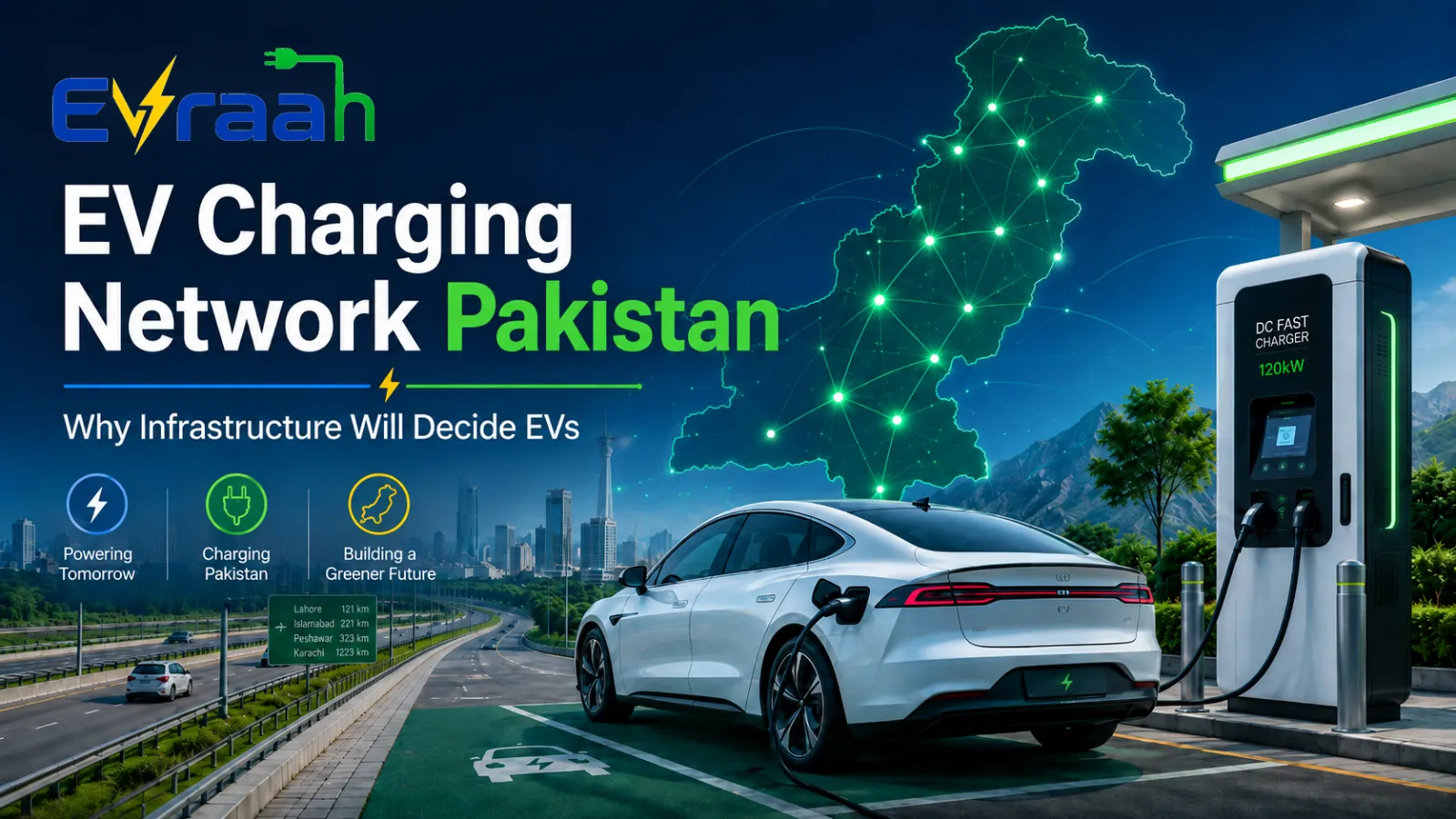
Why EV Charging Networks Will Decide Pakistan’s EV Future
What happens when Pakistan starts selling thousands of electric cars but drivers still don’t know where their next charge will come from?
That may turn out to be the real test of Pakistan’s EV transition.
Most of the conversation around electric cars still happens around the car itself: price, battery range, government incentives, new brands entering Pakistan and how much money an owner might save compared with petrol.
Fair enough. Those things matter.
But once you actually own an EV, another question quickly becomes more important: where are you going to charge it?
Pakistan can bring in better electric cars, assemble them locally and offer buyers longer driving ranges. None of that fully solves the problem if a driver leaving Lahore, Karachi, Islamabad or Multan is unsure whether the next charger exists, whether it works, or whether the car can actually use it.
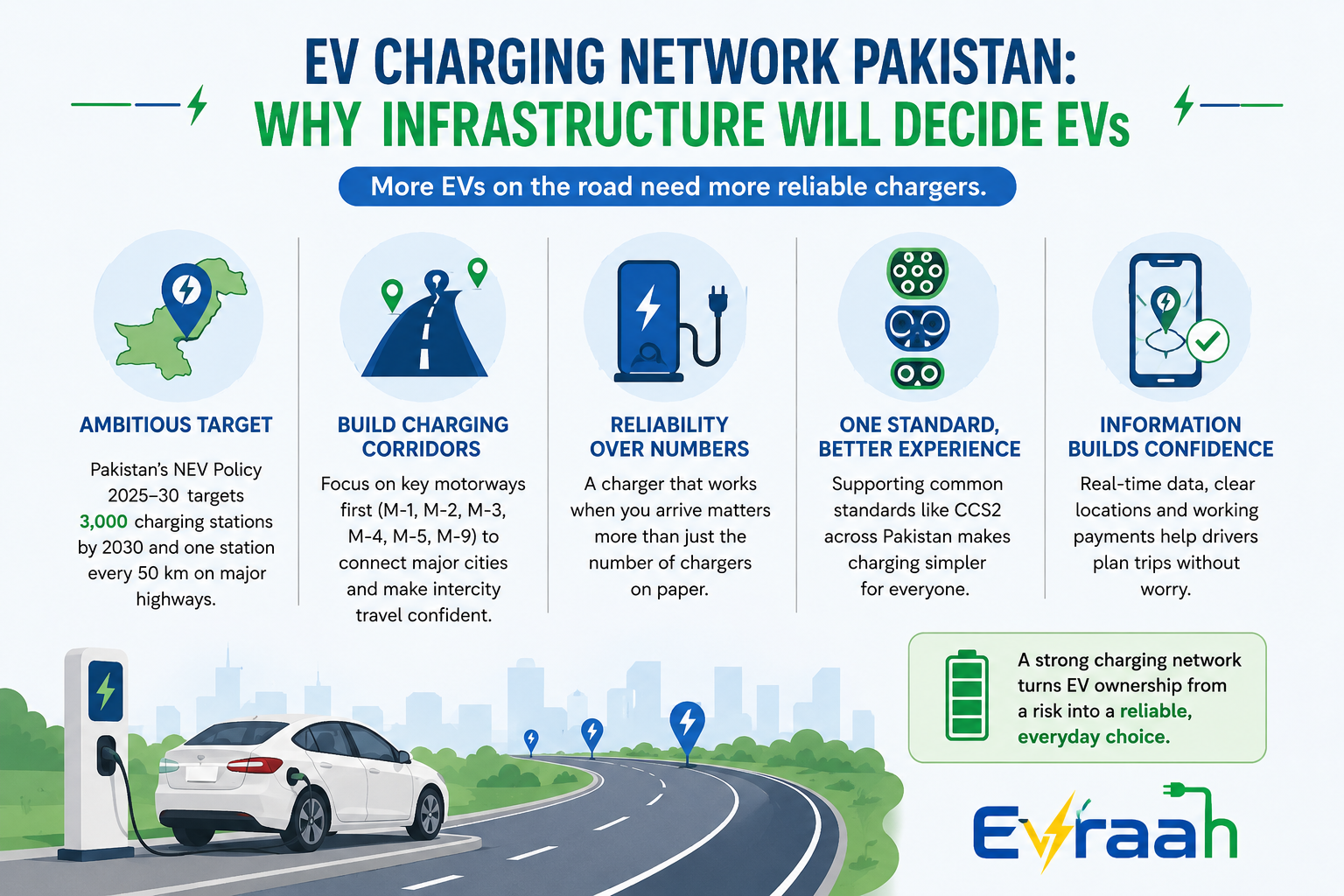
Pakistan’s New Energy Vehicles Policy 2025–30 clearly recognises this. It sets an indicative target of 3,000 charging stations by 2030, covering Level 3 fast chargers, Level 2 chargers, slower charging and battery-swapping infrastructure. The same policy eventually aims for a charging station every 50 kilometres on major highways.
Those are ambitious targets. The difficult part is turning them into a network drivers can actually depend on.
The next phase of Pakistan’s automotive shift may be decided less in showrooms and more at charging stations.
EV availability and EV usability are two different things
There is a big difference between being able to buy an EV and being comfortable using one.
An electric car may offer several hundred kilometres of driving range. That sounds reassuring in a brochure. On an intercity journey, though, the usable range is only part of the equation.
If the charger you were counting on is unavailable, incompatible or out of service, a big battery does not magically solve the problem.
This is the difference between EV availability and EV usability.
Availability means you can walk into a showroom in Pakistan and buy an electric car.
Usability means you can take that car where you normally drive without having to treat every longer journey like a small logistics operation.
This is not a Pakistan-only issue. The International Energy Agency says public charging remains important for widening practical access to EVs. By the end of 2025, the world had more than 7 million public charging points, after nearly 1.8 million were added during the year. The IEA also points out that charger power and capacity matter alongside the simple number of plugs. See the IEA Global EV Outlook 2026 charging analysis.
Pakistan is still much earlier in that process, which makes getting the fundamentals right even more important.
Range anxiety is often charging-infrastructure anxiety
Take a Lahore-to-Islamabad trip.
The driver may know the car can cover the distance on paper. But the questions begin before the journey starts.
Where can I charge if I need to?
Is that charger working today?
Does it have the connector my car uses?
How fast is it?
Will I reach it with enough battery left?
What happens if somebody else is already charging?
The same questions apply on Islamabad–Peshawar, Lahore–Multan, Multan–Sukkur and Karachi–Hyderabad. They become more serious when several intercity legs are joined together.
That is why range anxiety is not always really about battery range. Often it is about uncertainty.
A petrol driver generally does not leave Lahore worrying whether the only fuel pump within reach will accept the nozzle fitted to the car. EV charging is still not that simple, particularly in a market such as Pakistan where different vehicles can use different charging standards.
The real worry is often:
“What if I get there and the charger doesn’t work?”
Once drivers stop asking that question, EV ownership becomes much easier to sell.
Pakistan needs charging corridors before it needs chargers everywhere
Pakistan does not need a high-speed charger on every street tomorrow.
It does need dependable corridors between the places people actually drive.
The obvious backbone is the motorway system: M-1 between Islamabad and Peshawar, M-2 between Lahore and Islamabad, M-3 towards Abdul Hakim, M-4 through central Punjab towards Multan, M-5 between Multan and Sukkur, and M-9 between Karachi and Hyderabad.
NEECA’s public charging register already contains entries associated with several of these motorway corridors, including the M-1, M-2, M-3, M-4, M-5 and M-9. That register is useful evidence of infrastructure development, but a registration entry should not be mistaken for a guarantee of live availability at the moment a driver arrives. The NEECA EV charging infrastructure register is the better place to check the underlying official listing.
For a more driver-focused view of those routes, EVraah’s guide to EV charging stations on Pakistan motorways breaks the network down corridor by corridor.
Government policy is also built around this corridor idea. The NEV policy’s first phase calls for 40 Level 3 fast-charging sites, mainly along motorways and selected N-5 sections, at an average spacing of about 120 kilometres. It then proposes denser coverage as adoption grows, ultimately aiming for a charger every 50 kilometres on major highways by 2030. These are policy targets, not a claim that every proposed location is already live. The figures are set out in the official NEV Policy 2025–30.
Private investment is moving in the same direction. PSO said in its FY25 results that it had unveiled an M-2 fast-charging station with BYD Pakistan and HUBCO Green. HUBCO’s September 2025 investor briefing also reported charging installations in Karachi, Lahore and Islamabad and a motorway footprint on the Lahore–Islamabad route. Those statements show the direction of investment rather than providing a live nationwide uptime map. See PSO’s FY25 announcement and HUBCO’s investor briefing.
The point is not to cover every road immediately. It is to make the main intercity routes dependable first.
Charger placement matters almost as much as charger count
A country can install plenty of chargers and still end up with a poor charging network.
Location matters.
A fast charger makes sense at a motorway service area because the driver is already stopping there. Food, washrooms and somewhere to sit make the charging time easier to live with.
The same logic applies inside cities.
Malls, offices, hotels, commercial parking, dealerships and residential developments work well for charging because cars naturally remain parked there. Fleet depots make sense because buses, vans and company vehicles return to predictable locations.
Putting chargers where the cars already stop sounds obvious, but it is the difference between infrastructure built for a press release and infrastructure built for drivers.
Pakistan should not be asking only, “How many chargers have we installed?”
It should also be asking, “Are they in the places where people actually need them?”
AC at destinations, DC on the road
Not every charger has to be a giant DC fast charger.
For most routine use, slower AC charging can be perfectly sensible. A car parked at home overnight, at an office during working hours or at a hotel for the evening does not necessarily need to gulp down electricity as quickly as possible.
Motorways are different.
When somebody is travelling from Lahore to Islamabad or Karachi to Hyderabad, waiting for hours is not practical. That is where DC fast charging earns its place.
In simple terms:
AC charging suits places where the car is already going to sit.
DC fast charging suits places where the driver wants to get moving again.
For Pakistani owners trying to work out which option suits which situation, this fast charging vs slow charging guide goes into the practical differences in more detail.
This distinction matters when Pakistan plans motorway infrastructure. A slow charger may technically put another dot on the charging map, but it does not necessarily make an intercity route much easier to use.
Ten reliable chargers can beat fifty unreliable ones
Charger counts make good headlines.
Drivers care about something else: does the charger work?
Ten dependable chargers can be more useful than fifty that are badly maintained, difficult to locate or regularly offline.
A proper charging network needs decent uptime, maintenance, clear pricing, working payments, customer support and enough capacity to avoid one broken unit knocking an entire location out of service.
Connector compatibility matters too.
Pakistan’s EV market includes vehicles built for different international markets, which means drivers can encounter CCS2, Type 2, CHAdeMO and GB/T hardware. Anyone buying an EV—especially an imported one—should know what the car actually supports rather than assuming every public DC charger will work with it. EVraah’s guide to EV charging connectors in Pakistan explains those standards and where the differences matter.
NEECA’s own guidance encourages public charging operators to maintain 24/7 service with more than 90% availability and requires internet connectivity for public charging facilities to support online reservations. See NEECA’s EV charging infrastructure guidance.
That is the right way to think about the network. Not just installation. Operation.
Pakistan’s charging network also needs a digital network
A charger sitting beside a motorway is only half the job.
Drivers also need to know it is there.
Better still, they need to know whether it is working before they commit to reaching it.
A useful EV route-planning system should show location, connector type, charging power, opening hours, price and station status. Ideally, it should also tell a driver whether a charging point is occupied and suggest another stop if the original choice becomes unavailable.
Pakistan’s NEV policy recognises this and calls for a national mapping tool carrying spatial and other information on commercial charging stations. The policy says this data can help both EV owners and future infrastructure planning. The policy document is available from the Ministry of Industries and Production.
Platforms such as EVraah can play a useful role here as well by bringing charging locations, route planning and practical driver information into one place.
The important thing is accuracy.
A map full of stale charger pins can actually make things worse. If a station is shown as available and a driver arrives to find it dead, confidence in the whole system takes a hit.
Reliability will determine whether drivers trust EVs outside their cities
Picture the situation.
You leave Lahore with the family, plan your charging stop and reach it with a low battery.
The charger is offline.
There is no reliable alternative nearby.
Technically, one machine has failed. From the owner’s point of view, the entire idea of taking an EV on the motorway has failed.
That is why redundancy matters.
Important charging locations should eventually have more than one usable connector. Networks need remote monitoring, maintenance crews and enough nearby alternatives that one fault does not turn into a roadside problem.
A petrol driver has grown up assuming fuel will be available somewhere ahead.
An EV driver needs to develop the same instinct with electricity.
That trust is probably worth more to adoption than another kilometre or two on a brochure range figure.
Charging infrastructure is also electricity infrastructure
There is another side to this that is easy to forget when looking at charger maps.
The electricity has to come from somewhere.
A motorway charging hub with several cars plugged in at the same time can place a meaningful load on the local electricity connection. As EV traffic increases, utilities will need to think about transformers, feeders, local distribution capacity and peak demand before a charging site becomes congested.
Pakistan’s NEV policy tells the Power Division and relevant DISCOs to work on smart metering and reliable electricity supply for charging stations. It also makes the connection between EV rollout and future load planning. See the official NEV Policy 2025–30.
Solar generation and battery storage could help at some sites, particularly where they reduce peaks or provide extra resilience. But there is no point putting solar panels next to a charger if the basic service is unreliable.
The practical question is simpler:
Can Pakistan provide enough dependable electricity at the locations where EV drivers actually need it?
Charging could become a serious automotive business
There is money to be made here, but only if operators think beyond selling units of electricity.
Petrol stations already have the land, roadside access and customer habit. Motorway service areas can make money from food and retail while a car charges. Hotels can offer overnight charging. Offices and malls can turn parking time into charging time.
Fleet depots may become another important part of the business because commercial vehicles are used heavily and tend to follow predictable schedules.
The commercial model can vary: pay-per-kWh, memberships, fleet contracts, destination charging or partnerships with retailers.
What the customer is really buying, though, is confidence.
Turn up. Plug in. Pay without drama. Get enough charge. Leave.
That is the product.
The network has to grow before demand fully arrives
Here Pakistan runs into the familiar EV chicken-and-egg problem.
Drivers say: “I’ll buy an EV when there are more chargers.”
Charging companies say: “We’ll build more chargers when there are more EVs.”
If everybody waits, nothing moves quickly.
Some infrastructure therefore has to arrive before utilisation is ideal. Pakistan’s NEV policy acknowledges that reality through proposed viability-gap funding for charging projects that may be strategically necessary but initially less attractive commercially. See the official policy document.
That matters most on routes where one missing charging stop can create a huge practical gap.
A charger does not have to be packed with cars from its first week to be useful infrastructure. Sometimes its value is simply making a journey possible.
If Pakistan waits until EV numbers are already large before building those links, charging will become the bottleneck.
China’s lesson is about charging scale, not Chinese brands
China is useful here for one reason: it shows how quickly infrastructure requirements change once EV adoption gathers speed.
In June 2026, new-energy vehicles accounted for 67.2% of domestic passenger-car sales in China, according to CAAM data reported by Xinhua. The figures are available through China’s Belt and Road Portal.
The charging network grew alongside that market. China’s National Energy Administration reported 21.01 million charging points by the end of February 2026, including 4.834 million public charging facilities. The figures are published on China’s State Council website.
Pakistan obviously does not need Chinese-scale infrastructure today.
That is not the lesson.
The lesson is that once EV sales start moving quickly, charging cannot spend the next five years trying to catch up.
Road corridors, grid connections, software, standards and maintenance systems are easier to prepare before they become an emergency.
What a real national EV charging network would feel like
Imagine entering this route into a car or phone:
Karachi → Hyderabad → Sukkur → Multan → Lahore → Islamabad
The software knows the car’s battery level and likely energy use.
It shows suitable chargers along the route.
Before you reach one, you can see whether it is available, what connector it uses, how fast it can charge and what the session is likely to cost.
If that charger goes offline, the route changes before you are committed to it.
You stop, plug in, have tea, charge enough to reach the next leg and carry on.
No frantic phone calls. No hunting around a service area. No arriving with almost no battery and hoping the machine works.
That is a charging network.
A scattering of chargers is not the same thing.
What Pakistan should prioritise now
Priority 1 — Major motorway corridors
Get the main intercity routes right first. Karachi, Hyderabad, Sukkur, Multan, Lahore, Islamabad and Peshawar need to be connected by charging that drivers can realistically rely on.
Priority 2 — Reliable fast charging
On intercity routes, uptime and maintenance matter more than impressive installation announcements. Important locations also need redundancy.
Priority 3 — Urban and home charging
Motorway chargers handle road trips. Homes, workplaces, hotels, malls, residential parking and other destinations handle everyday life.
Both sides of the network matter.
Priority 4 — Accurate digital information
Drivers should be able to find chargers, check their status, understand compatibility and plan a journey before leaving home.
Priority 5 — Standardisation
Connector compatibility, payment methods, pricing information and station data need to become less confusing as the market grows.
Priority 6 — Grid planning
Charging sites cannot be planned separately from the electricity network supplying them. DISCOs, charging operators, motorway authorities and site owners need to plan capacity together.
The real EV revolution is an electricity highway
Pakistan’s EV future will not be decided simply by how many electric cars arrive in showrooms.
It will be decided by whether owners believe those cars can take them where they need to go.
Around the city.
To the office.
Across the motorway.
From Lahore to Islamabad.
From Karachi towards Punjab.
And eventually across the country without a driver having to wonder whether the next charger is a working machine or just a pin on a map.
A successful EV transition needs three things working together:
EVs + electricity + charging network
The car is only one part of that system.
The charging network is what turns an electric car from an interesting product into practical transport.
Pakistan already has charging investment, motorway activity, private operators and a national policy that puts infrastructure near the centre of the EV transition. The harder work now is connecting those pieces into something drivers can trust.
Pakistan doesn’t just need more electric cars. It needs a charging network that makes those cars practical wherever the road takes them.
Related blogs
More from Pakistan EV News.
Should You Buy an EV in Pakistan Now or Wait for the 2026–31 Auto Policy?
Pakistan's New Auto Policy Could Give EVs a Major Tax Boost