
EV Battery Guide for Pakistan: Lifespan, Degradation, Charging & Replacement Cost
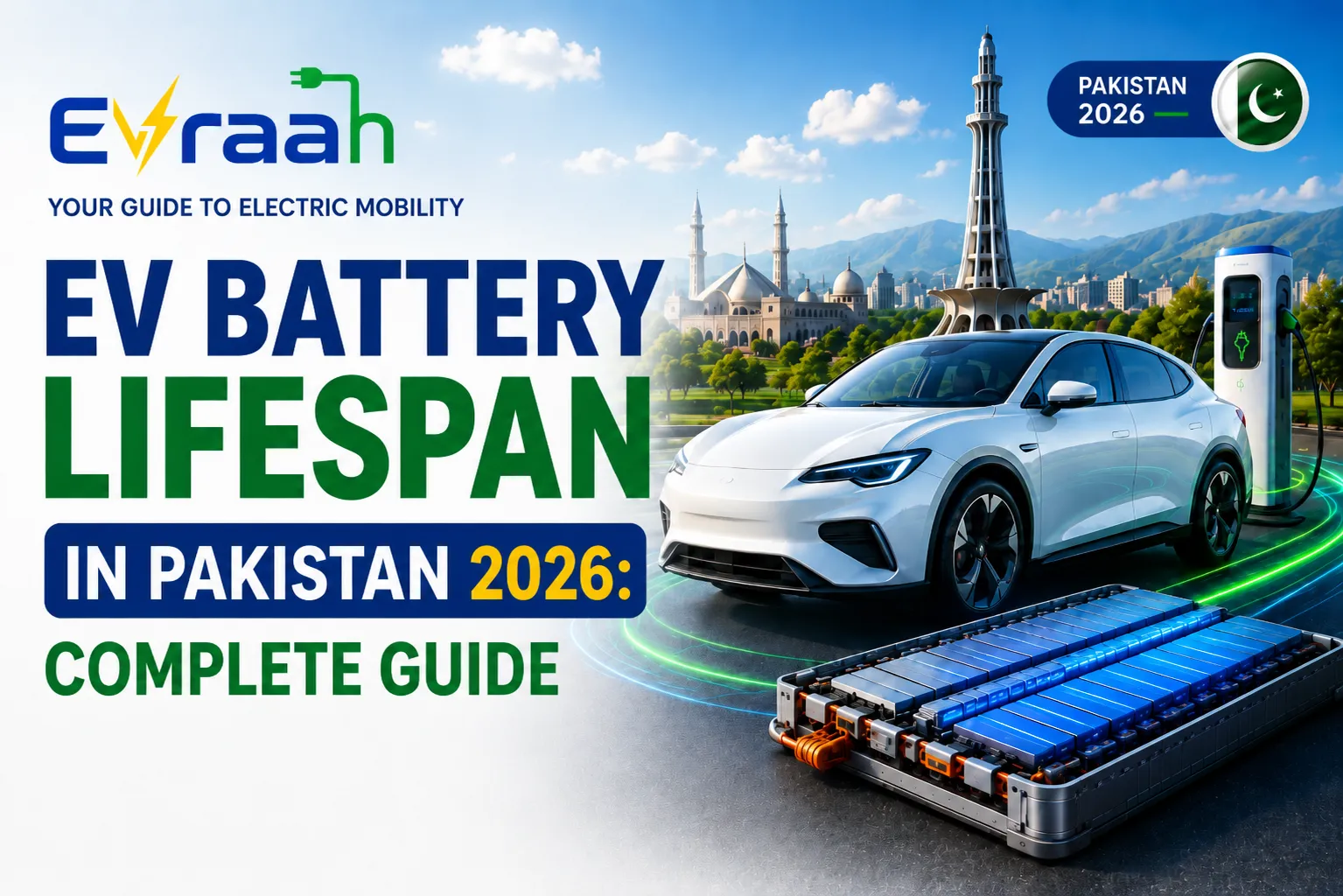
Buying an electric vehicle in Pakistan usually starts with one important question:
"How long will the battery last, and what happens when it needs replacement?"
For many buyers, the battery is the biggest concern when considering an EV. A petrol car owner understands engine oil changes, clutch repairs and mechanical maintenance. With electric vehicles, the battery becomes the component people think about most because it is expensive, advanced and responsible for the vehicle's range.
The reality, however, is more balanced than many online discussions suggest. Modern EV batteries are not designed to fail after a few years — manufacturers engineer them for long-term use, and real-world experience from mature EV markets, tracked by researchers including the National Renewable Energy Laboratory (NREL), shows that many batteries continue working well beyond their warranty period.
For Pakistani buyers, battery life deserves special attention because local conditions are different. Extreme summer temperatures, traffic congestion, long highway routes and a developing charging network all affect how an EV battery performs over time. This guide explains EV battery lifespan in Pakistan, battery degradation, charging habits, warranty coverage and what replacement could realistically cost.
Does an EV battery stop working after the warranty ends? No. A battery warranty is not an expiry date — it's a manufacturer guarantee that the battery will maintain a certain level of performance during the warranty period. Degradation after that point is gradual, not sudden.
What's In This Guide
- Why Battery Life Matters in Pakistan
- LFP vs NMC: Which Suits You
- How Long a Battery Actually Lasts
- Understanding Degradation
- Heat: The Pakistan-Specific Factor
- Does Fast Charging Damage Batteries?
- Battery Thermal Management
- Checking Battery Health (Used EVs)
- Battery Warranty by Brand
- Replacement Cost in Pakistan
- Does the Whole Pack Need Replacing?
- Battery Care Checklist
- Final Verdict
Why EV Battery Life Matters in Pakistan
Pakistan's EV market is growing quickly, in line with a global shift the International Energy Agency (IEA) tracks closely, but it is still relatively young. A buyer purchasing a BYD, Deepal, MG, Hyundai, ORA or JAECOO EV today is thinking about ownership several years into the future — and the concerns are understandable. A Karachi owner may worry about summer heat. A Lahore driver may wonder whether daily traffic, air-conditioning use and frequent charging will affect battery health. Someone importing an EV may be concerned about warranty coverage and battery condition.
The good news is that modern EV batteries are not simple battery packs — they are intelligent systems with cooling technology, sensors and software designed to protect the cells. Before choosing a vehicle, it's worth understanding the wider market through EVraah's Best Electric Cars in Pakistan 2026 guide, and if you're still deciding between a fully electric, hybrid, or plug-in hybrid model, EVraah's Types of EVs in Pakistan guide explains how battery size and chemistry differ across each category.
Pakistan's National EV Policy targets a significant share of new vehicle sales going electric by 2030 — see EVraah's Pakistan EV Target 2030 guide for what that means for the market you're buying into today.
Understanding EV Battery Chemistry: LFP vs NMC
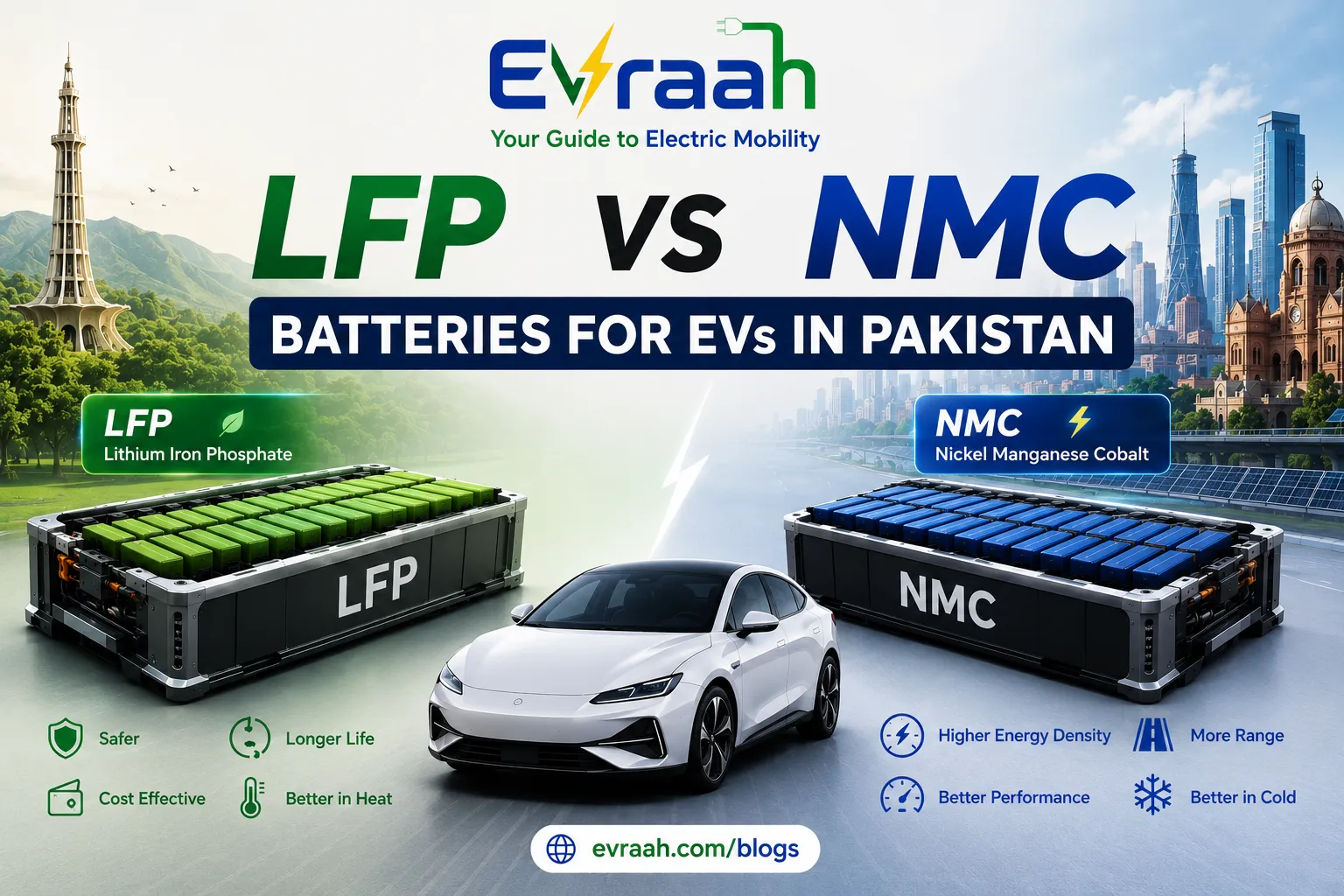
Battery chemistry plays an important role in durability, charging behaviour and performance. The two chemistries currently relevant in Pakistan are LFP (Lithium Iron Phosphate) — used in BYD's Blade Battery — and NMC (Nickel Manganese Cobalt), supplied by CATL for Deepal's models. For the full technical comparison, see EVraah's LFP vs NMC Battery Guide.
| Chemistry | Used In | Strengths | Trade-off |
|---|---|---|---|
| LFP (Blade Battery) | BYD Atto 2/3, Seal, Sealion 7; GWM/ORA | Long cycle life, strong heat tolerance, tolerates frequent full charging | Slightly lower energy density — needs a larger pack for similar range |
| NMC | Deepal S07 / L07 (CATL) | Higher energy density, longer range from a smaller/lighter pack | Prefers moderate daily charging; avoid long periods at 100% |
A vehicle parked outdoors during summer in Karachi, Lahore, or Multan experiences significant heat exposure — LFP batteries generally handle high temperatures better than NMC. The trade-off is energy density: NMC batteries store more energy in a smaller, lighter package.
LFP May Suit You If:
- You live in a hot region
- You charge frequently
- You want long-term durability
- You plan to keep the vehicle for many years
NMC May Suit You If:
- You need maximum range
- You travel long distances regularly
- Battery weight matters to you
Battery chemistry is only one part of battery life — cooling systems, software, and vehicle engineering also play a major role.
How Long Does an EV Battery Actually Last?
One of the biggest misunderstandings about EV ownership is confusing battery warranty with battery lifespan. They are different things: a battery warranty is the manufacturer's commitment; battery lifespan is how long the battery remains useful in real-world conditions. An EV battery does not suddenly fail when the warranty expires — instead, it slowly loses capacity over time.
For example, a new EV with a 400 km range may gradually provide less range after several years because the battery stores slightly less energy. The vehicle is still usable — the battery simply has reduced capacity compared with when it was new. Lithium-ion battery aging research from the U.S. Department of Energy shows that many batteries retain most of their usable capacity after years of operation.
Pakistan does not yet have enough old EVs on the road to provide complete local 10–15 year battery data. Be cautious of anyone making guaranteed predictions about long-term battery life specific to Pakistani conditions — the figures in this guide draw on international research and manufacturer data, clearly labeled as such.
What Is EV Battery Degradation?
Battery degradation means the gradual reduction in the battery's ability to store energy. Every lithium-ion battery experiences some degradation — the goal isn't to stop it completely, but to slow it down. Two main processes cause it.
Calendar Aging
Happens simply because time passes — even a parked EV battery slowly ages. Driven by heat exposure, storage conditions, and long periods at very high charge levels.
Cycle Aging
Happens through charging and discharging. A cycle represents using the equivalent of the battery's full capacity — using 50% today and 50% tomorrow is roughly one full cycle, not two. This is why regular top-up charging isn't necessarily harmful.
Degradation Example (Illustration Only)
This example is only for understanding, not a prediction. Imagine an EV with a 60 kWh battery:
| Battery Health | Remaining Capacity |
|---|---|
| 100% | 60 kWh |
| 90% | 54 kWh |
| 80% | 48 kWh |
| 70% | 42 kWh |
A battery at 90% health can still provide many years of useful service. A reduction in range does not automatically mean the battery is damaged — real-world range also changes because of air-conditioning, weather, highway speed, traffic, tyre pressure, and driving style.
What Causes EV Battery Degradation in Pakistan?
Heat: The Biggest Pakistan-Specific Factor
Cities including Karachi, Lahore, Multan, Islamabad, and Peshawar experience extremely hot summers, and vehicles parked outdoors can reach much higher temperatures than the surrounding air. High temperatures accelerate chemical reactions inside lithium-ion batteries, which can increase long-term degradation.
This does not mean EV batteries cannot survive in Pakistan. Modern EVs are designed for hot climates around the world and include active systems to control battery temperature. Pakistan's climate is a factor to consider, but it is not a reason to assume EV batteries will fail early.
Simple habits reduce unnecessary stress: park in shade whenever possible, avoid leaving the vehicle under direct sunlight for long periods, avoid unnecessary charging during peak afternoon heat, and keep cooling systems maintained.
Does Fast Charging Damage EV Batteries?
One of the most common myths about EV ownership is: "fast charging destroys the battery." The reality is more nuanced — EVraah's Fast Charging vs Slow Charging guide covers the speed and cost trade-offs in more detail, but on the battery-health side: DC fast charging creates more heat than slower AC charging, and because heat affects battery aging, frequent high-power charging can add stress over time.
However: occasional fast charging is normal, modern EVs are designed to handle DC charging, and battery management systems actively control charging speed and temperature. The real concern is repeated high-stress conditions — frequent back-to-back fast charging, charging in extreme heat, or keeping the battery at very high charge levels for long periods.
A Lahore-to-Islamabad trip using motorway fast chargers is exactly the situation DC charging was designed for — see EVraah's Lahore to Islamabad EV Charging Guide before a motorway trip, or use the EVraah Route Planner to map charging stops for any route.
Charging to 100%: Chemistry Matters
LFP Batteries
Generally tolerate full charging better. Some manufacturers recommend occasional full charges to help the BMS maintain accurate capacity readouts.
NMC Batteries
Generally benefit from avoiding long periods at very high charge. Reserve 100% for longer trips; keep daily charging moderate.
The best advice: follow your specific vehicle manufacturer's recommendation rather than applying one rule to every EV.
Battery Thermal Management: The Technology Protecting Your EV
An EV battery pack is a carefully managed system — cells, modules, a Battery Management System (BMS), temperature sensors, cooling systems, and safety electronics. The BMS constantly monitors battery temperature, cell voltage, charging speed, and overall condition. Many modern EVs use liquid cooling because it provides better temperature control than passive air cooling.
This is especially important in Pakistan because battery temperature directly affects charging performance, range, and long-term durability.
How to Check EV Battery Health Before Buying a Used EV
Buying a used EV requires more than checking the range shown on the dashboard — that estimate changes with temperature, driving style, AC usage, highway speed, and traffic. The more reliable measurement is State of Health (SOH) — the battery's current capacity compared with when it was new.
Ask for: a battery SOH report, a manufacturer diagnostic scan, remaining warranty details, full service history, accident history, a flood/water damage inspection, and any previous battery or BMS repair record. This is especially important for imported EVs, since warranty and service support may not always transfer.
EV Battery Warranty in Pakistan
Battery warranty is one of the strongest protections for EV buyers — but terms vary by brand, and buyers should always request the official document from the dealer, not a brochure summary.
| Brand / Model | Battery Warranty | Battery Type | Notes |
|---|---|---|---|
| BYD (Atto 2/3, Seal, Sealion 7) | ~8 years / 160,000 km | Blade LFP | Confirm exact Pakistan warranty terms with Mega Motor Company |
| MG ZS EV | ~8 years / 150,000 km | Lithium-ion | Confirm local warranty booklet |
| JAECOO EV models | ~8 years / 160,000 km | Lithium-ion | Confirm Pakistan-specific terms with NextGen Auto |
| Deepal S07 / L07 | Confirm with dealer | CATL NMC | Obtain the written battery warranty before purchase |
| Hyundai Ioniq 5 | Confirm Pakistan warranty | NMC | One source cites a notably short 4-year term — well below Hyundai's typical global 8-year EV warranty. Verify directly with Hyundai Nishat Motors rather than assuming either figure. |
Questions worth asking before buying: Is the warranty transferable? Is there a capacity guarantee? What mileage limit applies? Are flood or accident damages excluded? Are imported vehicles covered?
EV Battery Replacement Cost in Pakistan
Battery replacement is the biggest financial concern for many buyers. The honest answer:
Official EV battery replacement prices are currently not publicly published by any major manufacturer or distributor in Pakistan — this includes BYD, Deepal, MG, Hyundai, GWM/ORA, and JAECOO. Any exact price you see online should be treated carefully unless it comes directly from an authorised source.
| EV Model | Battery Type | Official Replacement Price |
|---|---|---|
| BYD Atto 2 | LFP Blade | Not publicly published |
| BYD Atto 3 | LFP Blade | Not publicly published |
| BYD Seal | LFP Blade | Not publicly published |
| Deepal S07 / L07 | CATL NMC | Not publicly published |
| MG ZS EV | Lithium-ion | Not publicly published |
| Hyundai Ioniq 5 | NMC | Not publicly published |
International battery replacement figures should not be directly converted into Pakistani prices — local taxes, labour costs, import duty, and supply chains are different. The final cost also depends on battery size, chemistry, and — critically — what actually needs fixing.
Does the Entire EV Battery Need Replacement?
Not always. An EV battery pack contains individual cells, modules, a Battery Management System, cooling system, wiring, contactors, and housing — a fault in one area does not automatically mean the entire battery must be replaced.
Minor Fault
A sensor, software, or BMS issue — often repairable without touching the cells.
Module-Level Problem
A damaged module may sometimes be replaced on its own, depending on vehicle design and local repair capability.
Major Failure
Extensive cell degradation or physical damage — this is where full replacement genuinely becomes necessary.
The common statement "one bad cell means the whole battery is finished" is not always true — but repair capability depends heavily on the brand, battery design, and availability of trained technicians in Pakistan specifically.
EV Battery Care Tips for Pakistani Owners
✔ Do
- Follow manufacturer charging recommendations
- Use home charging for daily use
- Maintain battery cooling systems
- Keep software updated
- Park in shade where possible
- Check battery health before buying used
✘ Avoid
- Repeated deep discharge
- Leaving NMC batteries at 100% for several days
- Ignoring battery warnings
- Unapproved battery modifications
For home charging setup, see EVraah's Home EV Charging Guide.
AC Charging vs DC Fast Charging
| Factor | AC Home Charging | DC Fast Charging |
|---|---|---|
| Speed | Slower | Faster |
| Heat generation | Lower | Higher |
| Daily use | Best option | Less common |
| Long trips | Less practical | Ideal |
| Battery impact | Gentle | Manageable when used properly |
Neither charging method is automatically good or bad — the biggest factors are frequency, temperature, and charging behaviour, not the method itself. EVraah's EV Charging Cost Guide breaks down the real cost difference between home and public charging, and the How Long Does It Take to Charge an EV guide covers realistic charging times on both AC and DC. For the bigger picture on where Pakistan's charging network is headed, see EVraah's EV Charging Network: The Future guide.
EV Battery vs Petrol Engine
| Factor | EV Battery | Petrol Engine |
|---|---|---|
| Normal wear | Gradual capacity loss | Mechanical wear |
| Maintenance | Lower | Higher |
| Moving parts | Few | Many |
| Major repair | Battery replacement can be expensive | Engine repairs can be expensive |
| Failure pattern | Usually gradual | Can sometimes be sudden |
EVs remove many routine maintenance costs, but buyers need to understand battery ownership and long-term planning — see EVraah's EV vs Petrol Car Running Cost Guide for a full cost comparison.
Should Battery Replacement Cost Stop You From Buying an EV?
For most buyers, the answer is no. Battery replacement cost is a genuine consideration, but it should not be the only factor. A modern EV battery is not a fragile component that regularly fails — with proper charging habits, thermal management, and maintenance, most owners can expect many years of reliable use.
The smarter approach: buy from a supported brand, understand warranty coverage in writing, check battery health when buying used, and follow sensible charging habits. Pakistan's EV ecosystem is still developing — as more vehicles age, repair networks, diagnostics, and replacement options will become clearer.
The balanced conclusion: EV batteries are expensive, but they are not fragile. For Pakistani buyers, understanding battery health matters far more than simply fearing replacement costs.
Disclaimer: Battery lifespan and degradation figures in this guide draw on international manufacturer data and research (NREL, U.S. Department of Energy, IEA) rather than Pakistan-specific long-term fleet data, which does not yet exist given how young the local EV market is. Warranty terms and replacement costs should always be confirmed in writing with the relevant manufacturer or dealer before making a purchase decision.
Related blogs
More from EV Basics.
You may also like
 Pakistan EV News
Pakistan New EV Policy 2026-2031: What Changes for Buyers
3 min read · 20 Oct 2026
 Buying Guides
BYD Atto 3 Price in Pakistan 2026: Specs, Range and Charging Cost
4 min read · 19 Oct 2026
 Buying Guides
BYD Atto 2 Price in Pakistan 2026: Specs, Range, Features and Charging Cost
6 min read · 14 Oct 2026