Types of EVs in Pakistan: BEV vs HEV vs PHEV vs FCEV
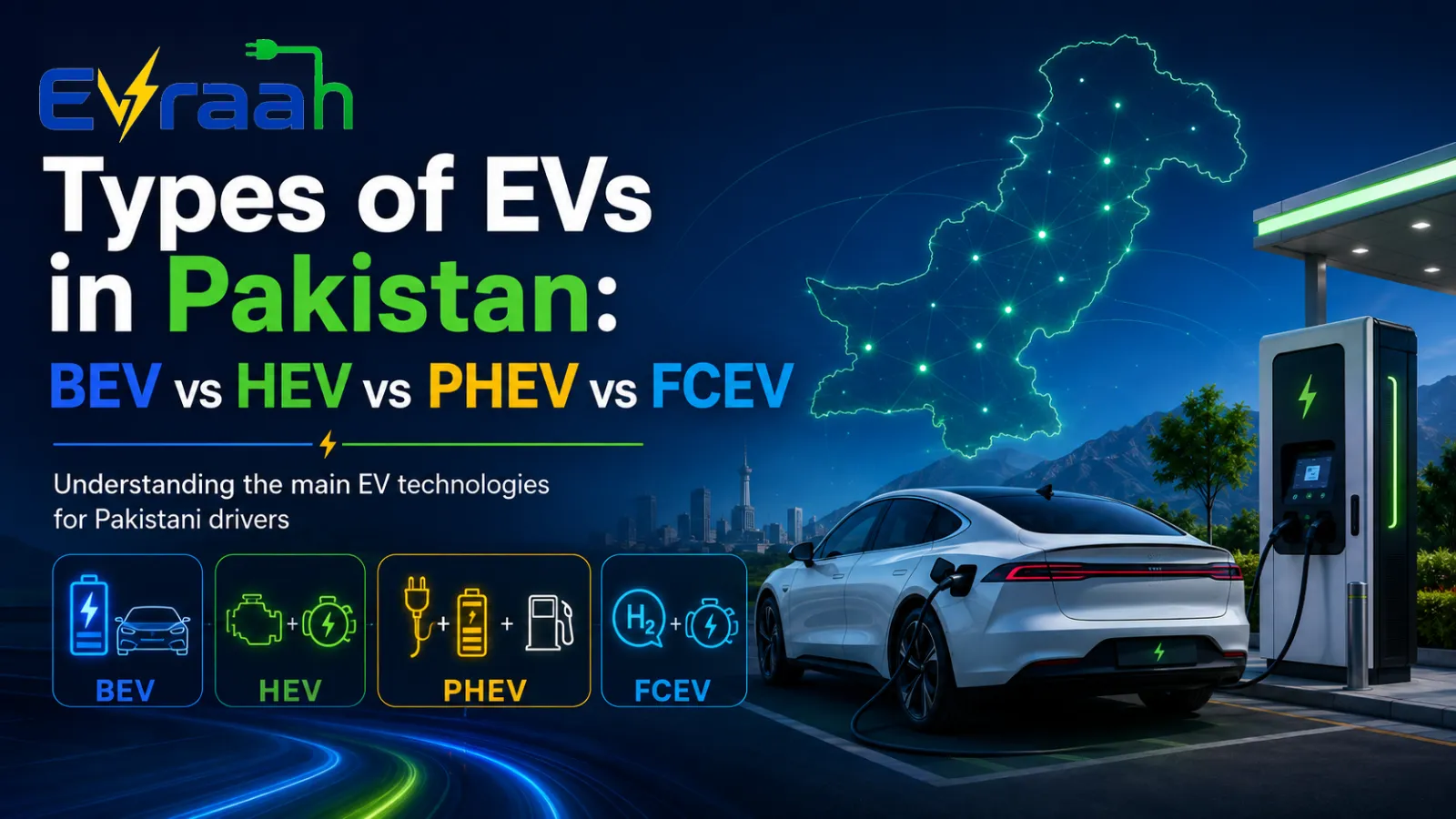
Types of Electric Vehicles Explained: BEV vs HEV vs PHEV vs FCEV — Which One Is Right for Pakistan?
Pakistani car buyers are hearing terms such as BEV, HEV, PHEV and FCEV more frequently as electric and hybrid vehicles become a bigger part of the local automotive market.
BYD, Deepal, MG, Hyundai and Kia now officially market battery-electric vehicles in Pakistan, while Honda, Toyota, Haval, Hyundai, Kia and MG offer different forms of hybrid technology.
But these labels describe very different powertrains.
A BEV runs completely on electricity. An HEV combines a petrol engine with an electric motor but normally cannot be plugged in. A PHEV also combines petrol and electric power, but adds a larger battery that can be externally charged. An FCEV is electrically driven but generates electricity onboard using hydrogen.
For Pakistani buyers, understanding these differences matters because the right choice depends on home charging, electricity supply, motorway travel, fuel costs, dealer support and how the vehicle will actually be used.
Pakistan is also working toward much wider EV adoption under its national electrification plans. For more background on where the market is heading, read Evraah’s guide to Pakistan’s EV target for 2030.
What Are the Different Types of Electric Vehicles?
The four main categories are:
- BEV — Battery Electric Vehicle: fully electric with no petrol or diesel engine.
- HEV — Hybrid Electric Vehicle: petrol engine + electric motor + battery, normally without external charging.
- PHEV — Plug-in Hybrid Electric Vehicle: petrol engine + electric motor + larger rechargeable battery.
- FCEV — Fuel Cell Electric Vehicle: an electric vehicle that generates electricity onboard using hydrogen.
BEVs, HEVs and PHEVs are already relevant to Pakistani buyers. FCEVs remain primarily a technology to understand rather than a mainstream local purchase option.
1. BEV — Battery Electric Vehicle
A Battery Electric Vehicle is what most people mean when they say “fully electric car.”
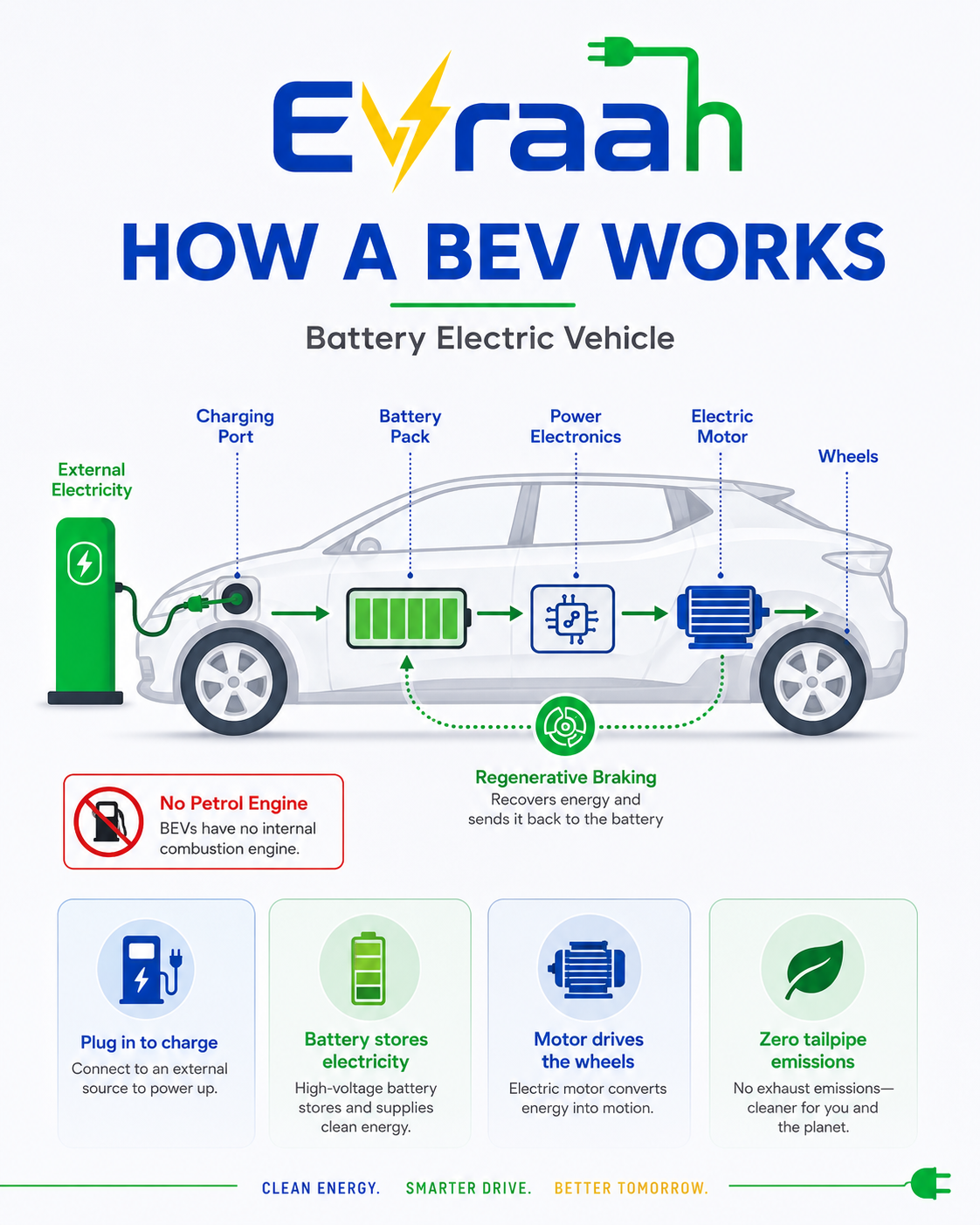
There is no petrol or diesel engine. Energy is stored in a large traction battery and supplied to one or more electric motors. When the battery becomes depleted, the vehicle must be connected to an external electricity source.
Electric motors deliver torque quickly, so BEVs generally feel smooth and responsive from low speeds. Regenerative braking can also recover some energy when the vehicle slows down and send it back to the battery.
How Is a BEV Charged?
A BEV can normally be charged using:
Home or workplace AC charging: Usually the most convenient option for everyday ownership because the vehicle can charge while parked for several hours.
Public AC charging: Useful at offices, shopping centres, hotels and other destinations.
DC fast charging: Particularly useful during motorway and intercity journeys because it can replenish the battery much faster than normal AC charging.
The actual charging time depends on several factors, including battery size, the charger’s output and the maximum charging rate supported by the vehicle. Evraah’s guide on how long it takes to charge an EV in Pakistan explains these differences in more detail.
It is also useful to understand the difference between AC and DC charging before buying. Our guide to fast charging vs slow charging for EVs in Pakistan explains where each type makes the most sense.
For Pakistani buyers, home charging can significantly influence how convenient a BEV feels. Someone who can charge overnight has a very different ownership experience from someone who must depend entirely on public chargers.
BEVs Officially Marketed in Pakistan
Pakistan’s officially marketed BEV selection has expanded considerably.
BYD Atto 2, Atto 3, Seal and Sealion 7: BYD Pakistan currently lists these models as fully electric vehicles. The Atto 3 is advertised with a manufacturer-claimed range of up to 410 km, while selected Seal variants are advertised with substantially higher claimed range figures depending on specification.
Deepal L07 and S07: Deepal markets the L07 as an all-electric sedan and the S07 as an all-electric SUV in Pakistan. Their official advertised range figures vary by model and testing standard.
MG4 EV Urban: MG Pakistan currently markets the MG4 EV Urban with a 43 kWh LFP battery and an advertised WLTP range of up to 316 km.
MG Binguo EV: A smaller battery-electric model positioned more toward urban use.
MG Cyberster: MG’s fully electric roadster is another officially represented BEV, although it serves a very different buyer from mainstream family EVs.
Hyundai IONIQ 5 and IONIQ 6: Both are officially represented in Hyundai Nishat’s Pakistani lineup as battery-electric vehicles.
Kia EV5 and EV9: Kia Pakistan also lists these as fully electric models.
Manufacturer-claimed range should always be treated as a test-cycle figure. Actual range can change with motorway speed, air-conditioning use, temperature, driving style, traffic and elevation.
Who Should Buy a BEV?
A BEV makes the strongest case for someone who has secure home or workplace charging, predictable daily travel and enough battery range for most routine journeys.
For drivers covering regular city commutes in Karachi, Lahore or Islamabad, a BEV can eliminate petrol use completely during everyday driving.
2. HEV — Hybrid Electric Vehicle
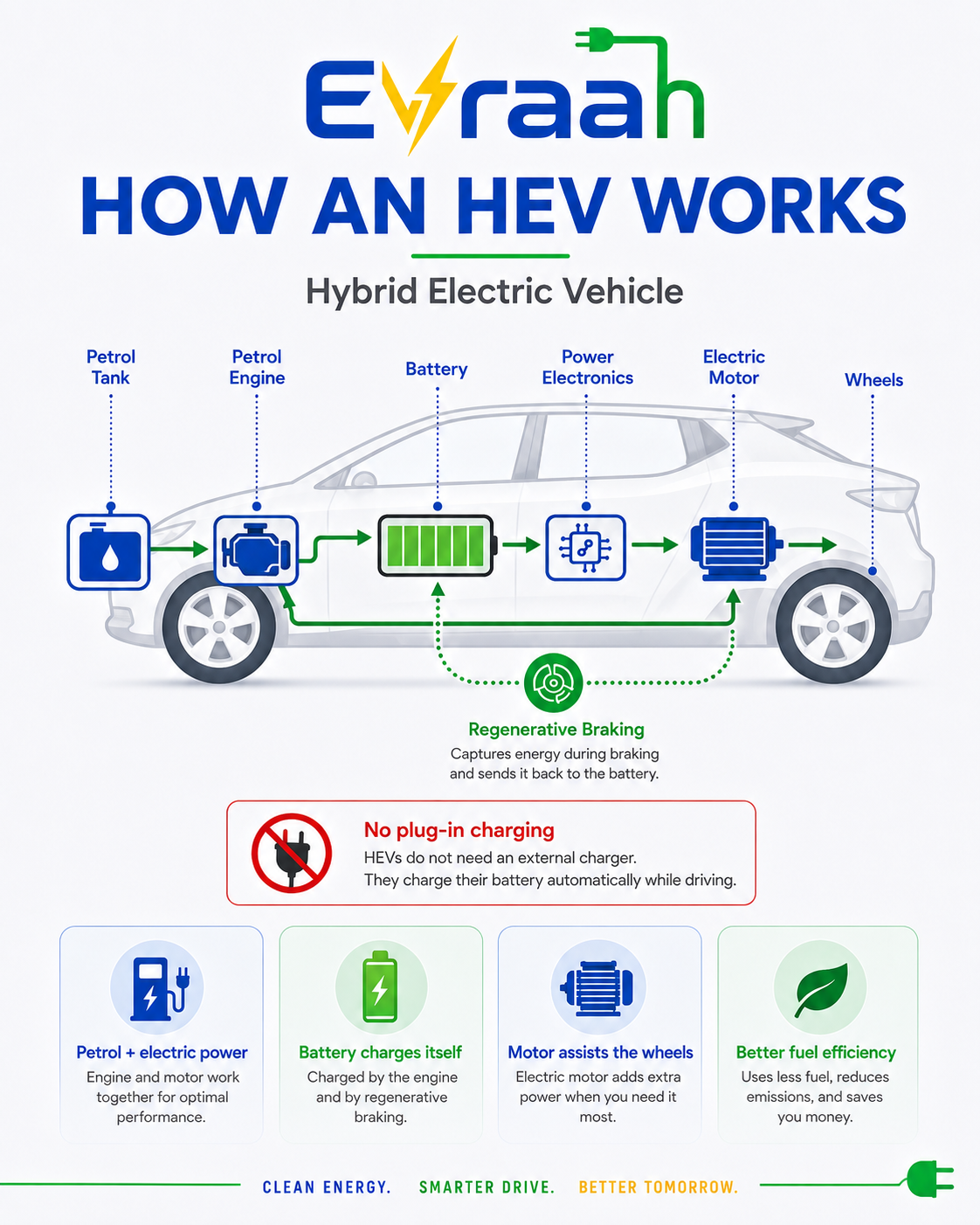
A conventional Hybrid Electric Vehicle combines:
Petrol engine + electric motor + battery
Unlike a PHEV, a normal HEV is not usually plugged into an external charger.
Its battery receives energy through the hybrid system and regenerative braking. During deceleration, the electric motor can work as a generator, converting part of the vehicle’s kinetic energy back into electricity.
This makes HEVs particularly useful in stop-start urban traffic.
Some full hybrids can move on electric power alone for short periods or at low speeds, but their batteries are much smaller than those found in BEVs or PHEVs. The petrol engine remains an essential part of normal operation.
Honda’s e:HEV system is one example. The term e:HEV is Honda’s branding for its hybrid technology; it is not a separate vehicle category.
HEVs Officially Available in Pakistan
Honda HR-V e:HEV: Honda Atlas officially introduced the HR-V e:HEV in Pakistan. Honda’s current local lineup does not list City e:HEV or Civic e:HEV as Pakistan-market models.
Toyota Corolla Cross HEV: Indus Motor Company officially markets the locally manufactured Corolla Cross Hybrid Electric.
Haval H6 HEV: Haval Pakistan offers a hybrid version of the H6 alongside other powertrain options.
Kia Sportage L HEV: Kia Pakistan markets hybrid versions of the current Sportage L.
Kia Niro and Sorento Hybrid: Kia’s local range also includes additional hybrid offerings.
Hyundai Elantra Hybrid, Tucson Hybrid and Santa Fe Hybrid: Hyundai Nishat has expanded its hybrid portfolio across multiple vehicle segments.
MG ZS Hybrid+ and MG HS Hybrid+: MG Pakistan markets both as petrol-electric hybrids.
An HEV is particularly relevant for drivers who want improved fuel efficiency but cannot install a charger at home.
You still visit a petrol station just as you would with a conventional car, making the transition relatively simple.
3. PHEV — Plug-in Hybrid Electric Vehicle
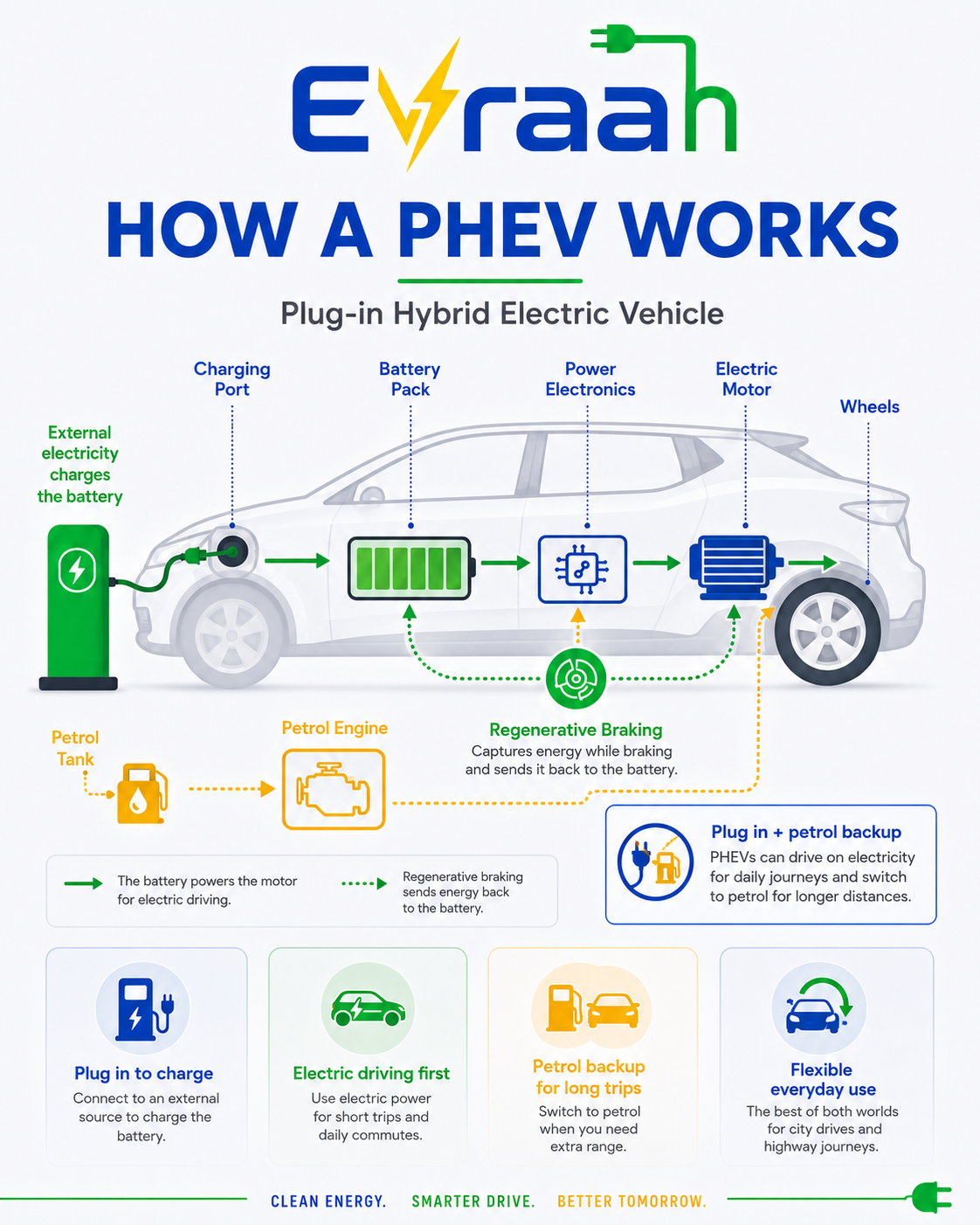
A Plug-in Hybrid Electric Vehicle combines:
Petrol engine + electric motor + larger rechargeable battery
The major difference between an HEV and a PHEV is that the PHEV can be connected to an external electricity source.
That larger battery allows the vehicle to cover a meaningful distance using electric power before the petrol engine becomes necessary.
In practical Pakistani use, this can mean:
Daily commute → electric driving where battery range allows
Long trip → electric system + petrol engine
That combination can be attractive for someone who drives mostly within the city during the week but also makes regular motorway journeys.
Charging a PHEV Matters
A PHEV delivers its greatest fuel-saving benefit when the owner charges it regularly.
If the battery is charged overnight and the daily commute falls within its usable electric range, petrol consumption during normal weekday driving can be greatly reduced.
If the owner rarely plugs it in, however, the vehicle continues carrying a larger battery and electric system without taking full advantage of them.
This is why access to home or workplace charging should still be considered before choosing a PHEV.
PHEVs Officially Marketed in Pakistan
MG HS PHEV: MG Pakistan markets the HS Plug-in Hybrid with a 16.6 kWh battery and an advertised electric-only range of more than 50 km.
MG HS Super Hybrid: Despite its “Super Hybrid” name, the vehicle is positioned as a plug-in hybrid and uses a larger rechargeable battery. MG advertises up to 135 km of electric range under the NEDC testing cycle.
BYD Shark 6: BYD Pakistan classifies the Shark 6 pickup as a PHEV and advertises a combined driving range of up to 800 km under its stated testing conditions.
Haval H6 PHEV: GWM Pakistan currently offers a plug-in hybrid version of the H6 alongside petrol and HEV versions.
Kia Sorento PHEV: Kia Pakistan also represents a plug-in hybrid version of the Sorento with a rechargeable traction battery.
A PHEV can therefore be particularly suitable for a Pakistani household that wants electric commuting without relying entirely on charging infrastructure during longer journeys.
4. FCEV — Fuel Cell Electric Vehicle
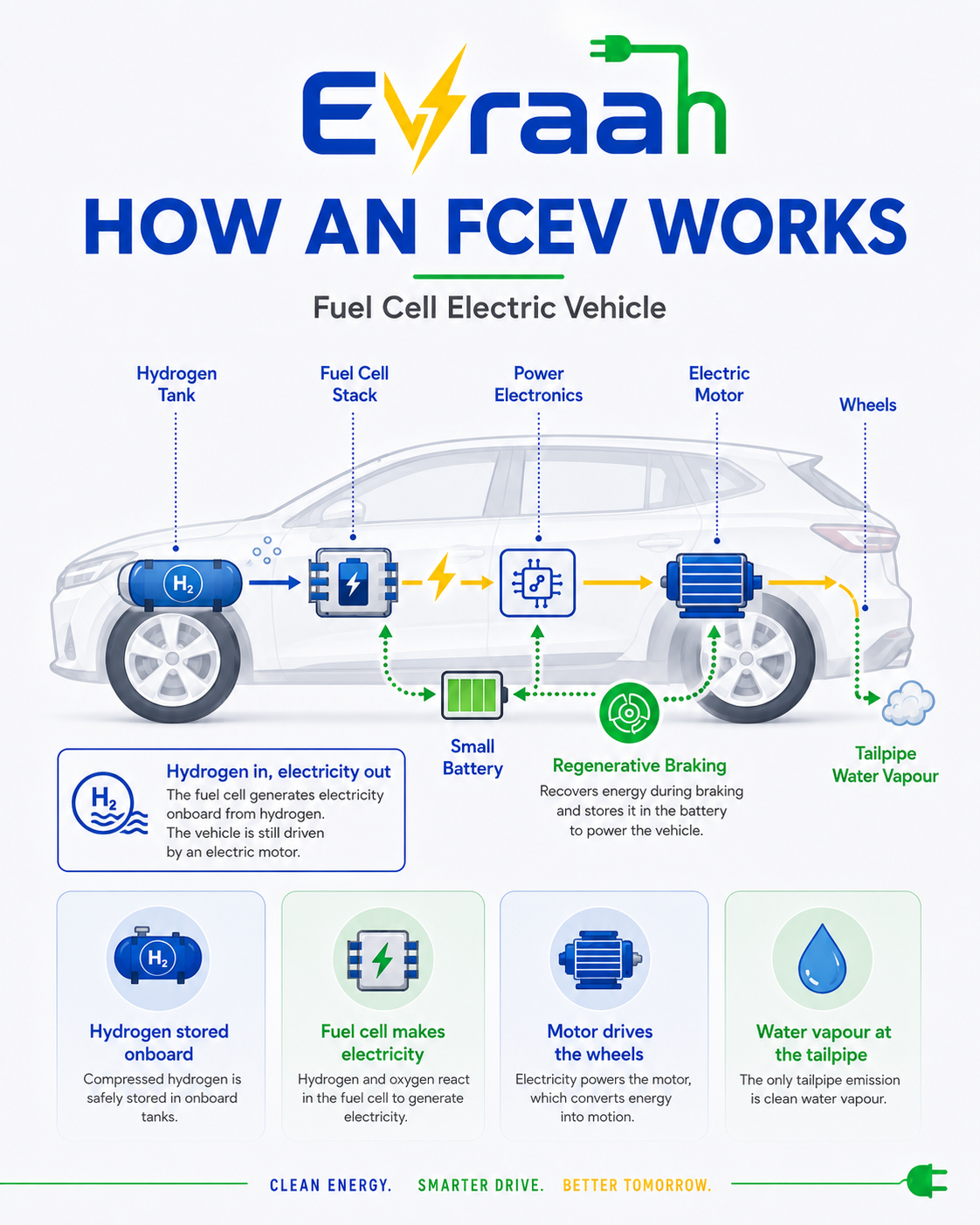
A Fuel Cell Electric Vehicle is also electrically driven, but it stores hydrogen rather than relying primarily on a large battery charged from the grid.
Hydrogen is supplied to a fuel-cell stack, where electricity is generated onboard and sent to the electric motor. A smaller battery is usually included to manage energy and store electricity recovered through regenerative braking.
The key difference is simple:
BEV → stores electricity in a rechargeable battery
FCEV → stores hydrogen and generates electricity onboard
That means BEVs need charging infrastructure, while FCEVs require specialised hydrogen production, storage and high-pressure refuelling facilities.
International examples include the Toyota Mirai and Hyundai Nexo. These demonstrate how FCEV technology works but should not be treated as mainstream officially marketed passenger vehicles in Pakistan.
BEV vs HEV vs PHEV vs FCEV
| Feature | BEV | HEV | PHEV | FCEV |
|---|---|---|---|---|
| Petrol/Diesel Engine | No | Yes | Yes | No |
| Electric Motor | Yes | Yes | Yes | Yes |
| Battery | Large | Small | Medium/Large | Smaller than typical BEV |
| External Charging | Yes | No | Yes | No |
| Petrol Refuelling | No | Yes | Yes | No |
| Hydrogen Refuelling | No | No | No | Yes |
| Zero Tailpipe Emissions | Yes | No | In electric mode only | Yes |
| Typical Use | Full electric driving | Fuel-saving hybrid driving | Electric commuting + petrol backup | Hydrogen-powered electric driving |
| Pakistan Infrastructure | Developing | Existing petrol network | Petrol + developing EV charging | Very limited |
| Long-Distance Suitability | Good with planning | Very good | Very good | Not practical locally |
Which Type of EV Is Best for Pakistani Drivers?
There is no single answer because different driving patterns favour different technologies.
For a Karachi, Lahore or Islamabad Daily Commuter
If you have home or workplace charging and your daily distance is comfortably within the vehicle’s range, a BEV can make excellent sense.
If you cannot charge reliably, an HEV gives you electrified driving without changing your refuelling routine.
For Someone Living in an Apartment
Start by checking your parking arrangement.
Can you install a charger? Is the parking space permanently allocated? Can electricity use be separately metered? Does the building have sufficient electrical capacity?
If dependable charging cannot be arranged, an HEV may be more practical than a BEV or PHEV.
For Someone Frequently Travelling Between Lahore and Islamabad
A sufficiently long-range BEV can handle the route with proper charging planning as motorway infrastructure improves.
Before making the journey, it is worth checking Evraah’s dedicated Lahore to Islamabad EV charging guide for the M-2, which focuses specifically on planning charging stops along this route.
A PHEV provides additional flexibility because its petrol engine can continue the journey when charging is inconvenient.
For Someone Who Drives Mostly in City Traffic
Both BEVs and HEVs work well in stop-start traffic because regenerative braking can recover energy during repeated deceleration.
The main deciding factor is likely to be charging access.
For Someone Worried About Charging Infrastructure
An HEV offers the least disruption.
A PHEV makes sense when charging is available most days but you still want petrol backup.
A BEV becomes easier to recommend when reliable home or workplace charging is available.
For Someone Looking for the Lowest Running Cost
Rather than relying on a fixed “rupees per kilometre” figure, calculate costs using your own rates.
For a BEV:
kWh consumed per 100 km × electricity price
For an HEV:
litres consumed per 100 km × petrol price
For a PHEV, calculate the electric and petrol portions separately.
Purchase price, financing, servicing, tyres and insurance should also be included in the ownership calculation.
What About EV Charging Infrastructure in Pakistan?
Pakistan’s EV charging network is expanding but remains much smaller than the petrol-station network.
For most BEV owners, home AC charging is likely to be the most convenient option. Public AC chargers can be useful at offices, malls and hotels, while DC fast chargers are especially important for motorway and intercity travel.
Drivers planning motorway journeys can use Evraah’s guide to EV charging stations on Pakistan’s motorways to understand the growing charging network on major routes.
Longer journeys require more planning. For example, drivers considering a cross-country trip can consult the Karachi to Lahore EV charging playbook for route-specific charging guidance.
Connector compatibility matters too. A charging station is useful only if your vehicle supports the available connector. Evraah’s guide to EV charging connectors in Pakistan, including CCS2, Type 2 and CHAdeMO explains the main standards Pakistani EV owners are likely to encounter.
Drivers should still verify a charger’s location, connector, power output and operational status before depending on it for a road trip.
What Should You Check Before Buying an EV in Pakistan?
Before choosing a BEV or PHEV, confirm where you will charge it.
Check whether your home electrical connection can support the charger and whether a proper dedicated installation can be arranged.
Also investigate:
- Home charging availability.
- Electricity connection and electrical load.
- AC and DC charging times.
- DC fast-charging compatibility.
- Battery warranty.
- Battery and high-voltage repair support.
- Spare parts availability.
- Dealer and workshop network.
- Insurance.
- Vehicle financing.
- Resale uncertainty.
- Ground clearance.
- Motorway charging on your regular routes.
- Electricity and petrol prices.
- Imported or locally assembled status.
- Software and connected-car support in Pakistan.
Battery warranties should be checked carefully for years, kilometre limits, coverage conditions and transferability.
Ground clearance is also worth checking against your actual roads, speed breakers and ramps rather than assuming all EVs have similar dimensions.
Software features deserve similar attention. A feature available on an international model may not necessarily be enabled or supported in Pakistan.
Final Verdict
If you have reliable home charging and predictable daily travel, a BEV offers the clearest move away from petrol.
If charging is not practical where you live or work, an HEV provides an easier route into electrified driving while keeping the familiar petrol-refuelling experience.
If you can charge regularly but also make frequent motorway journeys, a PHEV can provide a useful balance between electric commuting and long-distance flexibility.
An FCEV is electrically driven too, but hydrogen infrastructure means it is not currently a practical mainstream option for most Pakistani private buyers.
Instead of asking only:
“Which is the best EV in Pakistan?”
Ask:
“Which powertrain fits where I park, how far I drive, how often I travel between cities and how easily I can recharge?”
That question will usually lead to a much better buying decision.
Frequently Asked Questions
What are the four main types of electric vehicles?
The four commonly discussed categories are BEV, HEV, PHEV and FCEV. They differ mainly in how electricity is stored or generated and whether a petrol engine is also used.
Is a BEV better than a hybrid in Pakistan?
A BEV can make more sense if you have dependable charging and predictable mileage. An HEV can be more convenient if home charging is unavailable.
What is the difference between HEV and PHEV?
An HEV normally cannot be plugged into an external charger. A PHEV has a larger rechargeable battery and can drive farther using electricity alone.
Can a hybrid car be charged at home?
A conventional HEV normally cannot be plugged in. A PHEV can be charged at home.
Is MG HS PHEV a fully electric car?
No. It combines a petrol engine, electric motor and rechargeable battery, making it a plug-in hybrid rather than a BEV.
Are BYD cars fully electric?
Not all BYD vehicles are BEVs. In Pakistan, models such as the Atto 2, Atto 3, Seal and Sealion 7 are electric, while the Shark 6 uses a plug-in hybrid powertrain.
Are FCEV cars available in Pakistan?
International FCEVs such as the Toyota Mirai and Hyundai Nexo demonstrate the technology, but FCEVs are not currently a mainstream passenger-car option in Pakistan.
Which type is best for long-distance driving in Pakistan?
HEVs and PHEVs currently offer the easiest flexibility because they can use the existing petrol network. Long-range BEVs can also handle major routes with proper charging planning.
Related blogs
More from Buying Guides.
Deepal S07 vs BYD Sealion 7: Detailed Comparison for Pakistan
BYD Atto 2 vs MG4 Urban: Price, Range, Features & Which EV Makes More Sense in Pakistan?