
LFP vs NMC Batteries Explained Simply: Which Is Better for EVs in Pakistan?
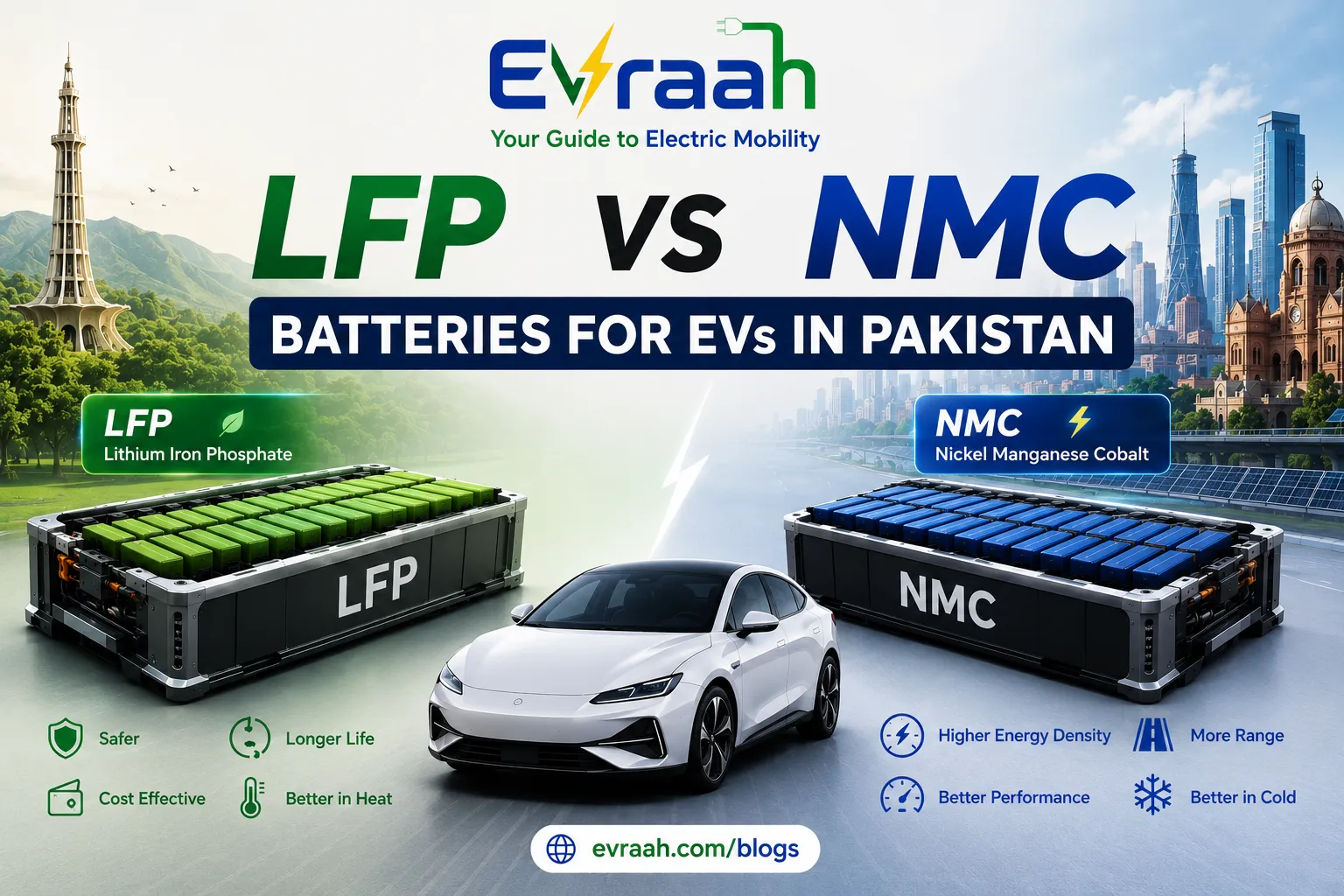
LFP vs NMC Batteries Explained Simply: Which Is Better for EVs in Pakistan?
You're comparing two electric cars. One has an LFP battery, while the other uses NMC. Their prices may be close, both appear to offer enough range for your daily driving, and both come from established manufacturers.
So which battery should you choose?
That question is becoming more relevant as Pakistan's EV market expands. Battery chemistry affects how much energy an electric car can store, how heavy its battery needs to be, how the pack behaves in heat, how it handles repeated charging and how it may age over years of ownership.
For someone commuting around Lahore or Karachi, the priorities may be very different from those of a driver regularly travelling between Lahore and Islamabad.
LFP generally favors longevity, thermal stability and lower cost. NMC generally favors higher energy density, lower battery weight and greater range potential. Neither chemistry is automatically the better battery for every EV buyer.
Better Fit for Durability
Strong cycle life, good thermal stability and comparatively low battery cost make LFP attractive for daily city driving, frequent charging and long-term ownership.
Better Fit for Energy Density
Higher energy density allows manufacturers to potentially provide more range without making the battery pack as large or heavy.
LFP vs NMC: What's the Difference?
Both LFP and NMC are types of lithium-ion batteries. The main difference lies in the materials used in the battery's cathode.
LFP stands for Lithium Iron Phosphate. It uses iron and phosphate and is known for strong thermal stability, comparatively low material cost and good cycle durability.
NMC stands for Nickel Manganese Cobalt. It uses different combinations of nickel, manganese and cobalt and is valued mainly because it can store more energy without requiring as much battery weight or space.
| Feature | LFP Battery | NMC Battery |
|---|---|---|
| Full Name | Lithium Iron Phosphate | Nickel Manganese Cobalt |
| Energy Density | Lower | Higher |
| Battery Weight | Usually heavier for the same stored energy | Usually lighter |
| Cycle Durability | Generally stronger | Generally lower than LFP under comparable conditions |
| Thermal Stability | Generally stronger | More heat-sensitive at cell chemistry level |
| High State of Charge | Generally more tolerant | Greater benefit from avoiding prolonged high SOC |
| Raw-Material Cost | Generally lower | Generally higher |
| Range Potential | Good | Generally higher for similar weight or size |
| Cold Weather | Generally more affected | Generally performs better |
| Best Suited For | Daily driving, frequent charging, longevity and lower cost | Long-range, weight-sensitive and performance applications |
If you're comparing complete vehicles, EVraah's Best Electric Cars in Pakistan 2026 guide is a useful place to compare current EV options.
What Is an LFP Battery?
LFP stands for Lithium Iron Phosphate, commonly written as LiFePO₄.
Its main attraction isn't maximum energy density. Manufacturers use LFP because it combines relatively inexpensive materials with strong durability and good thermal stability.
LFP batteries don't require nickel or cobalt in their cathodes. Instead, they use iron and phosphate, helping reduce dependence on some of the more expensive materials found in other lithium-ion chemistries.
Why LFP Batteries Are Popular in EVs
LFP was once associated mainly with lower-cost electric cars with modest range. That picture has changed considerably.
Better cell design and more efficient pack construction have allowed manufacturers to extract much better performance from LFP batteries. NMC still holds an energy-density advantage, but the gap has narrowed enough for LFP to appear in an increasingly broad range of vehicles.
Chinese automakers have pushed the chemistry particularly hard. BYD's well-known Blade Battery, for example, uses LFP chemistry.
Advantages of LFP
For an EV owner, LFP's strengths are practical. It generally handles repeated charging and discharging well, offers strong intrinsic thermal stability and usually costs less to manufacture than nickel-rich alternatives.
Battery research also commonly finds longer cycle life for LFP than comparable NMC batteries.
That doesn't mean an LFP battery lasts forever. Real-world battery life still depends on temperature, charging habits, cooling, software and vehicle design.
Limitations of LFP
The biggest compromise is energy density.
If two battery packs need to store the same amount of electricity, an LFP pack will generally require more weight or volume than an equivalent NMC pack.
LFP can also be more affected by very cold temperatures. That isn't a major concern for Karachi or Multan, although it can become relevant in colder parts of northern Pakistan.
What Is an NMC Battery?
NMC stands for Nickel Manganese Cobalt.
Different NMC batteries use different proportions of these materials, so NMC is better understood as a family of related battery chemistries rather than one identical battery design.
Why Automakers Use NMC
The biggest reason is energy density.
Imagine two battery packs occupying roughly the same amount of space. If one can hold considerably more electricity, the manufacturer may be able to provide additional driving range without making the vehicle substantially larger or heavier.
That makes NMC attractive for long-range SUVs, premium sedans and performance-focused EVs.
Advantages of NMC
NMC's higher energy density gives vehicle engineers more flexibility. They can potentially fit more battery capacity into limited space, reduce battery weight for a particular capacity or target greater driving range.
For Pakistani drivers who regularly travel long distances on motorways, that advantage can be genuinely useful.
Limitations of NMC
NMC batteries generally benefit more from avoiding prolonged periods at very high states of charge, particularly during hot weather.
They are also intrinsically less thermally stable than LFP cells, although modern cooling systems, battery-management software and pack engineering are designed to keep the battery within suitable operating temperatures.
Energy Density and Driving Range
Energy density sounds technical, but the idea is simple:
This is where NMC usually has the advantage.
That doesn't mean every NMC vehicle travels farther than every LFP vehicle. A 70 kWh LFP battery stores more electricity than a 50 kWh NMC battery.
Actual range also depends on aerodynamics, motor efficiency, tyre size, vehicle weight, air-conditioning use and driving speed.
This becomes particularly important on Pakistani motorways because an EV that is very efficient in city traffic may consume considerably more energy at sustained motorway speeds.
See EVraah's EV Charging Stations on Pakistan Motorways guide for intercity charging information.
Battery Life and Degradation
LFP generally has an advantage in cycle durability, but battery-life claims are often exaggerated.
A battery cycle means using the equivalent of 100% of its capacity. It doesn't necessarily mean draining the battery from 100% to 0% in one drive.
If you use 50% today and another 50% tomorrow, those two periods together represent roughly one equivalent full cycle.
Battery degradation is gradual. The pack normally doesn't suddenly become unusable after reaching a particular age or cycle count.
Instead, its ability to store energy slowly declines, which gradually reduces maximum driving range.
- Temperature
- Depth of discharge
- Charging habits
- Fast-charging frequency
- Battery thermal management
- BMS software
- Cell quality
- Vehicle mileage
- Calendar age
An ordinary driver covering 40–60 km per day could reasonably expect either a properly engineered LFP or NMC battery to provide a long useful life. LFP's cycle-life advantage becomes more valuable for high-mileage drivers, fleets and people planning to keep an EV for many years.
Safety and Heat: Why Pakistan Changes the Comparison
Lahore, Karachi, Multan and many other Pakistani cities regularly experience intense summer temperatures.
High temperatures can accelerate some of the unwanted chemical reactions associated with lithium-ion battery aging.
That doesn't mean Pakistan's weather automatically damages EV batteries. Modern EVs continuously monitor battery temperature and can regulate charging speed or performance when necessary.
Which Chemistry Handles Heat Better?
At cell-chemistry level, LFP generally has stronger thermal stability than NMC.
But battery chemistry isn't the whole thermal-management system.
A properly engineered NMC vehicle with effective liquid cooling can operate well in Pakistan. Likewise, choosing LFP doesn't make good cooling unnecessary.
Charging LFP vs NMC
Should You Charge an LFP Battery to 100%?
LFP batteries are generally more tolerant of high states of charge.
Some manufacturers allow or recommend regular full charging for particular LFP-powered vehicles.
However, different vehicles use different battery buffers and software strategies, so follow the charging guidance for your exact car.
Should You Charge an NMC Battery to 100%?
You can charge an NMC battery to 100% when you need the additional range.
If you're leaving Lahore for Islamabad tomorrow morning, starting with a full battery may make complete sense.
The habit worth avoiding is unnecessarily leaving an NMC battery at a very high state of charge for extended periods, particularly during extreme summer heat.
What About DC Fast Charging?
Both LFP and NMC batteries can support DC fast charging.
Battery temperature, SOC, battery voltage, charger output, cooling capability and the manufacturer's charging curve all influence charging speed.
Read EVraah's Fast Charging vs Slow Charging guide .
You can also check the EV Charging Time in Pakistan guide for typical charging durations.
For everyday charging, read the Home EV Charging in Pakistan guide .
For running-cost calculations, use EVraah's EV Charging Cost in Pakistan guide .
Which EVs in Pakistan Use LFP or NMC Batteries?
Pakistan's current EV market includes vehicles using both LFP and NMC battery chemistries. BYD is one of the most visible LFP users through its Blade Battery technology, while several other Pakistan-market EVs use NMC battery packs.
Battery chemistry can vary by trim, model year and market, so always confirm the exact Pakistan-spec vehicle before buying. The infographic below provides a quick model-by-model comparison.
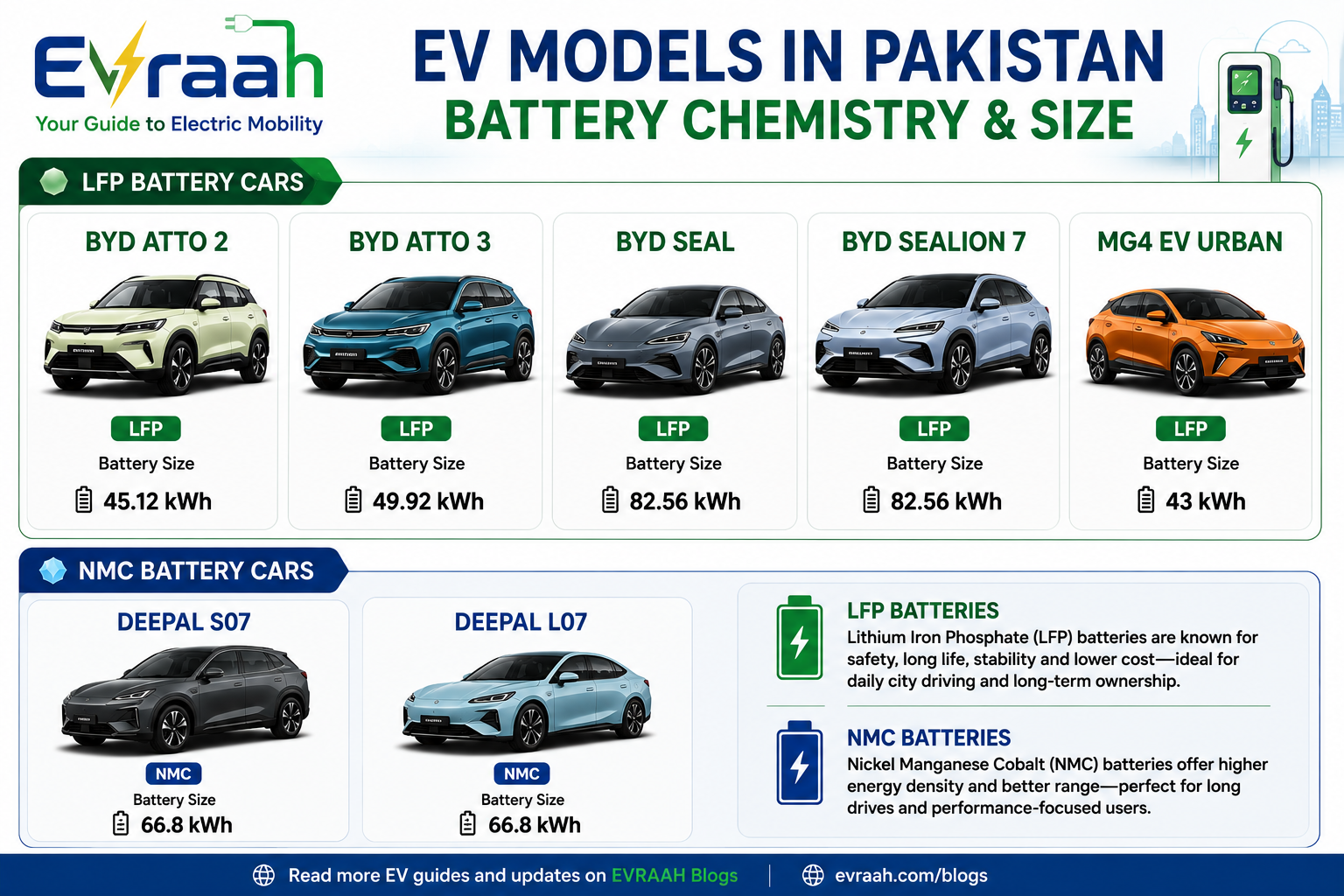
If you're also comparing charging compatibility, EVraah's EV Charging Connectors in Pakistan guide explains the main connector standards.
Which Battery Is Better for Pakistani EV Drivers?
For Daily City Driving
Imagine someone in Lahore covering around 40–60 km per day.
The car is mainly used for commuting, school runs, shopping and local errands, then plugged in at home overnight.
In this situation, LFP is a natural fit. Maximum possible energy density isn't especially important if the car already offers much more range than the owner needs each day.
For Regular Lahore–Islamabad Travel
Now imagine someone frequently travelling between Lahore and Islamabad.
Motorway efficiency, usable battery capacity and DC charging performance become much more important.
NMC's higher energy density can be useful if it allows a particular vehicle to offer more motorway range without requiring an extremely heavy battery.
But chemistry still doesn't decide the winner. A well-engineered LFP vehicle with sufficient capacity, strong efficiency and good fast charging may still be the better motorway car.
For this route, see EVraah's Lahore to Islamabad EV Charging Guide .
LFP vs NMC: Which One Should You Buy?
Choose LFP If...
- You mainly drive in the city.
- You charge frequently at home.
- You plan to keep the EV for many years.
- You prioritize cycle durability.
- You value stronger thermal stability.
- You want a lower-cost battery chemistry.
- You need enough range rather than maximum range.
Choose NMC If...
- You regularly make long-distance journeys.
- Maximum range is a major priority.
- Lower battery weight matters.
- You are considering a performance EV.
- You want more energy stored in limited space.
- The vehicle has strong active thermal management.
Battery Chemistry Isn't the Whole Story
Before buying an EV in Pakistan, look beyond LFP versus NMC and investigate the complete battery system.
- What is the usable battery capacity?
- Does the vehicle use active liquid cooling?
- What is its realistic motorway range?
- How quickly does it DC fast charge?
- What exactly does the battery warranty cover?
- How many years and kilometres are covered?
- Is proper battery diagnosis available locally?
- Can replacement modules or packs be sourced?
- Does the distributor have trained high-voltage technicians?
A sophisticated battery isn't particularly reassuring if replacement parts, diagnostics or warranty support become difficult to access.
Battery condition may also become increasingly important to resale value as Pakistan's used-EV market develops.
For the bigger financial picture, see EVraah's EV vs Petrol Car Running Cost in Pakistan guide .
What Pakistan's NEV Policy Means for EV Owners
Pakistan's New Energy Vehicles Policy 2025–30 aims to substantially increase adoption of electric and other new-energy vehicles.
The policy targets around 30% of new vehicle sales as NEVs by 2030 and includes expansion of charging infrastructure along urban and intercity routes.
A larger and more reliable charging network could gradually reduce the pressure buyers feel to choose the EV with the largest possible battery.
EVraah's Pakistan EV Charging Network guide looks more closely at charging-network development.
What Happens to an EV Battery After Several Years?
EV batteries normally don't suddenly stop working once they reach a certain age.
Instead, their capacity gradually declines.
A battery that could originally store a certain amount of usable energy may eventually hold slightly less, reducing maximum driving range.
That doesn't automatically mean the battery needs replacement.
Even an EV that has lost some capacity may still provide far more daily range than its owner actually needs.
Eventually, automotive batteries may also be suitable for second-life stationary storage before their materials are recovered through recycling.
Final Verdict: LFP or NMC for Pakistan?
For many Pakistani buyers who mainly use an EV in the city, LFP is probably the easier chemistry to live with.
Its combination of cycle durability, lower material cost, strong thermal stability and greater tolerance for frequent high-state-of-charge use fits home-charging routines and long-term ownership particularly well.
But that doesn't make NMC the wrong choice.
If you regularly travel long distances and a particular NMC-equipped vehicle gives you meaningfully more motorway range without requiring an extremely heavy battery, that advantage may matter more to you than LFP's cycle-life benefit.
If the vehicle offers enough real-world range, effective thermal management, suitable charging speed, a strong battery warranty and dependable local support, either chemistry can make sense.
Frequently Asked Questions
Is LFP better than NMC for EVs?
Neither chemistry is better in every situation. LFP generally offers stronger cycle durability, thermal stability and lower cost, while NMC provides higher energy density and greater range potential for a given battery size or weight.
Which EV battery lasts longer, LFP or NMC?
LFP generally has the cycle-life advantage under comparable conditions. Real-world lifespan also depends on temperature, charging habits, thermal management, software, mileage and cell quality.
Is LFP better for Pakistan's hot weather?
LFP has stronger intrinsic thermal stability, which is useful in hot conditions. However, the vehicle's battery cooling system and BMS remain extremely important.
Can I charge an LFP battery to 100% every day?
Many modern LFP batteries tolerate regular full charging well, and some manufacturers explicitly allow or recommend it. Always follow the charging instructions for your specific vehicle.
Should I charge an NMC battery to 100%?
Charging an NMC battery to 100% before a longer journey is normally fine when permitted by the manufacturer. For daily use, avoiding long periods at very high SOC can help reduce aging stress.
Which battery gives more driving range?
NMC generally has higher energy density. Actual vehicle range still depends on battery capacity, vehicle efficiency, speed, climate and other factors.
Is NMC more expensive than LFP?
Generally, yes. LFP does not require nickel or cobalt in its cathode and typically has a significant material-cost advantage.
Does fast charging damage LFP or NMC batteries?
Repeated high-power charging can add battery stress, particularly at unfavorable temperatures, but modern EVs regulate charging power to protect their battery packs.
Which EV battery should I choose in Pakistan?
For city driving, frequent home charging and long-term ownership, LFP is particularly attractive. NMC can make more sense where maximum range and lower battery weight are higher priorities.
Battery chemistry, capacity, charging recommendations and specifications can vary by model, trim, model year and market. Always verify the exact Pakistan-spec vehicle before buying and follow the manufacturer's official charging, servicing and battery-warranty guidance. Battery chemistry should be considered alongside usable battery capacity, thermal management, charging performance, efficiency, warranty coverage and local after-sales support.
Related blogs
More from EV Basics.
WLTP vs NEDC vs CLTC vs EPA: EV Range Explained for Pakistan
EV Maintenance Cost in Pakistan 2026: Complete Service & Repair Guide
EV Battery Guide for Pakistan: Lifespan, Degradation, Charging & Replacement Cost
You may also like
 Buying Guides
BYD Atto 2 Price in Pakistan 2026: Specs, Range, Features and Charging Cost
6 min read · 14 Oct 2026
 Charging Guides
Can You Charge an EV With Solar Panels in Pakistan?
5 min read · 13 Oct 2026
 Buying Guides
Cheapest Electric Cars in Pakistan: Prices, Range and Charging Compared
5 min read · 11 Oct 2026