BYD Atto 2 Price in Pakistan 2026: Specs, Range, Features and Charging Cost
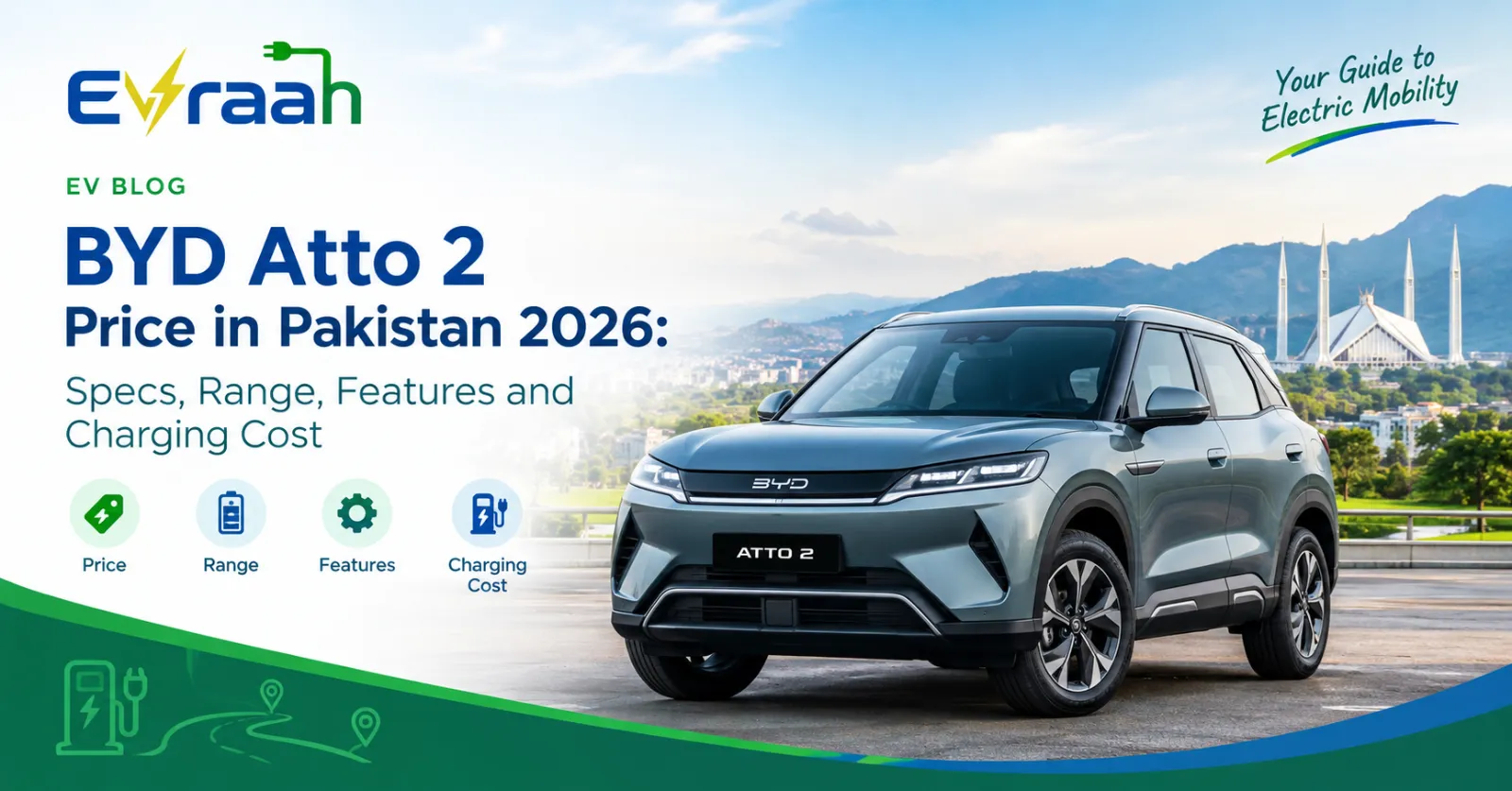
The BYD Atto 2 price in Pakistan is Rs 7,290,000 (Rs 72.9 lakh) for the Premium, the only variant currently listed. That is an ex-factory price, so registration, insurance and other on-road costs are extra. The car has a 45.12 kWh battery, a claimed 380 km NEDC range and CCS2 fast charging.
This guide covers price, specifications, charging time and cost, features and warranty, and whether the Atto 2 suits Pakistani buyers. Each figure is labelled official, listed or estimated.
Key takeaways
|
BYD Atto 2 Price in Pakistan 2026
The BYD Atto 2 Premium is listed at Rs 7,290,000, or Rs 72.9 lakh. It is the only Atto 2 variant offered locally. Pakistani listings describe the figure as ex-factory, and it was reported unchanged when the 2026–27 budget measures were announced in June.
|
Rs 7,290,000
Atto 2 Premium, ex-factory (Rs 72.9 lakh). Price checked October 2026.
|
| Item | Detail |
|---|---|
| Variant | Atto 2 Premium (only listed variant) |
| Price basis | Ex-factory; excludes registration, insurance and other on-road charges |
| Booking amount | Rs 1,400,000 (Rs 14 lakh) was reported around launch; the current amount is not confirmed |
| Delivery | Some listings show about one month; confirm with the dealer |
Ex-factory means the price before costs that depend on the buyer and city, such as registration, insurance and token tax. Ask the dealer for a written invoice that shows every charge. Treat launch-era offers, including complimentary charging sessions or a free home charger, as expired unless the dealer confirms them in writing. BYD Pakistan's official Atto 2 page is the place to check the current listing.
EVraah's EV import duty guide explains that the tiered Federal Excise Duty on imported EVs starts above Rs 20 million, so it does not apply here. The customs concession's expiry date is reported differently across sources, so confirm the invoice before paying a deposit.
BYD Atto 2 Specifications
The table uses BYD Pakistan's January 2026 flyer where it covers a figure. Where the flyer is silent, it uses Pakistani listings and says so.
| Specification | Detail | Basis |
|---|---|---|
| Battery | 45.12 kWh Blade (LFP) | BYD flyer |
| Claimed range | Up to 380 km (NEDC) | BYD flyer |
| Motor and drive | 130 kW (about 174 hp), 290 Nm, front-wheel drive | BYD flyer |
| 0–100 km/h | 7.9 seconds (manufacturer claim) | BYD flyer |
| Top speed | 160 km/h | Listings |
| AC charging | 7 kW, Type 2 | BYD flyer |
| DC charging | CCS2, up to 82 kW | BYD flyer |
| Dimensions | 4,310 × 1,830 × 1,675 mm; wheelbase 2,620 mm | BYD flyer |
| Ground clearance | 150 mm | Listings |
| Boot space | 380 L, or 1,320 L with seats folded | BYD Pakistan, listings |
BYD Atto 2 Battery Capacity and Range in Pakistan
The Atto 2 uses a 45.12 kWh Blade battery built on lithium iron phosphate (LFP) chemistry, which is valued for thermal stability and long cycle life. EVraah's LFP vs NMC guide explains the trade-offs in plain terms.
BYD Pakistan quotes up to 380 km on the NEDC test cycle. NEDC is an older, more optimistic procedure, so treat 380 km as a best case. A 323 km WLTP figure has also circulated for the same battery. It follows a stricter test but does not appear on BYD Pakistan's flyer. The EV range standards explainer shows why the two numbers cannot be compared directly.
| Estimate, not a test result: EVraah plans motorway trips with a 15–25% reduction from rated range. Applied to 323 km, that gives roughly 240–275 km at motorway speeds. Heat, air conditioning, high speed and passenger load all push it lower. |
City driving at moderate speeds should land closer to the rated figures. Intercity trips need planned stops. Check the motorway charging guide and the Route Planner before leaving.
BYD Atto 2 Charging Time
The Atto 2 has a 7 kW Type 2 AC port for home charging and a CCS2 port for DC fast charging. Pakistan's public network is built around CCS2 and Type 2, as the connector guide explains.
| Charging method | Time | Notes |
|---|---|---|
| Home AC, 7 kW (0–100%) | About 6.4 hours | Calculated: 45.12 kWh ÷ 7 kW, before charging losses. Published figures range from 5.5 to 8 hours. |
| DC fast, CCS2 (10–80%) | About 37 minutes | From listings; BYD's Pakistan material also quotes about 30 minutes for 30–80%. |
| DC peak power | Up to 82 kW | BYD flyer; some international sources list lower rates, so confirm with BYD Pakistan. |
The battery window matters. A 10–80% stop and a 30–80% stop are different tests. Fast charging also slows as the battery fills, which is why stopping near 80% is usually quicker overall, as covered in EVraah's guide on how long EV charging takes in Pakistan. For home setups, see the home charging guide, and use the charger map to filter public stations by CCS2.
BYD Atto 2 Charging Cost in Pakistan
No verified Atto 2 consumption test from Pakistani roads was available, so these figures rest on two labelled assumptions. Electricity rates are the working figures in EVraah's EV charging cost guide: Rs 50/kWh at home and Rs 120/kWh public, with public DC chargers ranging from Rs 110 to Rs 150/kWh. Energy use is derived from the claimed ranges. Replace the rates with your own bill or the charger's price.
Formula: kWh added × rate per kWh = cost. Charging losses are excluded.
| Charge | kWh added | Home (Rs 50) | Public (Rs 120) | Fast DC (Rs 150) |
|---|---|---|---|---|
| 0–100% | 45.12 | Rs 2,256 | Rs 5,414 | Rs 6,768 |
| 20–80% | 27.07 | Rs 1,354 | Rs 3,249 | Rs 4,061 |
Dividing battery size by claimed range gives two cost-per-kilometre benchmarks.
| Basis | kWh per 100 km | Home (Rs 50) | Public (Rs 120) |
|---|---|---|---|
| NEDC 380 km | 11.9 | Rs 5.9/km | Rs 14.2/km |
| WLTP 323 km | 14.0 | Rs 7.0/km | Rs 16.8/km |
Real-world use is usually higher than claimed figures. At 1,000 km a month, the energy bill works out to roughly Rs 5,900–7,000 on home charging and Rs 14,200–16,800 on public charging. For a petrol comparison, see EVraah's EV vs petrol running cost guide. Rooftop solar can lower home costs, though it needs upfront investment, as the solar charging guide explains.
BYD Atto 2 Features
BYD Pakistan's flyer lists the following equipment for the Premium:
- 12.8-inch rotating touchscreen
- Digital key and NFC card
- 50 W wireless phone charger
- V2L (vehicle-to-load), which powers small appliances from the car's battery
- 360-degree camera and airbags (six, according to listings)
- Portable Mode 2 charging cable alongside the Type 2 AC port
Overseas versions offer extras such as a panoramic roof, which are not confirmed for the Pakistan Premium, so check the dealer's equipment sheet. Listings describe the tailgate as manual.
On safety, the European Atto 2 earned five Green NCAP stars, but that test measures efficiency and emissions, not crash protection. Ask the dealer for crash-test documentation for the Pakistan-spec car.
BYD Atto 2 Size and Ground Clearance
At 4,310 mm long, the Atto 2 is a compact crossover that suits narrow streets and tight parking. The listed 150 mm of ground clearance gives modest margin over speed breakers, but it is not high by Pakistani standards. Steep ramps and badly built speed breakers still call for care, so test-drive it over your own route. Boot space is 380 litres, expanding to 1,320 litres with the rear seats folded.
BYD Atto 2 Warranty and Ownership
| Coverage | Term |
|---|---|
| Vehicle | 6 years or 150,000 km |
| Blade battery | 8 years or 160,000 km (as listed; confirm in the warranty booklet) |
Warranty is only part of ownership. Ask where the nearest authorised workshop is, how long parts take to arrive and whether the warranty transfers to a second owner. EVraah's EV maintenance cost guide covers typical service costs. Resale value is hard to judge because the model is new locally.
Is the BYD Atto 2 Worth Buying in Pakistan?
For many urban and suburban drivers with reliable home charging, the Atto 2 is a reasonable fit. The answer is less clear for frequent intercity travellers or buyers without a charging spot.
It may suit you if:
- Most trips are daily city or suburban driving.
- You can charge at home or work.
- You want a compact crossover body with 150 mm clearance.
Consider waiting or comparing if:
- You drive long motorway distances often, because the 45.12 kWh battery needs frequent stops.
- You depend on public chargers, which cost more than home charging.
- Service-centre distance or resale value worries you.
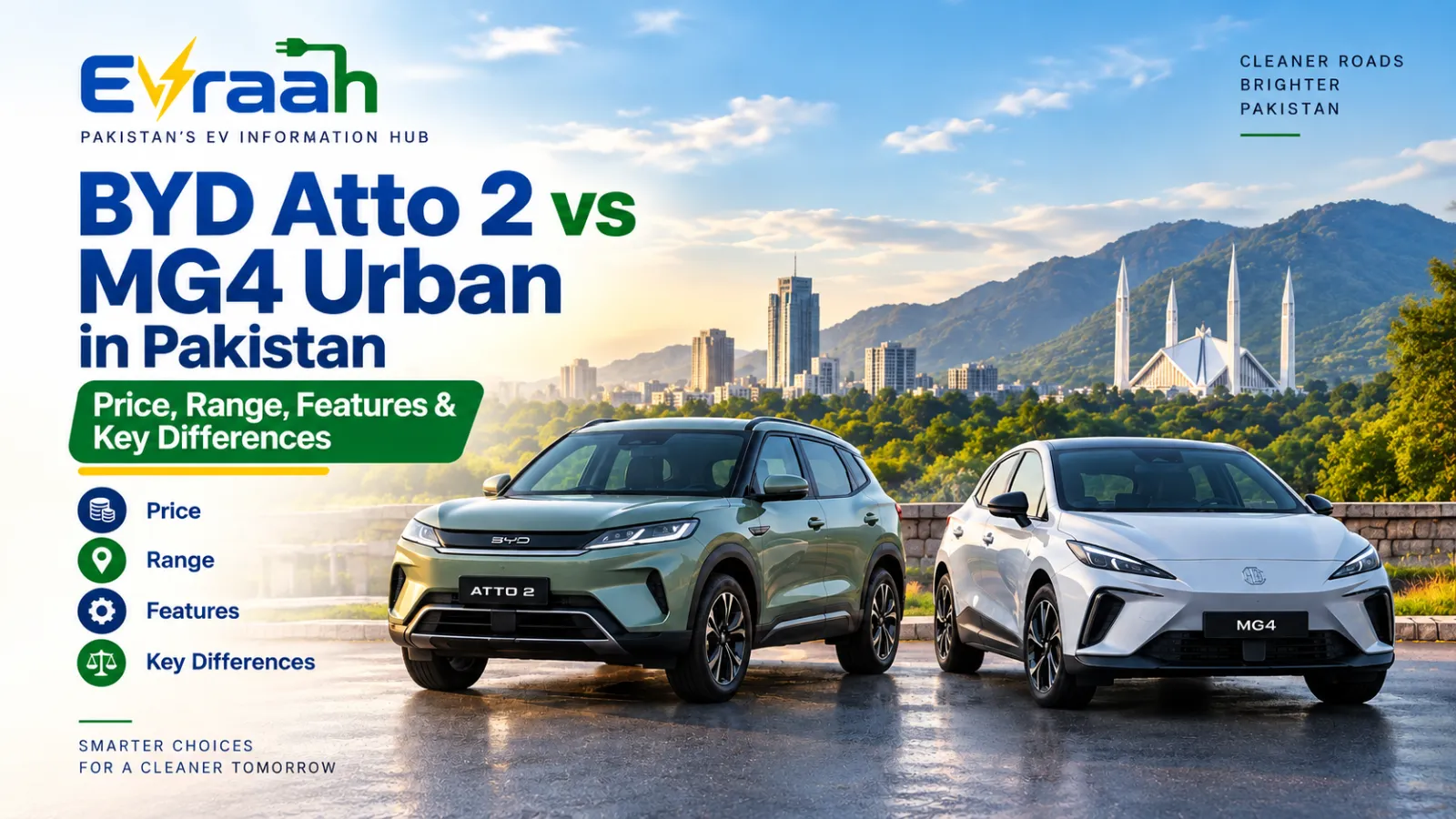
The closest rival on price is the MG4 Urban at Rs 6,999,000 in EVraah's September comparison, roughly Rs 291,000 lower. The Atto 2 vs MG4 Urban comparison sets out the trade-offs. For the wider market, see the best electric cars in Pakistan, or the buy now or wait guide if policy timing is a concern.
BYD Atto 2 Price in Pakistan: Frequently Asked Questions
What is the BYD Atto 2 price in Pakistan in 2026?
The Atto 2 Premium is listed at Rs 7,290,000 (Rs 72.9 lakh), ex-factory. It is the only variant currently offered. Registration, insurance and other on-road charges are additional, and prices can change, so confirm with an authorised dealer.
What is the BYD Atto 2 booking price?
A booking amount of Rs 1,400,000 (Rs 14 lakh) was reported around launch. That figure has not been confirmed as current. Ask the dealer for the present booking amount and its refund terms in writing.
What is the real-world range of the BYD Atto 2 in Pakistan?
BYD Pakistan claims up to 380 km on the NEDC cycle. A 323 km WLTP figure is a more cautious benchmark. On motorways, EVraah's 15–25% planning reduction gives roughly 240–275 km, which is an estimate.
How long does the BYD Atto 2 take to charge?
At 7 kW, a full home charge takes about 6.4 hours by calculation, and published figures range from 5.5 to 8 hours. DC fast charging from 10% to 80% is listed at about 37 minutes. The car supports CCS2 at up to 82 kW per BYD's flyer.
How much does it cost to charge a BYD Atto 2?
A full 45.12 kWh charge costs about Rs 2,256 at Rs 50/kWh and about Rs 5,414 at Rs 120/kWh. These rates are assumptions, so use your own electricity bill or the charger's price. A 20–80% charge at home costs roughly Rs 1,354.
What warranty does the BYD Atto 2 have in Pakistan?
Listings give 6 years or 150,000 km for the vehicle and 8 years or 160,000 km for the Blade battery. Confirm both terms in the written warranty booklet before buying.
What is the BYD Atto 2 ground clearance?
Listings give 150 mm. That is useful over moderate speed breakers, but it is not an off-road figure. Check steep ramps and damaged roads on a test drive.
Final Verdict: Check Before You Book
The BYD Atto 2 costs Rs 72.9 lakh ex-factory in Pakistan, with a 45.12 kWh battery and a claimed 380 km NEDC range. It suits city-focused buyers with home charging best. Before booking, get a written invoice, confirm the warranty and map your chargers. Start with EVraah's charger map and Route Planner, and compare networks in the network directory.
Last reviewed: October 2026. Price checked in October 2026; prices and offers can change. Specifications are from BYD Pakistan's January 2026 flyer and Pakistani listings. Duty information: FBR customs tariff.
Written by
Naeem
Naeem works in research and feasibility planning by day, and writes for Evraah on the side — mostly because EVs turned out to be more interesting than he expected. With 5+ years spent digging through data and assessing what's actually viable versus what just sounds good on paper, he brings the same habit to writing about EV routes, charging networks, and where the infrastructure is realistically headed. No grand mission, just a genuine curiosity about how this space is evolving — and a quiet hope that charging a car stops being a whole ordeal someday.
Related blogs
More from Buying Guides.
Cheapest Electric Cars in Pakistan: Prices, Range and Charging Compared
Deepal S07 vs BYD Sealion 7: Detailed Comparison for Pakistan