
WLTP vs NEDC vs CLTC vs EPA: EV Range Explained for Pakistan
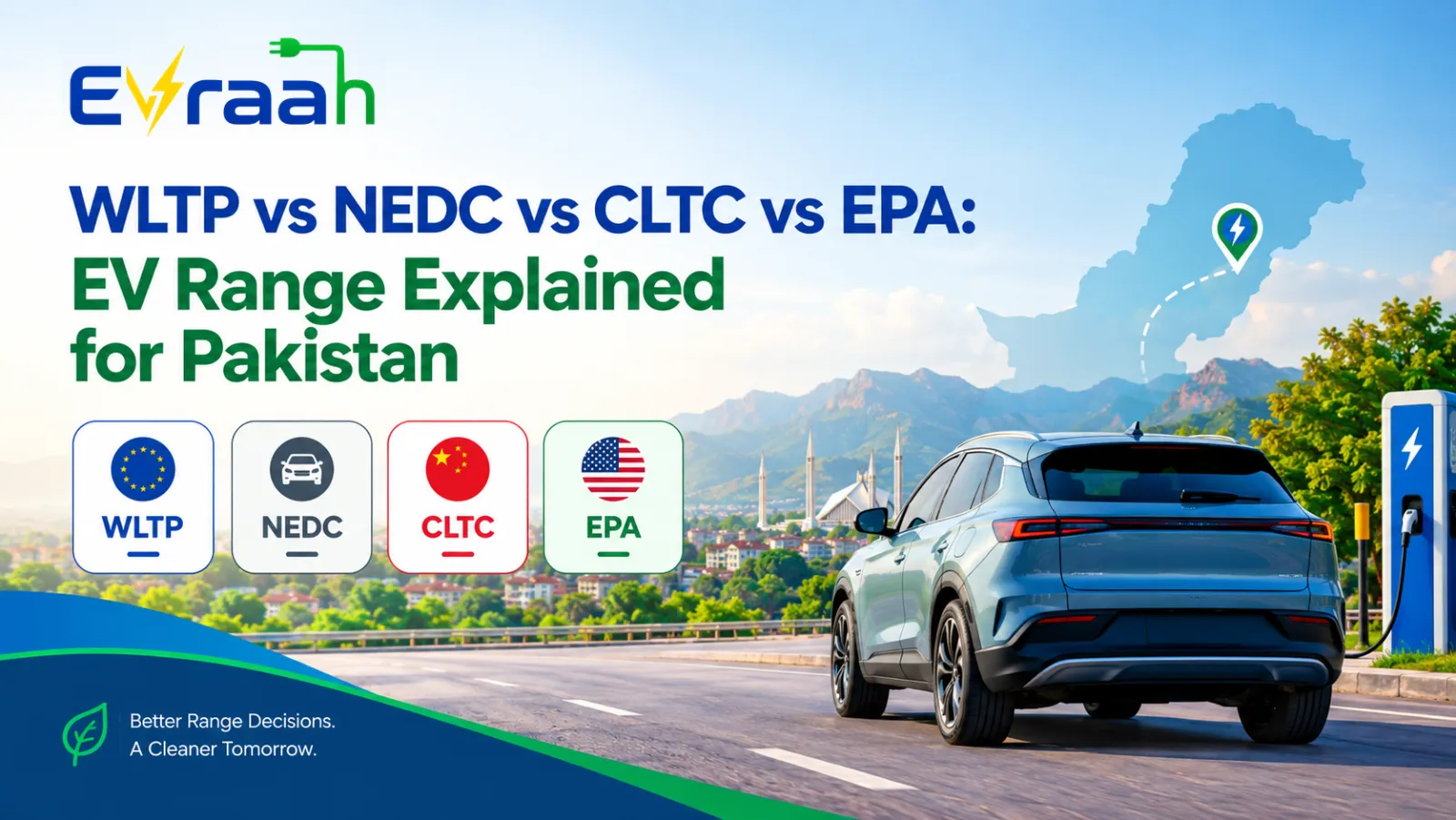
WLTP vs NEDC vs CLTC vs EPA: Which EV Range Figure Should Pakistani Buyers Trust?
Say you're comparing three brochures late at night. One EV claims 500 km. The next claims 430 km. The third claims 350 km. Easy choice, you'd think. But those three numbers may have come from three different tests, and a test is really just a rulebook for how fast, how long and how gently a car is driven inside a lab.
Once you know which rulebook was used, the numbers stop being confusing. Below we go through WLTP, NEDC, CLTC and EPA, show where they turn up on cars sold in Pakistan, and explain how EV range is calculated and tested, so you can read a brochure without getting fooled by it. If you're still building a shortlist, our guide to the best electric cars in Pakistan is a good place to start.
WLTP vs NEDC vs CLTC vs EPA at a Glance
What is the difference between WLTP, NEDC, CLTC and EPA?
They are lab procedures used to rate EV range in different regions. NEDC is the old European cycle, WLTP replaced it, CLTC is China's cycle, and EPA is the US method, which marks lab results down. Speeds, stops and adjustments differ, so the numbers can't be compared directly.
| Standard | Full name | Main market | General characteristics | How Pakistani buyers should read it |
|---|---|---|---|---|
| NEDC | New European Driving Cycle | Europe (retired for new cars); still quoted on some Chinese-brand specs | Old cycle with low average speed, gentle acceleration and long idle periods | The most generous label. Fine for a rough comparison inside NEDC, poor for planning a trip. |
| WLTP | Worldwide Harmonised Light Vehicles Test Procedure | Europe and many other markets | Longer cycle, higher speeds, more varied driving than NEDC | A sensible baseline for comparing cars. Still a lab result. |
| CLTC | China Light-Duty Vehicle Test Cycle | China | Built around congested city driving, with a low average speed and a lower top speed | Treat it as an upper reference, especially if you drive on motorways. |
| EPA | US Environmental Protection Agency range test | United States | Lab results adjusted downward before publishing | Usually the most cautious of the four. Still not a promise. |
What Is WLTP?
WLTP stands for Worldwide Harmonised Light Vehicles Test Procedure. Europe started using it for new car approvals in 2017 and it replaced NEDC there. The car sits on rollers in a lab held at a mild 23°C and runs a cycle of about half an hour that moves through low, medium, high and extra-high speed sections. Average speed is around 46 km/h, with a top speed a little over 130 km/h. Test weight, tyres and tyre pressure are all fixed by the rules, so every car is measured the same way.
That makes a WLTP figure a fair way to compare two cars. What it can't do is tell you what happens on the M-2 in June with four adults, luggage and the AC on full, or what Shahrah-e-Faisal does to your battery at six in the evening.
Is WLTP better than NEDC?
For everyday use, generally yes. WLTP uses higher speeds and more varied driving, so it usually gives lower, more realistic figures than NEDC. It's still a lab test, so it's a better reference and not a guarantee.
What Is NEDC?
NEDC is the New European Driving Cycle, the old test. Speeds were low (the average was about 34 km/h), acceleration was gentle, and the car spent a fair bit of the cycle standing still. Real drivers don't behave like that, which is why Europe moved on and why NEDC numbers tend to look generous.
You'll still see NEDC in Pakistan because plenty of Chinese-brand EVs quote it. BYD Pakistan, for instance, lists the Atto 2 at up to 380 km (NEDC) with a 45.12 kWh battery. There's nothing dishonest about that number. It was just measured on an easier course, so please don't set it next to a WLTP or EPA figure without saying so.
What Is CLTC?
CLTC is China's own test, the China Light-Duty Vehicle Test Cycle. The industry ministry began developing it around 2015 because NEDC didn't match how people actually drive in Chinese cities, and it was later written into a national standard. The passenger-car version averages only about 29 km/h, tops out at 114 km/h and includes a lot of idling. In other words, a crowded city.
EVs do very well in that kind of driving. They use no energy standing still and win some back when braking, so Chinese makers can print big numbers and still be telling the truth. The catch is obvious to anyone who has driven Lahore to Islamabad at motorway speed. Air resistance climbs quickly as you go faster, and CLTC barely tests for that. Published figures often show CLTC sitting well above WLTP, and WLTP above EPA, but the gap changes from car to car. Read that as a general observation, never a conversion rule.
Be extra careful with grey imports. A car with an eye-catching China-market range may also come with a different connector, software or warranty from an authorised Pakistan-market model. Before you fall for the number, read our guide on whether a GB/T EV can use a CCS2 charger. Generally it can't, unless compatibility is properly proven.
Is CLTC range accurate?
It accurately describes the car's result on the CLTC test. But it's the most flattering of the common cycles for mixed or motorway driving. When a Chinese EV shows a very high CLTC figure, check which battery and variant it belongs to, then treat it as an upper reference.
What Is EPA Range?
EPA is the US Environmental Protection Agency's method. As EPA explains on its site, a fully charged EV is driven on a dynamometer through city and highway cycles until the battery is empty. The lab results are then adjusted downward to reflect things like air conditioning, cold weather and faster driving. The most common adjustment is a factor of 0.7, and city and highway results are weighted 55/45 into the label figure. There's also a fuller five-cycle route that adds hot and cold weather tests, but most labels use the 0.7 shortcut, so don't assume every EPA number came from a heat test.
Why is EPA range lower?
Because EPA deliberately marks lab results down before publishing them. That built-in adjustment is the main reason EPA figures usually come out lower than WLTP, NEDC or CLTC for the same car.
That cautious approach is why many buyers see EPA as the most honest of the four. It is still built around American driving, though. It knows nothing about your route, your AC habits or your tyres.
Why Does the Same EV Have Different Range Numbers?
The car doesn't change between brochures. The test does. One battery pack can carry a certain figure in a China-market listing, another in a European one and a third in a US one, and all of them can be correct.
Pakistan shows the mess nicely. BYD Pakistan lists the Atto 3 at up to 410 km with a 49.92 kWh battery, and the page doesn't say which test produced it. We won't guess. If you're buying one, ask the dealer to name the standard in writing.
Or take two cars that look similar on paper. MG Pakistan rates the MG4 EV Urban at up to 316 km on WLTP with a 43 kWh battery. The Atto 2 gets 380 km on NEDC from a 45.12 kWh pack. The batteries are close in size and the headline numbers are 64 km apart, but the tests differ, so the gap tells you very little about which car is actually more efficient. For a fuller side-by-side, see our Atto 2 vs MG4 Urban comparison.
WLTP vs NEDC vs CLTC vs EPA: Why the Numbers Cannot Be Compared Directly
You'll find rules of thumb online that promise to turn one standard into another, something like "CLTC times a magic number equals WLTP". Please don't buy a car on the strength of one. Each cycle weighs speed, idling, acceleration and regenerative braking differently, and each car reacts to those weights in its own way. A car that is brilliant in slow traffic gains more from a city-style cycle than one tuned for highway cruising. So no single multiplier works for every EV.
The honest approach is simple. Compare cars only within the same standard, and look for independent tests when you can.
Which Range Standard Should Pakistani Buyers Trust?
None of them on its own. NEDC and CLTC lean optimistic. WLTP is a solid, fairly realistic baseline. EPA is the most conservative but comes from US driving. And none of the four knows what a 42°C afternoon on the motorway feels like.
Which EV range standard is most realistic?
EPA and WLTP are generally seen as closer to real-world use than NEDC or CLTC, with EPA usually the most conservative. But real range depends on how, where and when you drive, so no standard is right for everyone.
The practical lesson is this: treat the published range as a standardized reference point, not a promise of real-world kilometers. The advertised EV range is where the conversation starts. Your actual EV range is whatever your route, weather and habits produce. Use the first to compare cars tested the same way, then add your own conditions on top.
What Range Can You Realistically Expect in Pakistan?
Nobody can hand you one Pakistan adjustment percentage and be honest about it. What we can do is walk through what actually moves the number.
City driving first. Stop-and-go in Karachi suits an EV because braking feeds energy back in, but an hour of crawling with the AC on still drains the pack. Motorway driving is the harder test. At a steady 110 to 120 km/h, drag takes a big bite, and this is exactly where NEDC and CLTC figures say the least. Our guide to EV charging on Pakistan's motorways covers the route in detail.
Then there's the heat. AAA tested EVs at 95°F (35°C) and found that running the AC cut average range by about 17 percent. That was one US study on particular cars, and summer afternoons in Lahore and much of Punjab and Sindh often go past 35°C, so take it as a direction and not a forecast.
Does EV range change in hot weather?
Yes. Air conditioning and a hot battery both raise energy use. AAA's testing found average range dropped by about 17 percent at 35°C with the AC running. The exact effect varies by car, speed and conditions.
Everything else piles on top. A family of five with luggage, tyres a few PSI low, big wheels, a rough road surface and a heavy right foot all shave off kilometres. The climb into Islamabad and the hills beyond cost extra energy going up, and regenerative braking gives some of it back coming down. Battery age matters too. A pack loses capacity over the years, and a car that is regularly run down to almost nothing tends to feel worse. Our battery lifespan guide shows what ageing looks like in practice.
How much EV range do you actually get?
There's no single answer. Real-world range often falls short of NEDC and CLTC claims, and can land near or below WLTP and EPA figures in hot, fast or heavily loaded driving. Your own consumption over a few weeks is the best guide.
Don't Buy an EV Based on the Range Number Alone
A range figure is one line on a spec sheet. Before you commit, look at the standard behind it and the battery capacity that produced it. Check the car's efficiency and what owners report for city and highway range. Look at DC fast-charging and AC charging capability, and the connector that goes with them. Ask whether there are chargers along your routes, what the battery warranty covers, how the pack is kept cool, and how good local service and support are. Above all, think about how far you really drive in a day. Someone doing 30 km daily and charging at home has very different needs from someone who makes the Lahore to Islamabad run every month.
A car with a lower published range can still take you further, and more calmly, when the charging map is on your side. That is what a charger locator and route planner are for. They turn "410 km on paper" into "two comfortable stops on this route".
People also ask how much range to keep before looking for a charger. There's no magic percentage. Work backwards. Add the distance to the next charger, the distance to a backup in case it's busy or offline, and a margin for AC, headwind and speed. Any EV range calculator you find online is only as good as the numbers you feed it, so use your own measured consumption where possible.
Range Matters, But Charging Infrastructure Matters Too
An electric car's range means little if you can't top it up on your route. A modest range is perfectly livable when you know where the next charger is. A huge range can still leave you sweating if the map around your route is thin.
When you type "EV charging station near me" or "EV chargers near me" into a search box, what you really want to know is what's close, which connector it uses and who runs it. EVraah's live charging map works as an EV charger locator for Pakistan, and the route planner helps you decide where to stop on a longer drive. The charging networks directory shows who operates what, and the city pages help with local detail. EV charging stations in Pakistan are still being added and changed quickly, so checking before you leave is part of owning one.
On longer trips, plan your stop before you need it and leave a buffer so you're not rolling into a charger on fumes. Fast chargers slow down noticeably as the battery fills past roughly 80 percent, so charging to 80 and carrying on is usually quicker than waiting for a full pack. Stations can also be offline now and then, so having a backup in mind helps. That's how a lower-range EV becomes a perfectly good motorway car.
How to Compare Two EVs Before Buying
Step 1: Find out which test produced the range figure. If the brochure doesn't say, ask. Never compare NEDC with WLTP.
Step 2: Check battery capacity. Two cars with similar batteries and very different claims usually differ in test, not efficiency.
Step 3: Check efficiency, ideally in kWh per 100 km from an independent test.
Step 4: Look for real-world reviews, preferably at motorway speeds and in warm weather.
Step 5: Think about city versus motorway. Your typical week matters more than the headline claim.
Step 6: Check charging speed and whether the connector type (CCS2, Type 2, CHAdeMO) matches the chargers you'll actually use.
Step 7: Check charger availability along your normal routes, then work out what a stop really costs.
Step 8: Check the battery warranty and thermal management. In a Pakistani summer, how the pack is cooled matters as much as how big it is.
Final Takeaway
Don't ask only "How many kilometres does this EV claim?" Ask "Under which test, under what conditions, and how does that compare with my actual driving and charging options in Pakistan?" Buy, understand the range, plan the trip, find the charger, charge and carry on. That's the whole journey, and the brochure number is only the first step.
FAQs
What is WLTP range?
The range an EV achieves on the Worldwide Harmonised Light Vehicles Test Procedure, a lab cycle used in Europe and other markets. It's a standard reference for comparing cars, not a real-world guarantee.
What is NEDC range?
The range measured on the older New European Driving Cycle, which uses gentle acceleration and low average speed. It usually gives higher figures than WLTP.
What is CLTC range?
The range measured on China's light-duty test cycle, which reflects congested city driving with a low average speed and a top speed of 114 km/h.
What is EPA range?
The US range rating, where lab results are adjusted downward (most commonly by a factor of 0.7) to reflect things like AC use, cold weather and higher speeds.
Why is CLTC range higher than WLTP?
CLTC has lower speeds, more idling and gentler demands, which suit EVs. The size of the gap differs from car to car, so there's no universal conversion.
Which EV range standard is used in Pakistan?
There's no single Pakistani standard. Listings quote whatever the manufacturer uses, NEDC on some Chinese-brand cars and WLTP on others such as the MG4 EV Urban. Always ask which one is behind the number.
Can I expect the advertised EV range in Pakistan?
Rarely exactly. Heat, AC, traffic, speed, load and battery age all change real range. Use the published figure to compare cars and your own consumption to plan trips.
How can I plan an EV trip around charging stations?
Check your route on a charger locator, choose stops before you need them, keep a buffer, and use a route planner to line up your charging along the way.
Written by
Naeem
Naeem works in research and feasibility planning by day, and writes for Evraah on the side — mostly because EVs turned out to be more interesting than he expected. With 5+ years spent digging through data and assessing what's actually viable versus what just sounds good on paper, he brings the same habit to writing about EV routes, charging networks, and where the infrastructure is realistically headed. No grand mission, just a genuine curiosity about how this space is evolving — and a quiet hope that charging a car stops being a whole ordeal someday.
Related blogs
More from EV Basics.
EV Maintenance Cost in Pakistan 2026: Complete Service & Repair Guide
EV Battery Guide for Pakistan: Lifespan, Degradation, Charging & Replacement Cost
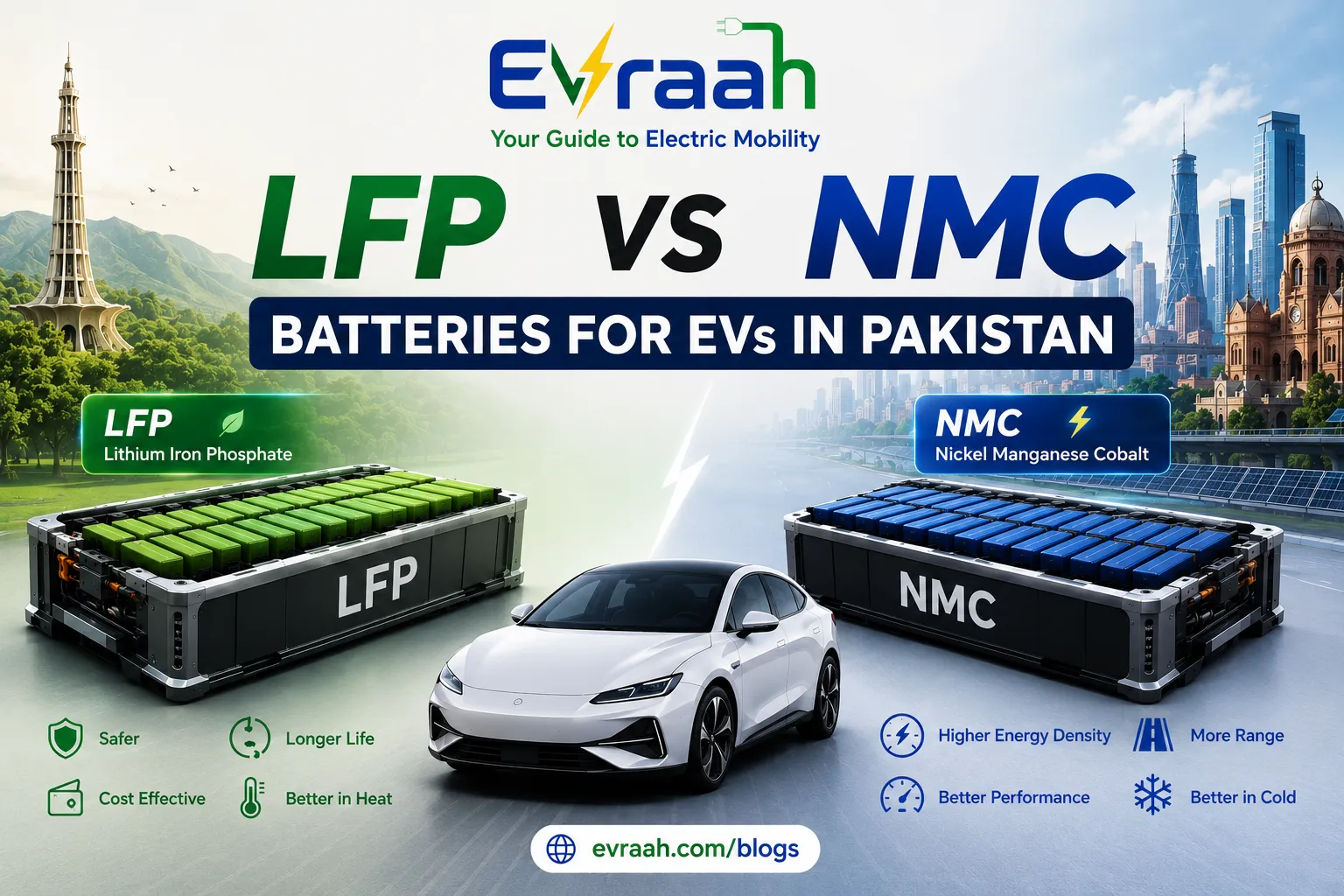
LFP vs NMC Batteries Explained Simply: Which Is Better for EVs in Pakistan?
You may also like
 Charging Guides
10 EV Charging Tips for New Drivers in Pakistan
5 min read · 30 Sept 2026
 Charging Guides
Can a GB/T EV Use a CCS2 Charger in Pakistan? Complete Compatibility Guide
5 min read · 22 Sept 2026
 Buying Guides
Deepal S07 vs BYD Sealion 7: Detailed Comparison for Pakistan
5 min read · 20 Sept 2026