
Import Duty and Tax Breakdown for EVs in Pakistan 2026: Complete Buyer Guide
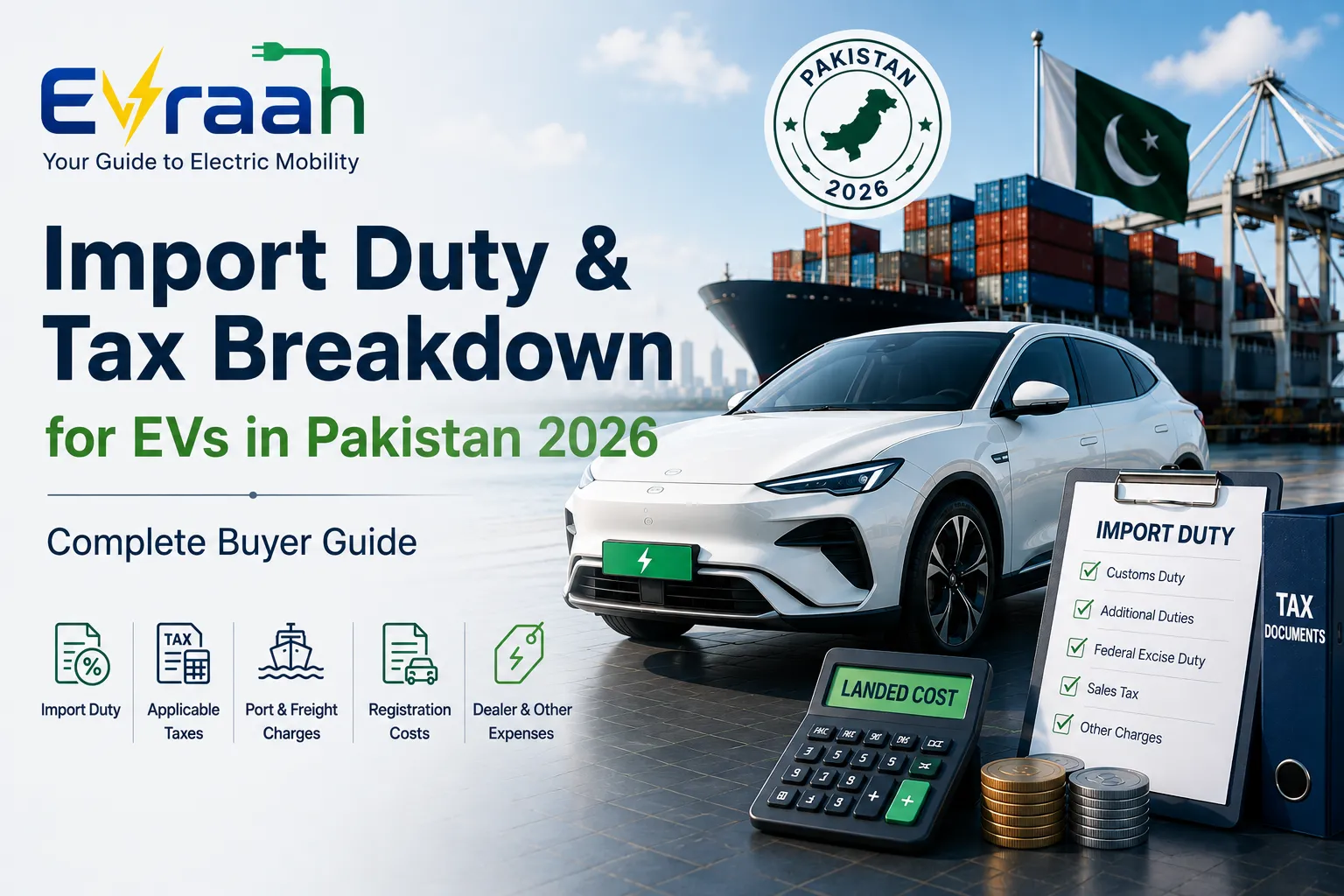
Import Duty and Tax Breakdown for EVs in Pakistan 2026
The price of an imported electric vehicle in Pakistan is not simply the international price converted into Pakistani rupees.
A vehicle advertised internationally for $35,000 may cost significantly more after reaching Pakistan because several additional charges are added during the import process — freight, insurance, customs duty, applicable taxes, port expenses, registration costs, and dealer/distribution expenses.
Pakistan's EV market now includes imported and locally distributed models from brands such as BYD, MG, and Deepal — see EVraah's Best Electric Cars in Pakistan 2026 guide for current pricing across the market — but the final price any individual buyer pays still depends heavily on the import and taxation route the vehicle took to get here.
The international vehicle price is only the starting point. Buyers should focus on the complete landed cost before comparing EV prices in Pakistan.
What's In This Guide
- How EV Import Cost Is Calculated
- EV Import Duty Structure 2026
- Customs Duty on Imported EVs
- BOI vs FBR Expiry Date
- CBU vs CKD: The Difference
- EV Component Import Duties
- Federal Excise Duty on Luxury EVs
- Worked Tax Calculation Example
- How Duty Affects BYD, MG, Deepal Prices
- Will Prices Fall After Local Assembly?
- FAQs
- Final Verdict
How EV Import Cost Is Calculated in Pakistan
Before understanding individual taxes, it is important to understand how imported EV pricing is calculated. Pakistan Customs uses customs valuation procedures to determine the taxable value of imported vehicles, starting with the CIF value.
CIF Means: Cost + Insurance + Freight
After determining CIF value, applicable duties and taxes are added:
After customs clearance, the final customer price may also include dealer margin, registration expenses, warranty costs, service network expenses, and currency adjustment. This is why comparing only international EV prices can create unrealistic expectations.
EV Import Duty Structure in Pakistan 2026
Pakistan has introduced special customs treatment for electric vehicles to encourage EV adoption and support local manufacturing. However, taxation depends on whether the vehicle is imported as a complete vehicle (CBU) or as components for local assembly (CKD).
| Tax / Duty | Rate (2026) | Applies To | Impact |
|---|---|---|---|
| Customs Duty | 25% (concessionary rate, eligible CBU 4-wheelers) | Import clearance | Major impact on landed cost |
| Federal Excise Duty (FED) | 0% / 30% / 40% — tiered by import value | High-value CBU EVs | Mainly affects luxury EV pricing |
| Additional Customs Duty | Category-dependent | Selected import categories | Raises landed cost where applicable |
| Regulatory Duty | Category-dependent | Selected categories | Depends on current notifications |
| Sales Tax | Standard rate, per current FBR rules | Most imported EVs | Adds to final price |
| Withholding Tax | Depends on filer status | Registration stage | Depends on buyer category |
Customs Duty on Imported EVs in Pakistan 2026
Customs duty remains one of the biggest factors affecting imported electric vehicle prices. Under the EV-related customs framework, eligible four-wheel EV imports receive concessionary customs treatment.
Customs Duty: 25%
The concession applies to eligible vehicles under the relevant customs classification and conditions.
The latest FBR Customs Tariff and Fifth Schedule documents should always be checked because EV policies can change through official notifications.
BOI vs FBR Expiry Date: What We Could and Couldn't Confirm
Board of Investment reference pages for the EV customs concession state an expiry of 30 June 2026. Some secondary reporting on Budget 2026-27 describes this concession as extended to June 2027.
We were not able to independently confirm which date is currently correct. FBR's own Fifth Schedule (updated 30th June, 2026) is the authoritative document, but the specific electric-vehicle provisions sit deep within a very long schedule and could not be fully verified against the secondary reporting at the time of writing. Treat the 2027 figure as reported-but-unconfirmed rather than settled fact.
Importers should request written confirmation of the current expiry date from FBR or a licensed customs agent before finalizing an import decision based on either date.
CBU vs CKD EV Pakistan: Understanding the Difference
The biggest difference in EV taxation comes from how the vehicle enters Pakistan.
| CBU (Completely Built Unit) | CKD (Completely Knocked Down) | |
|---|---|---|
| What it means | Vehicle arrives fully assembled from the manufacturing country | Vehicle arrives as components, assembled locally |
| Customs duty | 25% concessionary rate (eligible imports) | As low as 1% on EV-specific components |
| Best suited for | Individual imports, brands testing demand | Manufacturers committed to a long-term Pakistani presence |
CBU: Advantages & Disadvantages
✔ Advantages
- Faster availability — no local production facilities needed
- Factory-built quality — original production process and global standards
- Wider model choice — brands can test demand quickly
✘ Disadvantages
- Higher landed cost — full vehicle value is taxed
- Currency risk — international payments are exposed to FX swings
- Steeper luxury pricing — import costs compound at higher values
CKD EV Assembly in Pakistan
CKD means Completely Knocked Down. Instead of importing a fully assembled vehicle, manufacturers import components — battery systems, electric motors, controllers, chargers, power electronics, and other vehicle components — and assemble electric vehicles locally, reducing dependence on complete vehicle imports.
✔ Benefits
- Lower duties on EV-specific components (as low as 1%)
- Supports local supplier and manufacturing development
- Long-term path to more competitive pricing
✘ Challenges
- Requires assembly infrastructure and investment
- Longer timeline before vehicles reach the market
- Not viable for every manufacturer or model
EV Component Import Duty Structure
The EV policy framework provides lower customs treatment for selected components used in local EV manufacturing — this is what makes CKD assembly financially attractive over time.
| Component Category | Customs Duty |
|---|---|
| EV-specific CKD components (batteries, motors, controllers) | 1% |
| Non-localized CKD components | 10% |
The battery pack is one of the most expensive parts of an EV — cells, modules, battery management system, cooling, and safety electronics. Because it represents such a large share of manufacturing cost, this low component duty is one of the biggest levers for making local EV production competitive.
Federal Excise Duty (FED) on Luxury EV Imports
Customs duty and Federal Excise Duty are separate charges. While EV incentives support electric mobility adoption broadly, high-value imported electric vehicles can face additional taxation through FED — layered on top of customs duty, not instead of it.
| EV Import Value (CBU, personal use) | Federal Excise Duty |
|---|---|
| Up to Rs. 20 million | 0% |
| Rs. 20 million – Rs. 30 million | 30% |
| Above Rs. 30 million | 40% |
Most officially distributed EVs in Pakistan today — BYD, MG, Deepal, and similar brands — are priced well under the Rs. 20 million threshold, so FED does not apply to them. This mainly targets genuine luxury imports such as Tesla, Porsche, and high-end Mercedes/BMW EVs.
EV Import Tax Calculation Example
To understand how import duty affects EV pricing, consider a simple example.
Customs Duty Calculation (25%)
Additional costs may still apply on top of this: sales tax, withholding tax, port charges, documentation fees, and registration expenses.
This example is only an illustration, using a $35,000 CIF value below the FED threshold. Actual customs assessment depends on vehicle classification, valuation rules and applicable government notifications in force at the time of import.
How Import Duty Affects BYD, MG and Deepal EV Prices
Many Pakistani buyers search for BYD import duty Pakistan, BYD Atto 3 price Pakistan, MG4 EV Pakistan price, and Deepal EV Pakistan — but the international price does not represent the final Pakistani price. Check EVraah's Best Electric Cars in Pakistan 2026 guide for current showroom pricing across these brands.
Import Structure
A CBU vehicle carries the complete imported vehicle value, while CKD vehicles benefit from component-level incentives.
Exchange Rate Impact
Since imported vehicles involve international payments, currency movement can directly affect EV prices in Pakistan.
After-Sales Support
Warranty coverage, spare parts availability, service infrastructure, and technical support all factor into brand pricing.
Will EV Prices Decrease After Local Assembly?
Local EV assembly could play an important role in reducing long-term dependence on imported vehicles.
More CKD Production
- Lower import dependency
- Better vehicle availability
- More competitive pricing
Stronger Local Supply Chain
- Local EV component production
- Electronics manufacturing growth
- Supporting systems investment
Higher EV Adoption
- More manufacturers enter the market
- Increased competition
- Better pricing options over time
Frequently Asked Questions
What is the import duty on EVs in Pakistan 2026?
Eligible four-wheel EV imports receive a 25% concessionary customs duty rate. High-value CBU imports may additionally face a tiered Federal Excise Duty of 0%, 30%, or 40% depending on import value. Always confirm the current rate against the latest FBR customs schedule.
Are EV taxes lower than petrol cars in Pakistan?
On the CKD/local-assembly side, yes — EV-specific components carry duties as low as 1%. On CBU imports, EVs receive a concessionary customs rate, but high-value EV imports also face a new FED specifically targeting luxury electric vehicles.
What is the EV CKD parts duty in Pakistan?
EV-specific CKD components are listed at 1% customs duty, while non-localized CKD components are listed at 10%, subject to applicable conditions.
Is CBU or CKD better for EV prices?
CKD assembly generally provides more opportunity for lower long-term pricing because manufacturers import components instead of complete vehicles.
Do EV batteries have separate import duties?
Battery-related duties depend on component classification and whether the parts are imported for complete vehicles or local assembly. EV-specific battery components in CKD form carry just 1% customs duty.
Will BYD EV prices decrease after local assembly?
Prices may reduce if manufacturers achieve efficient production volumes, develop local suppliers and reduce import dependency. This is a multi-year structural shift, not something reflected in current showroom pricing.
Final Verdict
The import duty on EVs in Pakistan 2026 plays a major role in determining electric vehicle prices. The international price of an EV is only the beginning — customs duty, import method, component taxation, exchange rate, and local taxes all factor into what a buyer actually pays.
CBU imports provide faster access to global EV models, while CKD assembly offers a pathway toward stronger local manufacturing and potentially more competitive pricing. Before purchasing or importing an electric vehicle, buyers should verify the latest FBR Customs Tariff and Fifth Schedule because EV taxation policies can change through official notifications and annual budgets.
Import duty is only one side of the ownership equation — once the vehicle lands, running costs matter just as much. EVraah's EV vs Petrol Car Running Cost guide and EV Charging Cost in Pakistan guide are natural next reads before finalizing a purchase.
Disclaimer: Tax rates and duty structures referenced in this guide are current as of the time of writing and based on Budget 2026-27 and related FBR notifications. These are subject to change through further notifications. This guide is informational and does not constitute customs, tax, or legal advice — confirm applicable rates with FBR or a licensed customs agent before making an import decision.
Written by
Naeem
Naeem works in research and feasibility planning by day, and writes for Evraah on the side — mostly because EVs turned out to be more interesting than he expected. With 5+ years spent digging through data and assessing what's actually viable versus what just sounds good on paper, he brings the same habit to writing about EV routes, charging networks, and where the infrastructure is realistically headed. No grand mission, just a genuine curiosity about how this space is evolving — and a quiet hope that charging a car stops being a whole ordeal someday
Related blogs
More from Pakistan EV News.
Should You Buy an EV in Pakistan Now or Wait for the 2026–31 Auto Policy?
Pakistan's New Auto Policy Could Give EVs a Major Tax Boost
How to Register Your EV Charger with NEECA in Pakistan: Step-by-Step Guide
You may also like
 Buying Guides
BYD Atto 3 Price in Pakistan 2026: Specs, Range and Charging Cost
4 min read · 19 Oct 2026
 Buying Guides
BYD Atto 2 Price in Pakistan 2026: Specs, Range, Features and Charging Cost
6 min read · 14 Oct 2026
 Charging Guides
Can You Charge an EV With Solar Panels in Pakistan?
5 min read · 13 Oct 2026