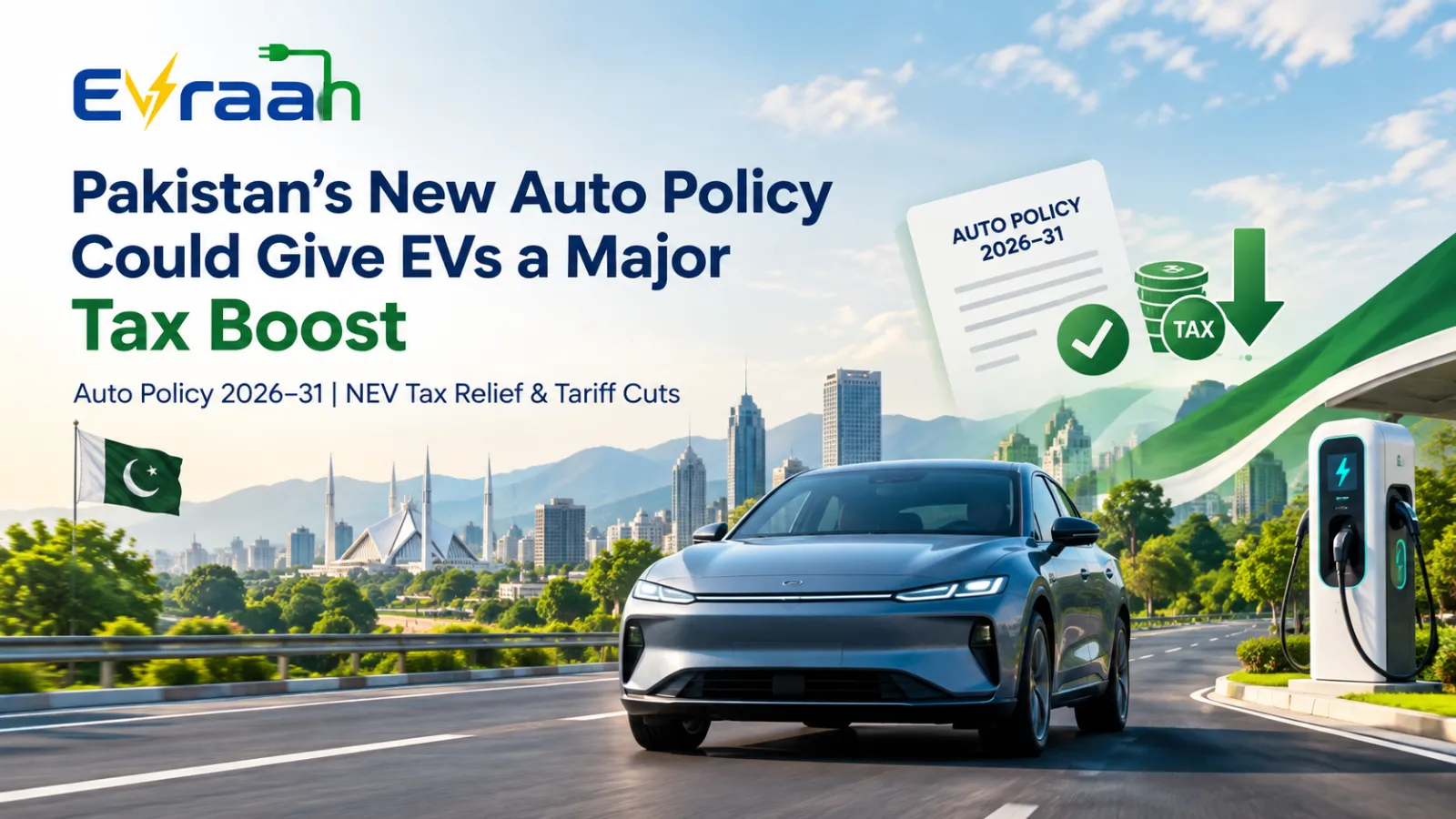
Pakistan's New Auto Policy Could Give EVs a Major Tax Boost
Editorial Note
By the EVraah Team. Last reviewed September 15, 2026, against FBR notifications and government policy announcements.
This article covers a draft policy — tax rates and dates may change before final notification.
Prime Minister Shehbaz Sharif has approved the draft Automobile Policy 2026–31, and the headline for EV buyers is a proposed 1% sales tax on new energy vehicles (NEVs), paired with exemptions from several other levies. It's a significant proposal — but it's still a draft, not a law. Here's what was actually approved, what it could mean for EV prices in Pakistan, and what still has to happen before any of it reaches a showroom.
At a Glance
| NEV Sales Tax 1% — already in force, just formally extended to June 2027 | HEV Sales Tax 18% — cut from 25%, notified September 12, 2026 |
| Vehicle Customs Duty Ceiling Up to 50% today, proposed to fall to 15% by FY2030–31 (draft, pending approval) | NEV Financing Rs 3 million / 3-year tenor today, proposed Rs 10 million / 5-year tenor (draft, pending approval) |
Existing Rules vs. What's Proposed
| Policy Area | Before / Currently in Force | Proposed Under Draft Auto Policy 2026–31 |
|---|---|---|
| NEV (EV) sales tax | 1% on locally manufactured EVs — just formally extended to June 30, 2027 via FBR notification | Same 1% rate carried forward, plus a new proposed exemption from FED, CVT, and WHT |
| HEV sales tax | Had risen to 25% after the previous auto policy expired in July 2026 | Cut to 18% via FBR notification (already in force, separate from the five-year draft) |
| NEV financing | Loan limit of Rs 3 million, 3-year tenor | Proposed loan limit of Rs 10 million, 5-year tenor |
| Customs duty on imported EV charging equipment | Standard duty applies | Proposed at 1% |
| Overall vehicle customs duty ceiling | Up to 50%, varying by engine capacity and vehicle type | Proposed to fall to 15% by FY2030–31, phased over five years. See the current Pakistan EV import duty rates 2026 for what importers face today. |
| Assembler protection (SROs) | Currently in place | Proposed to phase out gradually by FY2029–30 |
| BEV vs. REEV vs. PHEV treatment | No differentiation under prior NEV rules | Proposed tiered treatment — BEVs most favorable, then REEVs, then PHEVs |
| Battery-swap stations | No dedicated support mechanism | Proposed support through Viability Gap Funding |
Rows describing the draft Auto Policy 2026–31 reflect proposals still pending legal vetting, IMF review, and cabinet approval — not rates currently in force.
What the New Auto Policy Proposes
The draft Auto Policy 2026–31 was approved during proceedings in Islamabad, according to press, citing government officials involved in the policymaking process. It sets out tax and tariff treatment for vehicles over the next five fiscal years, with new energy vehicles — a category covering battery electric vehicles (BEVs), range-extended EVs (REEVs), and plug-in hybrids (PHEVs) — getting the most favorable terms.
Under the approved draft, NEVs, along with their completely knocked-down (CKD) kits, parts, and raw materials, would face just a 1% sales tax. They would also be exempt from federal excise duty (FED), Capital Value Tax (CVT), and withholding tax (WHT).
A technical committee had recommended treating BEVs, REEVs, and PHEVs equally. The Prime Minister overruled that, directing that BEVs get the most preferential treatment, followed by REEVs, then PHEVs. Conventional hybrids and petrol/diesel vehicles, by contrast, will continue to be taxed the same as each other.
The draft also proposes real changes to NEV financing: the maximum loan limit rises from Rs 3 million to Rs 10 million, and the loan tenor extends from three years to five. Separately, customs duty on imported EV charging equipment is proposed at 1%, with battery-swap stations to be supported through Viability Gap Funding — relevant as Pakistan's charging network continues to expand.
What It Could Mean for EV Buyers
On paper, a 1% sales tax plus exemption from FED, CVT, and WHT is a meaningfully lighter tax load than what conventional vehicles carry. That creates room for EVs to be priced more competitively against petrol cars — but room isn't a guarantee. What buyers actually pay will still depend on how manufacturers set prices, the rupee-dollar exchange rate, global battery and component costs, and import logistics. None of those move just because a tax rate changes on paper.
The financing changes may matter just as much day-to-day. A higher loan ceiling and a longer repayment period directly affect monthly installments, which for many buyers is a bigger factor than the sticker price itself. If you're already weighing EV ownership costs against a petrol car, it's worth comparing against real running-cost numbers rather than assuming tax relief alone settles the math.
For local assembly, the policy's tiered treatment — best terms for BEVs, then REEVs, then PHEVs — is designed to nudge manufacturers toward fuller electrification rather than just adding hybrid variants. Whether assemblers respond by localizing EV production or continue importing CKD kits will depend on their own cost calculations under the new rates, not the policy alone.
Broken down by who stands to gain most under the proposed tiering:
- Most favorable treatment: Battery electric vehicles (BEVs), particularly locally assembled models, which get the 1% sales tax plus the proposed FED/CVT/WHT exemptions in full.
- Middle tier: Range-extended EVs (REEVs), which the Prime Minister separated out from BEVs during review — still NEV-favorable, but one step down.
- Least favorable among NEVs: Plug-in hybrids (PHEVs), placed below REEVs under the revised framework.
- Unchanged: Conventional hybrids (HEVs) and petrol/diesel vehicles, taxed the same as each other under this draft.
For current model pricing rather than tax treatment, EVraah's guide to electric cars in Pakistan tracks what's actually on sale today.
Tariff Cuts Could Change the EV Market
The draft also proposes a broader restructuring of vehicle tariffs. Customs duty on all cars is set to fall to 15% by FY2030–31, with up to an 80% reduction in automobile tariffs and no regulatory duty by the end of the policy period. Additional customs duty on imported cars is proposed to end after two years, and statutory regulatory orders (SROs) protecting existing assemblers would be phased out by FY2029–30. For a look at what importers currently pay, see the guide to Pakistan EV import duty rates 2026.
That said, the phase-out is gradual by design. Tariffs stay unchanged for the first two years, and protection for existing conventional-vehicle assemblers largely holds for that same window before declining. The policy document's own projections, reported by Profit, show limited near-term relief for conventional cars: vehicles up to 850cc are expected to see only a 5.5% price drop in year one — largely offset by a new 4.5% additional customs duty — while cars up to 1,000cc aren't expected to move much until later in the five-year window.
The tariff structure is also proposed to be reviewed after two years, based on energy costs, exchange-rate flexibility, and export performance — meaning even the current draft rates aren't locked in for the full five years.
What Happens Next?
This is the part worth being precise about: an "approved draft" is not the same as an implemented tax regime. Per Express Tribune and Profit, the draft now goes to the Ministry of Law for legal vetting, while the Ministry of Finance has been directed to take it to the IMF for review. Samaa's reporting adds that federal cabinet approval is still required after that before the policy can take effect.
A separate report from days after the initial announcement noted the IMF has reportedly pushed back on the proposed 1% NEV sales tax and a proposed 9% rate for hybrids, preferring the standard 18% GST applied uniformly, with direct subsidies as its suggested alternative to tax cuts. Whether that disagreement is resolved — and how — will materially shape what the final, notified policy actually looks like.
One concrete step has already happened, separate from the five-year draft: on September 12–13, 2026, the Federal Board of Revenue formally notified an extension of the 1% sales tax on specified EVs through June 30, 2027, and cut the sales tax on locally manufactured hybrids from 25% to 18%, per Business Recorder's reporting on the relevant S.R.O. That's a real, legally notified change — but it's a narrower interim measure, not the broader Auto Policy 2026–31 framework, which still needs legal vetting, IMF clearance, and cabinet approval before its tariff phase-down and NEV exemptions take effect.
EVraah Take
If this draft survives legal vetting, IMF review, and cabinet approval largely intact, it would represent one of the more substantial tax-policy tilts toward EVs that Pakistan has proposed to date — a 1% sales tax and multiple exemptions is a real gap versus conventional vehicle taxation, and the financing changes could open EV ownership to more buyers regardless of what happens on price. It would also be a meaningful step toward Pakistan's own stated EV sales target for 2030.
But tax relief on paper is only one input into whether EV adoption actually scales here. Pakistan still needs charging infrastructure that keeps pace with EV sales, local assembly that can absorb these incentives rather than just passing through import costs, and buyers who trust that the charging network will be there when they need it. Policy can create the conditions — the rest depends on what gets built next. Use the EVraah charging map to see current station coverage as that build-out continues.
Frequently Asked Questions
Has the new Auto Policy already come into effect?
No. The Prime Minister has approved a draft. It still requires legal vetting by the Ministry of Law, review by the IMF, and federal cabinet approval before it can be formally notified and take effect.
Will EV prices in Pakistan definitely fall under this policy?
Not guaranteed. Lower proposed taxes and duties create room for lower prices, but actual pricing depends on manufacturers, the exchange rate, global import costs, and other factors outside the policy itself.
What tax relief is being proposed for EVs specifically?
A 1% sales tax on new energy vehicles (BEVs, REEVs, PHEVs) and their CKD kits/parts, along with exemption from federal excise duty, Capital Value Tax, and withholding tax.
Does the policy also reduce duties on hybrid and petrol cars?
Yes, but more gradually — protection for existing assemblers of conventional vehicles largely continues for the first two years before tariffs decline in phases through FY2030–31. Separately, the sales tax on locally manufactured hybrids was already cut from 25% to 18% via an FBR notification on September 12, 2026.
Is it a good time to buy an EV in Pakistan right now?
The 1% sales tax on locally manufactured EVs is already in force and extended through June 2027, regardless of how the wider draft policy plays out — so that concession isn't something you'd be waiting for. The bigger proposed changes, like the FED/CVT/WHT exemptions and the higher NEV loan limits, are still pending approval and aren't guaranteed to land exactly as drafted. Whether to buy now or wait comes down to your own timeline and financing needs more than the policy calendar, and it's worth checking current charging coverage in your area either way.
Written by
Naeem
Naeem works in research and feasibility planning by day, and writes for Evraah on the side — mostly because EVs turned out to be more interesting than he expected. With 5+ years spent digging through data and assessing what's actually viable versus what just sounds good on paper, he brings the same habit to writing about EV routes, charging networks, and where the infrastructure is realistically headed. No grand mission, just a genuine curiosity about how this space is evolving — and a quiet hope that charging a car stops being a whole ordeal someday.
Related blogs
More from Pakistan EV News.
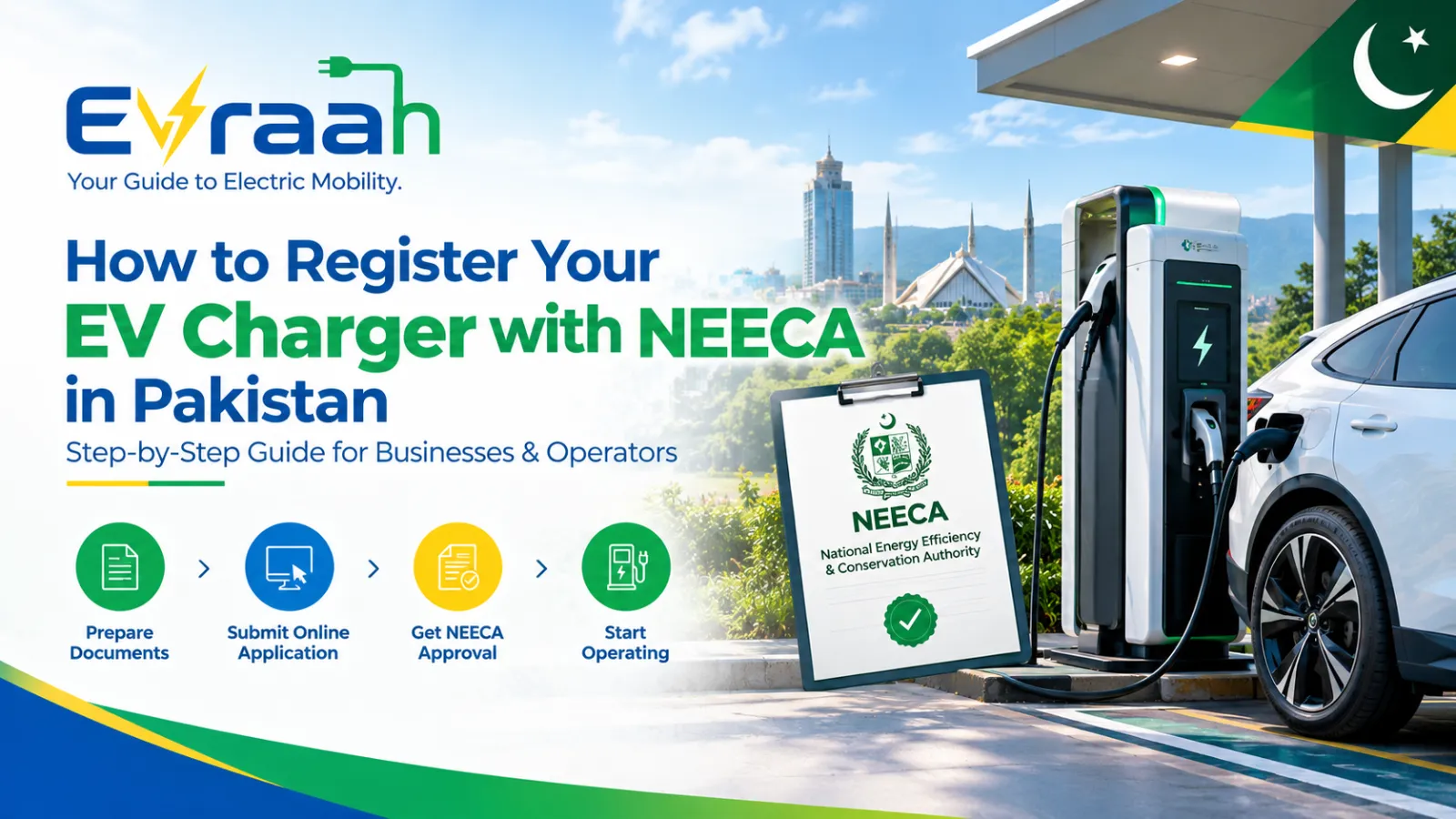
How to Register Your EV Charger with NEECA in Pakistan: Step-by-Step Guide
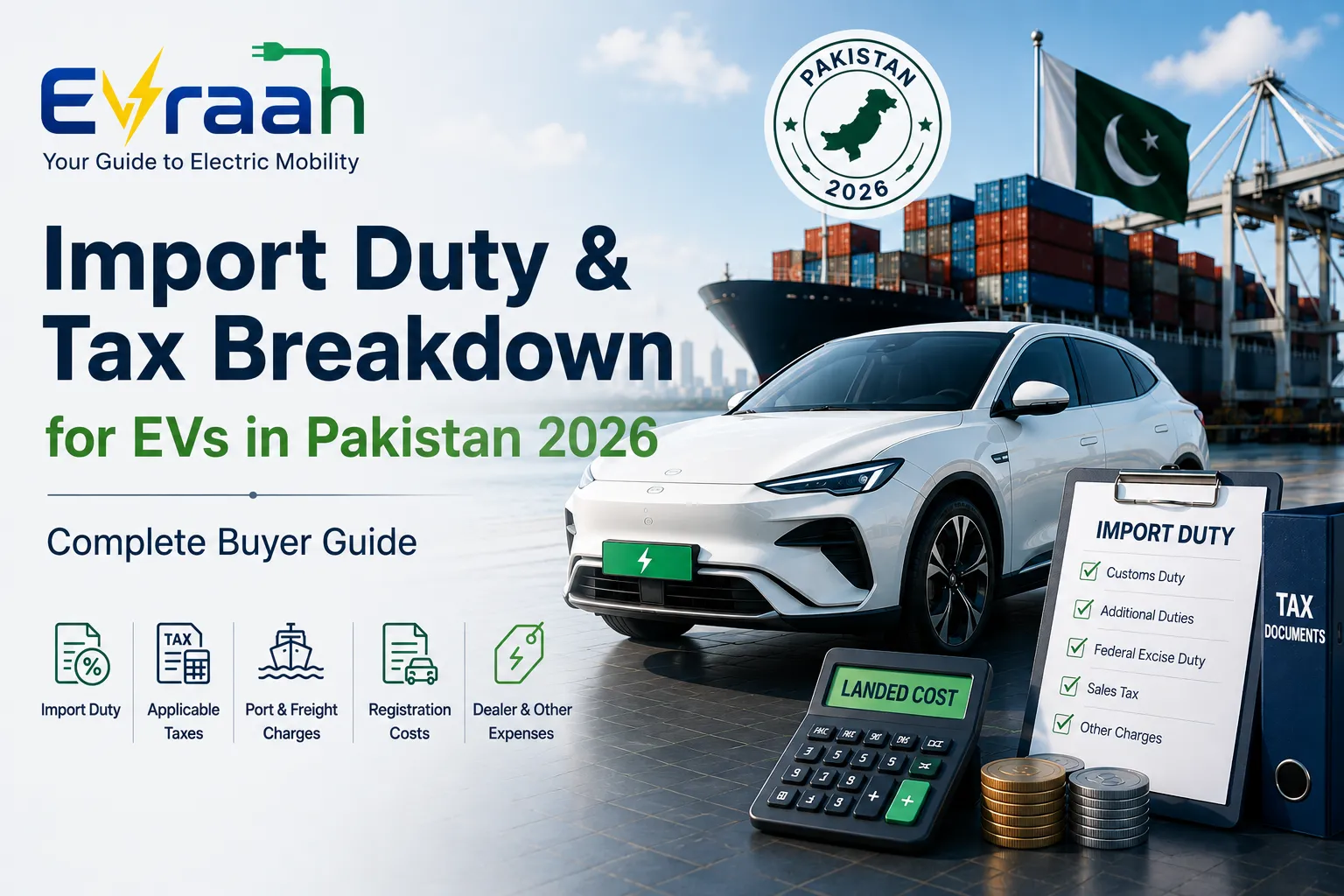
Import Duty and Tax Breakdown for EVs in Pakistan 2026: Complete Buyer Guide
EV Charging Network Pakistan: Why Infrastructure Will Decide EVs
You may also like
 Buying Guides
EVs in Pakistan 2026: Complete List of Electric Cars, Prices, Range & Buying Guide
6 min read · 10 Sept 2026
 Charging Guides
EV Chargers in Islamabad: Locations, Costs & Complete Guide
6 min read · 8 Sept 2026
 Charging Guides
Best Places to Install EV Chargers in Pakistan: A Business & Investment Guide
6 min read · 6 Sept 2026